TuTu App Store Review: A New Distribution Option for Independent Developers

TuTu is an app store for indie developers with transparent downloads and an image-supported community.
TuTu is an app store targeting the indie developer ecosystem, addressing pain points for two user groups: helping everyday users see screenshots, ratings, and version details before downloading, and giving independent developers' niche projects a lower-barrier path to visibility. Beyond app discovery, TuTu features a built-in community Square with image comments, @mentions, and bookmarks, plus a Personality Store for avatar frames and badges — nudging users from one-time downloads toward ongoing community participation. The article notes that listing rules, review mechanisms, and safety standards remain opaque, which will be key to determining whether TuTu can become a reliable long-term distribution platform for developers.
An App Store Built for Independent Developers
Finding the right software is a frustration many people know well: you want a useful tool, but end up bouncing between multiple websites, unable to find basic details like version numbers or file sizes before downloading — only to discover after installation that it's not what you needed. A platform called TuTu offers its own solution to this problem. It serves both as a download portal for everyday users and as a publishing platform for independent developers.
For indie developers, the lack of a friendly distribution channel has long been a persistent challenge. Major app stores set high bars with complex review processes, making it difficult for personal projects to gain any visibility. TuTu positions itself to fill exactly that gap — giving independent developers' apps a legitimate place to be listed and discovered by more users.
Independent developers typically refer to individuals or very small teams who handle app development and operations on their own. Their core dilemma: mainstream platforms like the Apple App Store and Google Play impose steep requirements around developer credentials, account fees (Apple charges $99/year), and lengthy review cycles. A niche utility app may languish at the bottom of search results simply due to low download numbers. Domestic Chinese platforms like Tencent MyApp and Xiaomi's app store offer somewhat lower barriers, but they cover only the Android ecosystem and are equally competitive. This structural challenge of "building something no one can find" is precisely what drives demand for vertical platforms focused on indie developer distribution.
A Complete Path to Finding Software
TuTu's homepage logic is straightforward. When you open the app, you're first greeted with recommended and newly listed content — great for users who aren't sure what they want and just want to browse. If nothing specific comes to mind, the rankings surface popular picks. If you already know what you need, a search bar gets you there directly. Category tabs for tools, games, AI apps, and more round out the experience so you don't have to scroll endlessly.
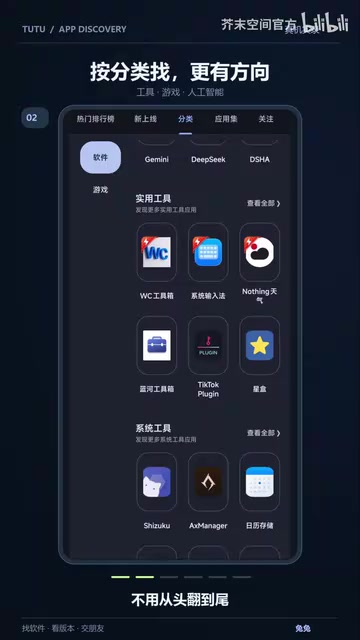
This multi-path design — Recommended → Rankings → Search → Categories — accommodates different browsing habits and reduces the friction of finding software.
See the Details Before You Decide
TuTu puts real effort into its app detail pages. Once you find something interesting, you can view screenshots, a description, ratings, and file size; switching to the version tab shows you the specific version number and release type.
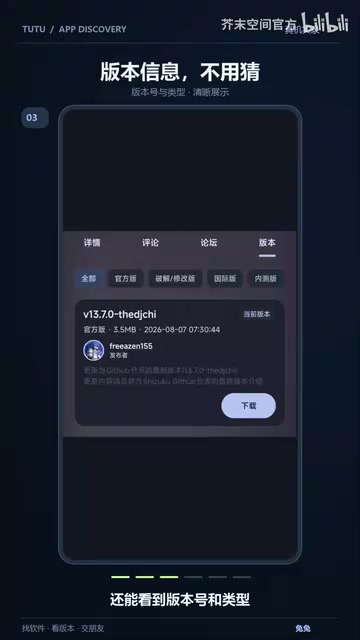
This "look before you download" design directly addresses the frustration mentioned earlier — avoiding the awkward situation of realizing after installation that the version is wrong or the features don't match. For users, surfacing decision-critical information upfront means lower trial-and-error costs. For developers, comprehensive version details also help build credibility.
More Than a Download Portal — A Community Square
The biggest difference between TuTu and traditional app markets is its built-in community layer. Beyond downloading, the platform features a "Square" where users can share discoveries, ask questions, and join discussions.
Comments support image attachments, replies, and @mentions. When words fall short, a screenshot makes communication instantly clearer. This kind of exchange is especially well-suited for software-related content — whether reporting a bug or sharing a usage tip, a screenshot is almost always more effective than plain text.
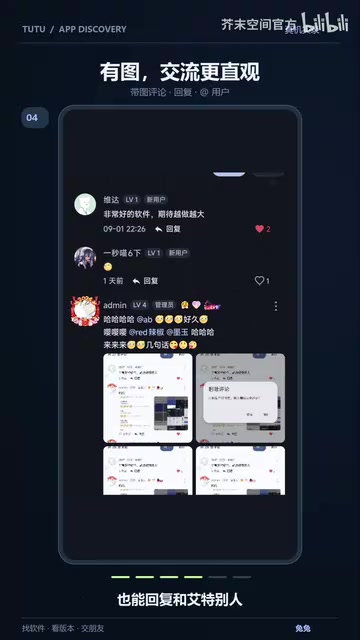
Favorite posts and apps can be saved for easy retrieval later. This pushes TuTu beyond a purely utility-driven app toward a community platform centered on "discovering great tools and connecting with like-minded users."
Personalization: Give Your Profile Some Style
TuTu also invests in personalization. The platform features a "Personality Store" offering decorative items like avatar frames, list frames, and badges. Users can pick styles they like to make their profiles and posts more distinctive.
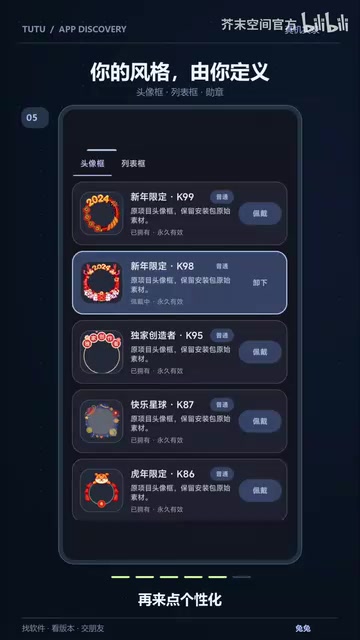
This kind of community-driven personalization system isn't unusual in content platforms, but seeing it in an app store signals that TuTu wants users to stick around and form an active community ecosystem — not just download and leave.
The product logic of combining community features with app distribution has proven precedent in the industry. Product Hunt is the most representative example — it's fundamentally a community where developers launch products and users vote and discuss, discovering quality indie products far more efficiently than traditional app stores. Domestically, platforms like Sspai's content ecosystem have similarly built loyal audiences for utility apps through community-driven content. TuTu's built-in Square aims to replicate this "discover → discuss → spread" community flywheel: when users share their experiences in the Square, they organically promote developers' work, creating a word-of-mouth chain that carries more trust than algorithmic recommendations.
TuTu's Differentiated Value
Overall, TuTu attempts to stand apart on two levels:
For developers, it offers a relatively lightweight publishing channel aimed at personal projects, giving niche tools and indie creations a real chance of being discovered.
For users, it makes "finding software" a more effortless and socially engaging experience — transparent download information, image-supported community discussions, saveable content, and personalized profile decoration.
That said, based on currently available information, TuTu's public-facing presence focuses primarily on product design and user experience. Key operational details — listing rules, review processes, app safety standards, and quality assurance mechanisms — remain to be clarified. For independent developers, whether a platform can genuinely serve as a long-term distribution base often hinges on exactly these behind-the-scenes systems.
If you enjoy discovering useful small tools or want somewhere to talk about software, TuTu is worth a look. For indie developers, it also opens up a new path to distribution — the next hidden-gem app that breaks through to a wider audience might just start here.
Related articles

JobRunner MCP Server: AI Agents Can Now Fix Failed Java Jobs
JobRunner launches an open-source MCP server enabling AI agents to view cluster status, diagnose failures, and recover Java jobs—incident response from any cloud coding environment or existing agent.

MLAI Digital Launches 9 Security Agents: MCP Server Safeguards the Full Lifecycle of Agentic AI
MLAI Digital launches Security MCP Server with nine built-in specialized security agents covering vulnerability discovery, attack simulation, prompt injection detection, API and infrastructure assessment, and accelerated remediation—embedding security validation across the full Agentic AI lifecycle from development to production.

Running Isaac Lab on H100 GPUs: Exploring Better Approaches
Exploring optimization methods for running Isaac Lab on NVIDIA H100 GPUs, including MIG configuration, mixed precision, TensorRT acceleration, and community experience to improve robotics simulation and reinforcement learning efficiency.