TWIST Benchmark: Evaluating the "Intervention Quality" of Conversational Memory Systems

TWIST benchmarks whether memory systems know when to intervene — not just whether they can remember.
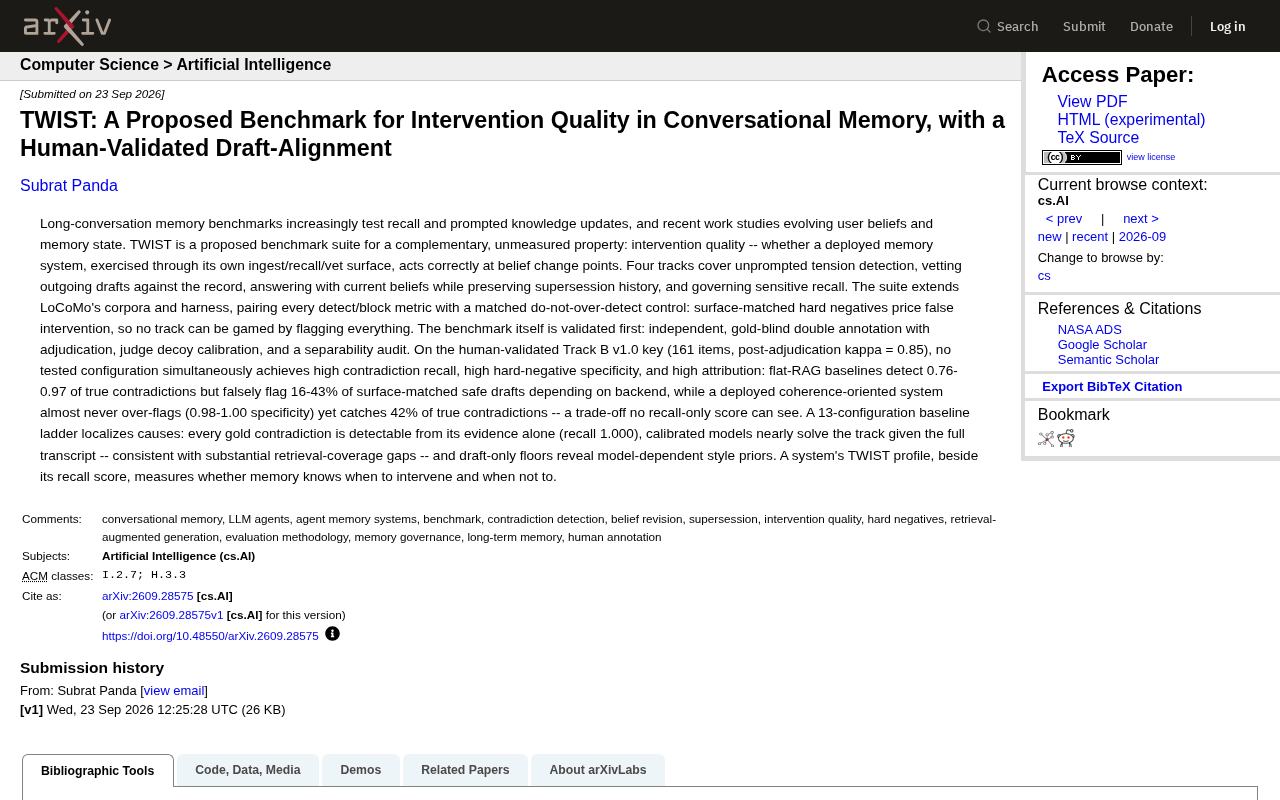
Most evaluations of conversational memory systems focus only on recall accuracy, overlooking whether a system knows when to intervene as user beliefs shift. TWIST addresses this gap with four evaluation tracks — contradiction detection, draft vetting, supersession-aware answering, and sensitive recall governance — paired with surface-matched hard negatives to prevent recall-gaming. Experiments reveal that high recall, high specificity, and high attribution accuracy cannot be achieved simultaneously: flat RAG baselines achieve strong recall but 16–43% false-positive rates, while coherence-optimized systems nearly eliminate false positives but only catch 42% of real contradictions. A 13-rung baseline ladder pinpoints retrieval coverage — not model reasoning — as the primary bottleneck.
The Blind Spot in Long-Conversation Memory: Knowing When to Step In
As large language models move toward long-term dialogue and persistent memory, most evaluations have focused on a single question: can the model accurately recall historical information, and can it update its knowledge when prompted? But a newly released arXiv paper argues that memory systems have a long-overlooked critical property — intervention quality.
Simply put, a deployed memory system doesn't just need to remember things — it needs to respond correctly at the inflection points where a user's beliefs change: issuing reminders when appropriate, flagging inconsistencies when necessary, and staying silent when it's none of its business. TWIST is a benchmark suite proposed specifically to measure this capability.
TWIST's Four Evaluation Tracks
TWIST (proposed in the paper as a benchmark suite) evaluates system behavior through a memory system's own ingest/recall/vet interfaces, and is organized into four complementary tracks:
- Unprompted contradiction detection: Can the system autonomously identify belief conflicts in a conversation without being explicitly prompted?
- Draft vetting: Compare an outgoing draft against existing records to identify inconsistencies.
- Answering from current beliefs: Answer questions based on current beliefs while preserving the historical trajectory of superseded beliefs.
- Sensitive recall governance: Manage and control the recall and exposure of sensitive content.
The core idea behind this design is to reposition memory systems from passive "knowledge stores" into active participants that must judge when to intervene.
LoCoMo (Long Conversation Memory) is the foundational corpus framework that TWIST extends. Originally designed to evaluate models' memory and comprehension in long-conversation settings, it provides dialogue datasets spanning many rounds of interaction. The ingest/recall/vet interface abstraction decomposes the functionality of a memory system into three independent operations: ingesting (writing new information into memory), recalling (retrieving historical information on demand), and vetting (proactively validating information for consistency or safety). By standardizing these three interfaces, TWIST enables a fair cross-architecture comparison — whether the system uses vector-retrieval-based RAG or a structured knowledge graph — without depending on any specific implementation details.
Key Design: Preventing the "Flag Everything" Hack
TWIST incorporates a clever methodological safeguard. It extends LoCoMo's corpus and evaluation framework and, crucially, pairs every detection/interception metric with a matching "don't over-detect" control group.
This is achieved by introducing surface-matched hard negatives — samples that look like conflicts but are actually safe. If a system falsely flags them, it pays a penalty in the form of "erroneous intervention." As a result, no track can be gamed by simply "flagging everything as suspicious," because over-detection directly lowers the score. This design precisely targets the weakness of traditional recall-only evaluations.
In information retrieval and classification tasks, "recall" measures a system's ability to find all true positives, while "specificity" or "precision" measures its ability to avoid mislabeling negatives as positives. There is a classic trade-off between the two: a system that flags every input as problematic achieves 100% recall but generates massive false positives, driving specificity toward zero. Traditional evaluations that only measure recall inadvertently reward this kind of indiscriminate flagging strategy. TWIST's surface-matched hard negatives strategy essentially plants carefully crafted "traps" in the test set — samples that closely resemble real contradictions at the lexical and syntactic level but are semantically safe. This forces systems to demonstrate genuine semantic understanding rather than relying on shallow keyword matching or conservative blanket-flagging to score well.
Validate the Benchmark First, Then the Systems
The paper emphasizes that TWIST first validates the reliability of the benchmark itself rather than rushing to evaluate the systems being tested. To this end, the researchers employed an independent, answer-blind dual-annotation-with-adjudication process, combined with judge decoy calibration and separability audits.
On a human-validated Track B v1.0 gold set (161 entries, post-adjudication kappa of 0.85), inter-annotator agreement was very high. This rigorous upfront validation makes the downstream system evaluation findings considerably more credible.
Cohen's kappa (κ) is a statistical measure of inter-annotator agreement, ranging from -1 to 1, where 0 indicates agreement no better than chance and 1 indicates perfect agreement. A κ ≥ 0.80 is generally considered "strong agreement," meaning the annotations are unlikely to be coincidental. The post-adjudication kappa of 0.85 on Track B v1.0 indicates strong consensus among annotators on what constitutes a genuine contradiction — an important prerequisite for benchmark credibility. "Judge decoy calibration" refers to the practice of inserting known-answer decoy samples into the evaluation pipeline to detect and correct systematic biases in automated LLM-as-judge evaluators, preventing the judging process itself from introducing new sources of error.
Core Finding: The Trade-Off That Recall Scores Can't See
TWIST's most valuable experimental finding is a trade-off that recall-only scoring could never reveal.
On the human-validated Track B:
- A flat RAG baseline detects 76%–97% of genuine contradictions — impressive recall — but at the cost of generating false positives on 16%–43% of surface-similar but safe drafts (depending on the backend).
- By contrast, an already-deployed system optimized for coherence almost never produces false positives (specificity of 0.98–1.00), but only captures 42% of genuine contradictions.
In other words, no single tested configuration achieves high recall, high hard-negative specificity, and high attribution accuracy simultaneously. This is precisely the truth that a single recall score conceals.
A 13-Rung Baseline Ladder: Pinpointing Root Causes
To decompose the sources of failure, the paper constructs a 13-configuration baseline ladder, yielding several clear conclusions:
- Every canonical contradiction is detectable from its evidence alone (recall 1.000) — meaning there is no information-level deficit.
- A calibrated model given the full conversation log can nearly solve the track — consistent with the finding that there is a significant retrieval coverage gap, and that the problem lies in retrieval rather than reasoning ability.
- A draft-only lower-bound experiment exposes the stylistic priors that models rely on.
This stepped diagnostic approach transforms the vague intuition of "why is the system underperforming" into a concrete, locatable bottleneck.
RAG (Retrieval-Augmented Generation) is one of the most common approaches to implementing long-term memory: the system splits historical conversations or knowledge into chunks stored in a vector database, retrieves relevant chunks via semantic similarity when needed, and feeds them into the prompt for the language model to generate a response. "Flat RAG" typically refers to a basic RAG implementation with no hierarchical organization or reranking mechanism, using vector retrieval results directly as context. The paper's conclusion about a "significant retrieval coverage gap" means that even when reasoning ability is sufficient (a calibrated model with full conversation access performs near-perfectly), the retrieval step in actual deployments frequently fails to surface all relevant historical chunks — implying that optimization efforts should prioritize retrieval strategy improvements over model reasoning capabilities.
Significance: A "Personality Profile" for Memory Systems
The value of TWIST lies in providing, beyond traditional recall scores, a TWIST profile — an intervention portrait of a memory system — measuring whether the memory "knows when to step in and when to hold back."
For conversational AI moving toward real-world deployment, this capability may be closer to the essence of usability than raw memory capacity. An assistant that over-reminds is annoying; one that never flags contradictions is useless. TWIST attempts to provide a quantifiable ruler for finding the balance between these extremes.
(Note: This article is based on an arXiv preprint. The findings are pending peer review and further validation.)
Related articles

Chain of Thought Isn't Just for AI: How Humans Can Use CoT to Improve Thinking Quality
Chain of Thought isn't just a prompt trick for large models. Starting from a Hacker News discussion, this article analyzes why CoT works for human thinking too, breaks down actionable ways to transfer it, and highlights the key differences between human CoT and machine CoT.
Cloudflare Teams Up with OpenAI: Closi…
Cloudflare Teams Up with OpenAI: Closing the Loop from Vulnerability Discovery to Defense with AI
Cloudflare uses OpenAI Daybreak to investigate security vulnerabilities and generate reviewable remediation plans, while developers use Codex to boost coding efficiency and quality.

Orca Multi-Agent Orchestration in Practice: A Guide to Parallel Collaboration with Claude and Codex
Orca is Stable AI's free open-source agent workbench supporting 34 agents like Claude Code and Codex in parallel. Learn its Git worktree isolation, multi-model orchestration, and mobile management.