Two Ex-Google Employees Raise $11.3M to Back Enterprise AI Startups

Ex-Googlers launch BAG Ventures with $11.3M to back enterprise AI startups that customers actually pay for.
Two former Google employees have co-founded venture firm BAG Ventures and closed an $11.3 million Fund I, targeting AI startups whose enterprise customers are genuinely willing to pay. The strategy sets B2B commercialization as its core admission criterion, diverging from approaches that chase frontier models or consumer-side hype. Operating as an early-stage Micro VC, the fund primarily enters at the seed or angel round, leveraging the founders' Google-honed technical judgment and enterprise software experience to support founding teams. BAG Ventures reflects a broader market shift in AI investing — moving away from technology-narrative-driven enthusiasm toward a more grounded focus on commercial validation and sustainable paying customer loops.
Google Alumni Launch BAG Ventures
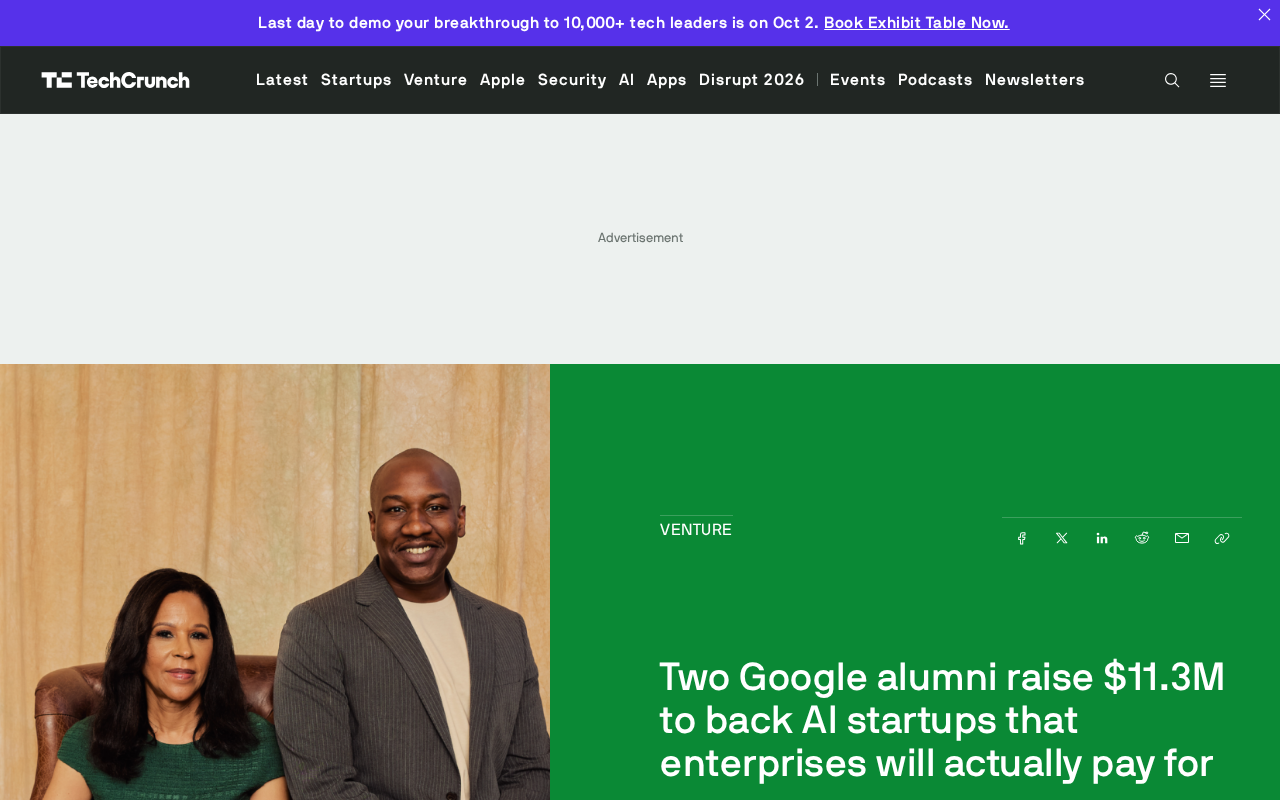
Two former Google employees have joined forces to launch a new venture capital firm, BAG Ventures, announcing the close of their $11.3 million Fund I. The fund has a clear thesis: invest in everything AI-related, with particular focus on startups that enterprise customers are actually willing to pay for.
In today's AI startup frenzy, overvalued companies with impressive demos but zero paying customers are all too common. By anchoring its investment criteria to "enterprise willingness to pay," BAG Ventures is making a pragmatic bet — one that reflects a broader shift toward rationality in the capital markets after a period of AI-fueled euphoria.
Why "Enterprises Will Actually Pay" Is the Core Standard
The investment logic embedded in the fund's thesis is worth unpacking. Rather than chasing the hottest frontier models or consumer-facing apps, BAG Ventures sets its bar at B2B commercialization capability. For enterprise AI, the ability to solve real business pain points and sustain a reliable paying customer loop often matters more than raw technical superiority when it comes to a company's survival.
This stance aligns with a growing industry-wide reflection: many AI products dazzle in demos, only to stumble at deployment due to high integration costs, unclear ROI, and lengthy enterprise procurement cycles. Making "enterprises will actually pay" a foundational investment conviction signals that this fund values commercial validation over pure technical storytelling.
The commercialization challenges of enterprise AI are captured by a widely cited concept in the industry — the "last-mile problem" of AI. A massive gap exists between a technical demo and production deployment: when enterprises evaluate AI tools, they must assess data security and compliance, integration complexity with existing IT systems, employee training costs, and quantifiable ROI. Research from firms like Gartner shows that many enterprise AI pilots stall at the proof-of-concept stage and never scale. That's precisely why "has an enterprise already paid for this?" becomes the most direct evidence that a project has crossed that chasm — a payment signals that the customer has validated the product's real-world value, not merely been impressed by a demo.
Market Positioning of the $11.3M Fund
At $11.3 million, BAG Ventures is a small, early-stage fund. These vehicles typically enter at the seed or angel round, providing a startup's first institutional capital while delivering value-add services through the founders' technical judgment and professional networks built at Google.
The Google pedigree gives the two founders more than just a technical lens — it also provides firsthand understanding of how enterprise software gets adopted by large organizations. That experience carries real weight when evaluating B2B AI projects, since they have a sharper sense of what enterprise customers actually care about when procuring AI tools.
Within the venture ecosystem, small funds in the tens-of-millions range — commonly known as Micro VCs — have grown significantly in number in recent years. These funds typically write checks of $250K to $500K for 5%–10% equity stakes, with their competitive edge rooted not in capital volume but in the founders' industry relationships and domain expertise. For the AI sector specifically, Micro VCs enjoy distinct advantages: they can make investment decisions faster, enter before a seed round, and help founding teams bridge the critical gap from proof-of-concept to first paying customers. Compared to large institutional funds, Micro VCs also tend to have more flexible return thresholds, making them better suited to accompany AI startups tackling specific vertical industry problems — companies with modest but clearly defined addressable markets and solid business models.
What This Signals for AI Founders
For AI founders currently seeking funding, the emergence of BAG Ventures sends a clear message: pure technical demos are no longer enough to win over this class of investor. Teams that can demonstrate paying customers, a well-defined business model, and a credible path to sustainable revenue will have a distinct edge.
As AI investing enters a phase focused more on tangible results, capital concentrated on enterprise paying use cases is becoming a steady, grounding force in the market. BAG Ventures' Fund I is a microcosm of exactly that trend.
Related articles

DeepCell: One-Click AI Generation of Documents, Spreadsheets, and Slides
DeepCell tops Product Hunt with one-click generation of documents, spreadsheets, and slides, using the .deepcell format for linked updates, designed for System 2 tasks like modeling and sales reviews.

Doneas: 15-Minute Daily Accountability Calls That Keep Indie Developers From Procrastinating
Doneas is a daily accountability tool for indie developers: plan tasks on Monday, join a 15-minute call with five builders each day, and log deliveries on a public progress page. This article analyzes its core mechanics, effectiveness, and potential issues around retention and matching.

Fastlane 2.0: Fully Automated AI Ad Campaigns, From Creative to Optimization
Fastlane 2.0 is an AI ad automation tool: enter your website and it learns your brand, generates video and image ads, and runs and optimizes them on Meta, TikTok, Instagram, and YouTube.