Two Months of Green Lights, Zero Output: The 'Success' Trap in AI Agent Pipelines

A zero-output pipeline hid for two months behind a 'no exception = success' logic.
An engineer discovered their Agent pipeline had been reporting success for two straight months with a fully green dashboard — and zero actual output. The root cause: the system equated a clean process exit with task success, while the artifact-generation step silently failed every run. The investigation also surfaced two hidden bugs: a log message saying 'daily budget hit' that actually meant hourly, and a back-off mechanism that misread network jitter as server-side rate limiting, halving throughput for 48 hours per blip. The core lesson: 'Completion is not an outcome' — success must be defined by results, not process, and verified with real output data.
A Pipeline That Was 'Always Succeeding'
An engineer shared a chilling ops story on Reddit: the long-running Agent pipeline they maintained reported success for two consecutive months — dashboards completely green — while producing absolutely nothing.
The root cause sounds mundane but is deeply representative: as long as a run finished without throwing an exception, it was marked done/success. That seems reasonable on the surface, but it's fundamentally wrong. This logic concealed a dead pipeline for two full months, until the author happened to notice an output count looked suspiciously low and started digging.
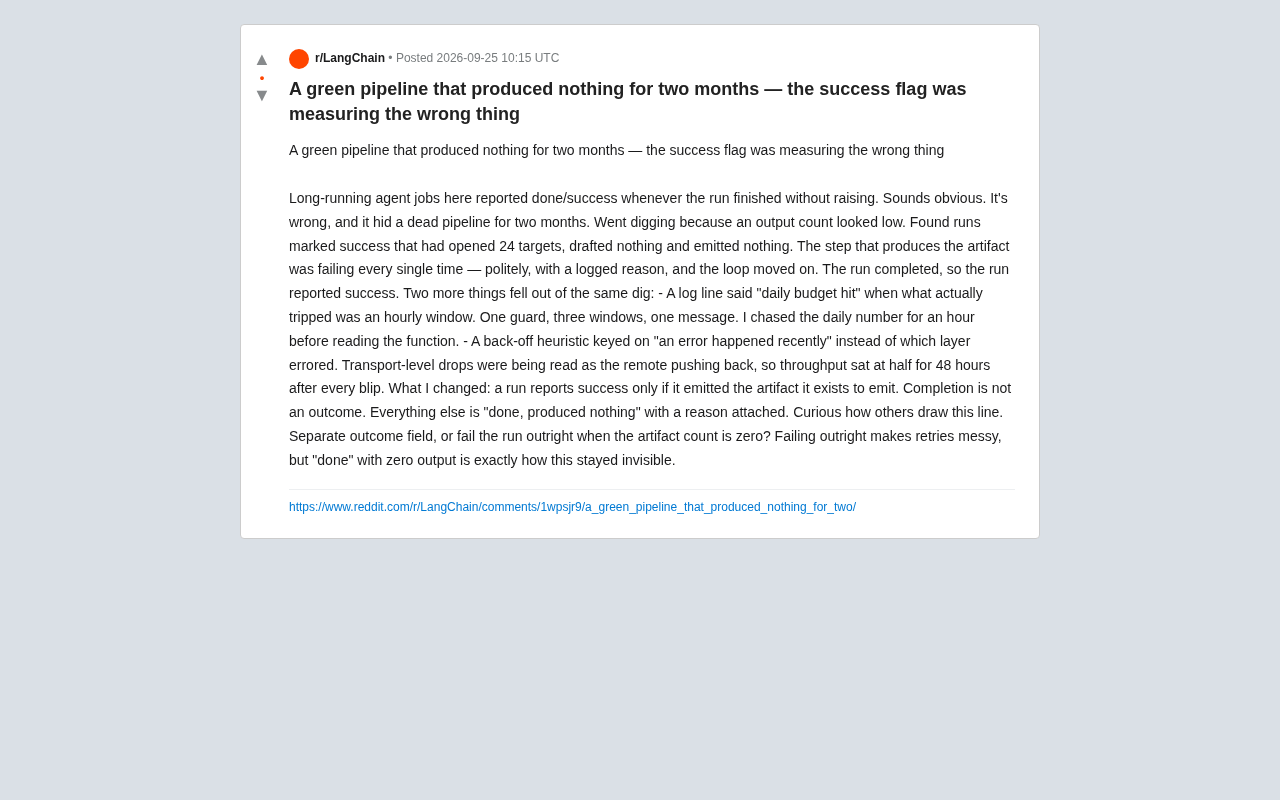
What they found was alarming. Those runs marked success had opened 24 targets but written zero drafts and produced zero results. The step responsible for actually generating artifacts was failing every single time — and failing politely: it logged a reason, then let the loop continue. The run completed, so the run reported success.
Completion Is Not an Outcome
The author distills the core lesson into a single line: Completion is not an outcome.
In automated systems, we routinely conflate "process exited cleanly" with "task achieved its goal." But these are two entirely different things. An Agent exists to produce a specific artifact — if it doesn't, then even if the entire pipeline ran without a single error and gracefully completed every step, it fundamentally failed.
The author's fix was straightforward: a run only reports success if it actually produced the artifact it was supposed to produce. Everything else is classified as "done, produced nothing" with a reason attached.
This looks like a simple change to a conditional check, but it's actually shifting the definition of "success" from process correctness (didn't crash) to outcome validity (produced something). For any system that depends on automated Agents, that shift is critical.
Two Hidden Bugs Found Along the Way
During the investigation, the author also uncovered two classic "misleading signal" problems — both worth noting for anyone doing systems engineering.
A Log Message That Wasted an Hour
The logs showed daily budget hit, but what actually triggered was a per-hour window limit. The reason: a guard function managing three time windows (daily, hourly, etc.) shared a single error message across all of them. The author spent an hour chasing the "daily quota" number, only to realize the truth when they finally read the function's source code.
Lesson: Error messages must precisely match the actual condition that triggered them. A vague log entry can send someone debugging in the wrong direction for a long time.
A Back-off Strategy Reading the Wrong Signal
Even subtler was the back-off mechanism. It triggered based on "did a recent error occur," without distinguishing which layer the error came from. As a result, transport-level network jitter was misread as the remote service actively pushing back with rate limiting. Every minor network blip caused the system to assume it was being throttled, cutting throughput in half — and holding it there for 48 hours.
This meant a trivial network hiccup could slash the entire pipeline's efficiency for two full days, with no one knowing why.
Back-off is a classic distributed systems strategy for handling overload or errors: when the system detects a failure signal, it proactively reduces request rate or throughput to avoid cascading failures. The most common variant is exponential back-off, where the wait time doubles after each retry. The underlying assumption is that error signals accurately reflect "the remote service is under pressure." The problem described here is precisely that this assumption breaks down — transport-level network jitter (such as occasional TCP timeouts or connection resets) and server-side rate limiting responses (like HTTP 429 Too Many Requests) look behaviorally similar but have completely different root causes. The former only needs a brief pause to recover; the latter genuinely warrants extended back-off. When a system treats both indiscriminately as "the server is pushing back," it imposes unnecessary long-duration penalties on a perfectly healthy remote service, all because of what might have been a single routing blip.
Where Should the Line Be Drawn?
At the end of the post, the author raises a design question worth sitting with: How should you label a run that produced nothing?
Two approaches are offered, each with trade-offs:
- A separate outcome field: Keep the
completionstatus, but add a dedicated field that records whether anything was produced. The upside is clean semantics; the downside is that downstream systems have to actively read this field — otherwise you're back to "only checking completion." - Zero output means failure: Just make runs with zero artifacts report as failed. The upside is simplicity and visibility; the downside is that retry logic gets messy — because many "zero output" runs are perfectly valid (e.g., there's genuinely no data to process today), and marking them all as failures triggers unnecessary retries.
The author acknowledges the dilemma: marking zero output as failure makes retries dirty, but "done with zero output" is exactly why this bug hid for two months.
This design tension has a more general name in engineering practice: semantic state modeling. Traditional task state machines typically distinguish only four states — pending, running, success, failed — with the implicit assumption that "completed successfully" equals "achieved the business goal." In Agent-based systems, however, tasks often have conditional outputs — some runs may legitimately produce zero results (no new data today), making binary success/failure semantics insufficient. Introducing a separate outcome field is essentially decoupling "execution state" from "business result," similar to the design philosophy behind HTTP's separation of status codes and response bodies: 200 OK only means the request was correctly processed; whether valid content was actually returned is left for the caller to determine. The cost is that downstream systems must actively consume this additional field — otherwise the decoupling is meaningless.
Takeaways for Automated Systems
This real-world story has broad implications for the growing landscape of Agent-based and automated engineering:
First, success signals should measure outcomes, not process. When defining success, ask yourself: what does this task exist to accomplish? If it didn't accomplish that, it's not a success.
Second, error messages must map one-to-one to their actual trigger conditions. Shared, generic log messages are silent killers of debugging time.
Third, back-off and retry strategies need to distinguish error sources. Network-layer jitter and server-side rate limiting are completely different signals — treating them the same causes systems to incorrectly penalize themselves.
Fourth, green lights don't equal health. Periodically cross-validating with actual output data — not status flags — is the only way to avoid the quiet death of a system that looks perfectly fine.
A pipeline that's always green can sometimes be more dangerous than one that's throwing red — because no one ever looks at something that appears to be working.
Related articles

Workbuddy for Absolute Beginners: How a Desktop AI Agent Fits Into Real Workflows
A beginner's guide to the Workbuddy desktop AI agent: installation, claiming credits, file management, and building automated workflows—compared with CodeX for fit and cost, helping professionals shift from AI question-askers to AI managers.

OpenAI's New Agent Stack: Computer Use, Decisions API, and Ultra-Fast Workflows
OpenAI Dev Day unveiled a new agent stack: Computer Use outperforms humans, Decisions API delivers ultra-low-latency classification via Luna, Agents API opens the same Computer Use capabilities, and GPT-6.1 Sol costs only one-seventh of Astra. Core updates, benchmark data, and developer insights.

Liang Wenfeng Open-Sources DeepInfo Inference Framework, Takes On U.S. Ban
DeepSeek open-sources its DeepInfo inference framework after its models, featuring GPU/CPU cross-pipelining, small-model prediction with large-model verification, and full Huawei Ascend and NVIDIA chip support—facing the U.S. federal ban head-on. This article analyzes its significance for AI deployment and open-source strategy.