Two Root Causes of Agent Context Rot: Distraction vs. Poisoning Explained

AI Agent context rot splits into two distinct causes—attention dilution and causal chain poisoning—requiring separate fixes.
AI Agent "Context Rot" isn't a single problem but two distinct failures: Distraction (attention dilution)—where signals get buried by noise causing the model to lose focus; and Poisoning (causal chain contamination)—where early errors get repeatedly referenced and reinforced into accepted "facts." Distraction is addressed through compression, external memory, task slicing, and tool offloading to boost signal-to-noise ratio. Poisoning requires fact verification, Checkpoints, rollback, or restart to sever error chains. Stable Agents need a complete context governance layer defending against both failure modes.
Many people have experienced this scenario when using AI Agents: the conversation starts out smart, but gradually drifts off-topic, edits make things worse, and ultimately starting a fresh conversation instantly fixes everything. Is the model getting dumber, or is something wrong with the context?
The answer is the latter. So-called "Context Rot" isn't actually a single ailment—it's two completely different failure modes: Distraction (attention dilution) and Poisoning (causal chain contamination). Conflating these two problems guarantees your solution will miss the mark.
Distraction: It's Not About Window Size—It's About Attention Budget
Signals Drowned by Noise
Imagine an Agent processing a task with a massive pile of conversation history, tool return values, code snippets, and intermediate logs stacked up front. It looks information-rich, but the truly valuable signals have long been buried under mountains of noise.
At this point, the model isn't completely blind to key information—it can see it but can't lock onto it accurately. You'll observe several highly typical symptoms: slower responses, drifting choices, referencing secondary information when it should be grabbing the key point, and long-term task threads gradually breaking apart.
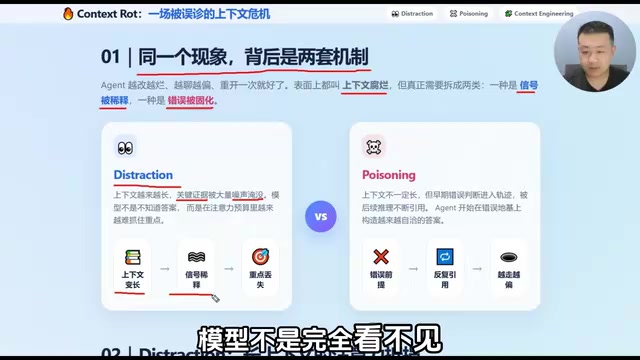
This aligns perfectly with findings from long-context research—performance degrades continuously as input token count grows, and often the quality drops well before hitting the window limit. The Self-Attention mechanism in Transformer architecture theoretically allows every token to attend to all other tokens in the sequence, but in practice, attention weight distribution is far from uniform. As input sequences grow longer, attention weights get spread thinner across more tokens, reducing the model's ability to focus on critical information. Google's "Lost in the Middle" research (2023) explicitly demonstrated that when key information is placed in the middle of a long context, the model's retrieval and reasoning accuracy drops significantly. This means even if a model claims to support 128K or even 1M token context windows, its effective utilization capacity is often far below that number—the actual reliable working range might be only a fraction of the stated value. A model's effective context window is often much smaller than its maximum advertised token count.
Three Words Summarize Output Degradation: Slow, Drift, Break
From the input side, the pressure sources are clear: accumulated message history, growing low-value tokens, and dispersed key signals. The output side manifests as:
- Slow—processing more historical information increases inference latency
- Drift—starts grabbing the wrong focus, answers deviate from the core question
- Break—ability to maintain long-term goals declines, task threads fracture
This is fundamentally an engineering problem, not some mystical phenomenon. The solution isn't infinitely expanding the context window—it's making the context short, precise, and alive.
Four Remediation Strategies for Attention Dilution
For Distraction-type context rot, there's a clear remediation path:
- Compression and folding: Transform historical processes into state summaries, delete redundant, expired, and low-value content, keeping only what's genuinely needed for current decisions.
- External memory: Move long-term materials, documents, and logs outside the context window, pulling them back via RAG retrieval only when truly needed. RAG (Retrieval-Augmented Generation) centers on not stuffing all information into the context window, but instead using vector search to find the most relevant document fragments from external databases when needed, then injecting those fragments into the current prompt. A typical RAG pipeline includes four steps: document Chunking, Embedding, Similarity Search, and Context Injection—ensuring the context window always contains only information highly relevant to the current question.
- Task slicing: Break one large task into multiple small phases, each carrying only local objectives, inputs, and acceptance criteria.
- Tool offloading: Delegate computation, search, parsing, and validation to specialized tools—the model only consumes structured results.
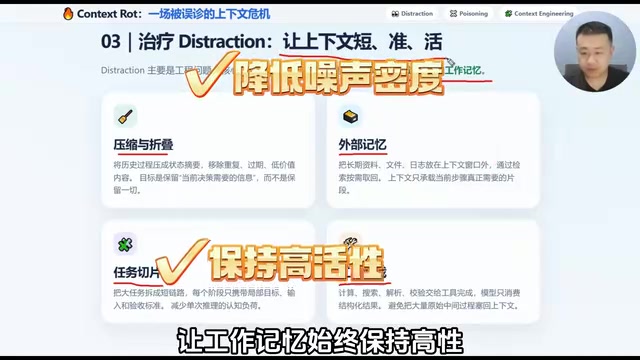
All these methods are essentially doing the same thing: reducing noise density in the context, keeping working memory at a consistently high signal-to-noise ratio. This is also the most central consensus in current Context Engineering discussions. It's worth noting that Context Engineering differs fundamentally from early Prompt Engineering. Prompt Engineering primarily focuses on crafting individual prompts well—wording, formatting, few-shot examples, etc. Context Engineering focuses on dynamic management of context throughout the entire conversation lifecycle, including what information should enter the context, when it should be compressed or removed, and how to pass and isolate context between multiple Agents. Andrej Karpathy and others have drawn an analogy to memory management in traditional software engineering: Prompt Engineering is writing a good line of code; Context Engineering is managing the entire program's runtime state.
Poisoning: It's Not Too Long—It's Trusting the Wrong Thing
A More Dangerous Failure Mode Than Distraction
What makes Poisoning terrifying is that the context length might not be excessive at all, but an early incorrect judgment, misinterpretation, or hallucinated result enters the context and gets continuously referenced by subsequent steps, eventually becoming a "premise everyone seems to agree on."
It's not diluting the signal—it's contaminating the causal chain.
It might start as a small error—perhaps misunderstanding a requirement, or treating an unreliable tool result as truth. But every subsequent reference, every summary, every continued reasoning step reinforces that error once more. Eventually, the model constructs an increasingly self-consistent answer on a faulty foundation: the logic appears smooth on the surface, but everything is skewed underneath.
It's particularly important to understand the role that LLM Hallucination plays in causal chain contamination. Hallucination refers to the model generating content that seems reasonable but is actually incorrect or fabricated from nothing. Its root cause lies in the model being essentially a sampler from a probability distribution—it generates text based on statistical patterns in training data rather than factual reasoning. In multi-turn dialogue or multi-step reasoning Agent scenarios, the harm of hallucinations is multiplied: incorrect information produced by one hallucination gets written into the context, and subsequent steps treat it as confirmed fact to continue referencing and reasoning upon, forming what's called a "Hallucination Cascade." This is one of the most common triggers for Poisoning, and also why relying solely on a model's "self-correction" capability is often insufficient.
The Four-Step Evolution of Poisoning
Breaking causal chain contamination into stages, it typically follows four steps:
- Error enters the context: Could be a misinterpretation, incorrect assumption, invalid tool result, or a hallucination generated by the model itself.
- Error becomes an anchor: Subsequent reasoning starts revolving around it, no longer actively verifying.
- Error gets repeatedly referenced: The more it's cited, the more it resembles "fact."
- Repair becomes difficult: You're no longer fixing a single point—you're fixing an entire error chain.
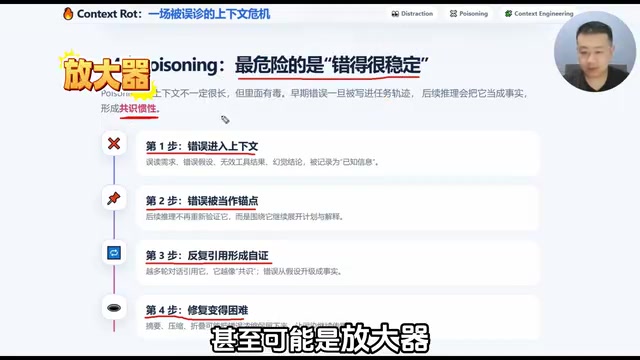
Here's a counterintuitive point: for Poisoning, compressing the context isn't necessarily the cure—it might actually be an amplifier. Because summarization can concentrate toxic information even more tightly, carrying it forward.
Four Key Operations to Sever the Error Causal Chain
The principle for handling Poisoning is simple—don't stubbornly persist on a bad trajectory; decisively sever the error causal chain:
- Fact verification: Validate key assumptions through tools, rules, or independent verification paths before they enter the main trajectory—don't let something the model said automatically become fact.
- Checkpoint: Save clean state snapshots at critical decision points so you can return to a trusted version if things go wrong later. In traditional software engineering, Checkpoint and rollback are classic concepts in database transaction management and distributed systems. In Agent systems, Checkpoint implementation typically involves saving the complete context state at critical decision nodes—including conversation history, confirmed facts, intermediate reasoning results, and task progress. This approach is isomorphic to branching and reverting in Git version control and transaction Rollback in databases—the only difference is the operation target changes from code or data to the Agent's reasoning state.
- Rollback: Once you discover premises have been contaminated, don't continue making patch-style fixes on the contaminated trajectory—retreat directly to the state before the error entered.
- Restart: When the contamination source can't be clearly located or contamination runs too deep, the most effective approach is often to clear the context and start fresh.
This thinking is simple but extremely important: fixing Poisoning isn't about rationalizing the error—it's about completely cutting it out of the causal chain.
Sub-Agents: Isolation Chambers or New Contamination Sources?
Many people think that splitting a large task across multiple Sub-Agents would naturally shorten context and isolate contamination, right? Yes, that is indeed their value:
- Explore different directions in parallel, search independently and only aggregate results and evidence
- Task isolation prevents local failures from contaminating the main context
- Structured delivery where subtasks only output results, rationale, and confidence levels
For Distraction, Sub-Agents genuinely help—they shorten individual context length and reduce single-point complexity.
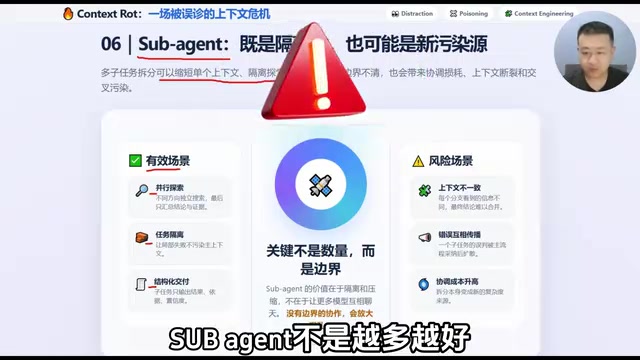
But here's the problem: more Sub-Agents isn't always better—what matters is boundary design. Multi-Agent architecture is one of the mainstream design patterns in the current AI Agent field, with typical frameworks including AutoGen, CrewAI, LangGraph, etc. In this architecture, a main Agent (Orchestrator) handles task decomposition and result aggregation, while multiple sub-agents each handle specific subtasks. The core challenge of this design lies in information consistency and coordination costs: each sub-agent has an independent context window and may form different or even contradictory understandings of the same problem; the main Agent must handle conflicts, assess credibility, and filter low-quality outputs when merging results. If coordination protocols are poorly designed, the overall performance of a Multi-Agent system may actually be worse than a single Agent—this is the so-called "Coordination Tax" problem.
Specifically, if each sub-agent sees inconsistent information, merging becomes very difficult; if one branch's misjudgment gets adopted by the main flow, errors propagate across Agents; if coordination costs after splitting are too high, the split itself becomes a new source of complexity.
So Sub-Agents are both isolation chambers and potential new contamination sources. What truly matters isn't whether you have Sub-Agents, but whether boundaries are clear, outputs are clean, and the main flow only consumes structured results.
Building a Context Governance Layer: A Complete Defense System
Looking at the full picture, truly stable Agents don't rely on a super-long context window—they rely on a context governance layer. From top to bottom: User Goal → Task Planning → Working Context → Tool Execution → Result Delivery.
Around this main pipeline, two lines of defense need to be established:
- Front layer against Distraction: Use retrieval instead of full text, summaries instead of running logs, folding instead of stacking, tool results instead of raw processes—keep working context at a consistently high signal-to-noise ratio.
- Back layer against Poisoning: Fact-check key assumptions, isolate risky conclusions, Checkpoint critical steps, and rollback or restart contaminated trajectories.
The former solves the "can't see clearly" problem; the latter solves the "trusted the wrong thing" problem. The former uses context engineering to optimize signal-to-noise ratio; the latter uses trajectory management to sever error propagation.
Once you diagnose Distraction and Poisoning as two separate root causes, many seemingly mysterious Agent degradation problems suddenly become crystal clear.
Key Takeaways
- Context Rot is fundamentally two different failures: Distraction (attention dilution) and Poisoning (causal chain contamination)—they must be governed separately
- Distraction's core is a signal-to-noise ratio problem; remediation focuses on compression/folding, external memory, task slicing, and tool offloading to keep context short, precise, and alive
- Poisoning is more dangerous—an early error gets repeatedly referenced and reinforced into "fact"; compression/summarization may actually amplify toxicity; it requires fact verification, Checkpoints, rollback, and restart to sever the error causal chain
- Sub-Agents help isolate Distraction, but with unclear boundaries they become new contamination sources—the key lies in structured output and how the main flow consumes results
- Stable Agents need a complete context governance layer: front-end defense against Distraction to maintain signal-to-noise ratio, back-end defense against Poisoning to maintain causal chain correctness
Related articles
Deep Dive into AI Agent Skill Design: …
Deep Dive into AI Agent Skill Design: Engineering Practices from Anthropic and Perplexity
A deep dive into Skill design philosophy from Anthropic's Claude Code team and Perplexity's Agent team, covering the Tax Test, Gotchas Flywheel, progressive disclosure, and Eval-First practices for building high-quality AI Agent skill systems.
Deep Dive into OpenAI's Official GPT-5…
Deep Dive into OpenAI's Official GPT-5.6 Prompting Guide: The Shift from Manual to Automatic
A deep dive into OpenAI's official GPT-5.6 Sol prompting guide: conciseness-first, outcome-oriented design, autonomy boundaries, tool routing, and reasoning intensity tuning.
 Deep Dives
Deep Dive into How OpenClaw (Open-Source Crayfish) AI Agent Works
Deep analysis of OpenClaw AI Agent internals: System Prompt, tool calling, SubAgents, Skill system, memory, and Context Engineering explained.