Two-Tier Encryption in the UK: The Backdoor Controversy Reignites

UK legislation pushing encryption backdoors risks creating a security double standard with global consequences.
The UK's Online Safety Act and related legislation continue to pressure end-to-end encryption, seeking law enforcement access to user communications. The tech community describes this as a "two-tier encryption" dilemma: governments and elite institutions retain full strong encryption while ordinary users' security is legislatively weakened. Cryptographers argue no backdoor can be made safe — any reserved access channel is a systemic vulnerability exploitable by attackers and authoritarian regimes alike. Companies like Signal and Apple say they would rather leave the UK market than compromise encryption. The deeper concern is that UK precedent could inspire global copycat laws, undermining the trust foundation of digital communication worldwide.
The UK government's stance on encryption policy has once again become a focal point for the tech community. An article titled Two-tier encryption in the UK sparked intense discussion on Hacker News, drawing 297 upvotes and nearly 300 comments — a clear signal of how deeply developers and security professionals care about this issue.
The Core Controversy: A Double Standard on Encryption
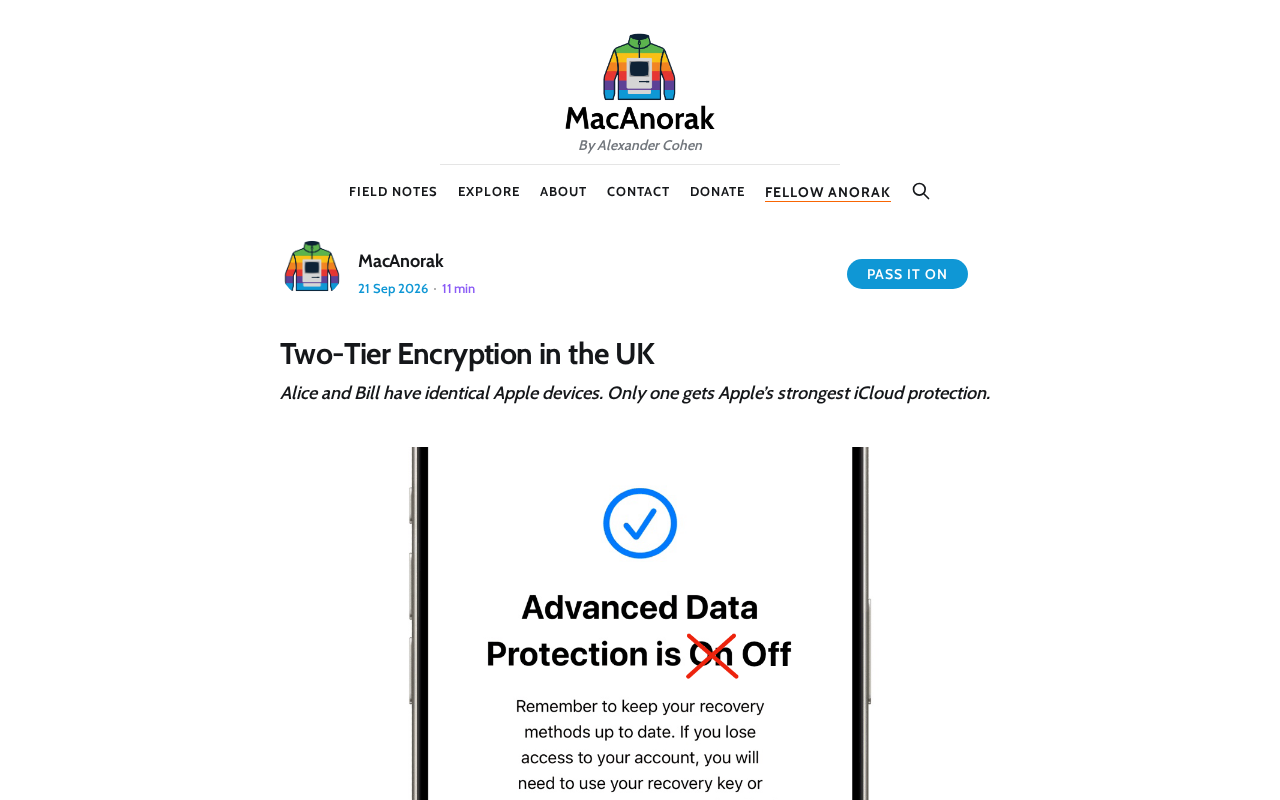
"Two-tier encryption" refers to a contradictory situation: on one hand, government agencies, corporations, and high-value targets continue to enjoy the full protection of strong encryption; on the other, ordinary users' communications may be weakened under legislative pressure, forcing them to accept "accessible" encryption — what most people call a "backdoor."
This is not a new issue in the UK. Through legislation such as the Online Safety Act and the Investigatory Powers Act, the UK has been steadily applying pressure on end-to-end encryption. Regulators want the ability to access encrypted communications in the name of public safety and fighting crime — and that is precisely what the tech community so strongly opposes.
Why the Tech Community Broadly Opposes Encryption Backdoors
The cryptography community has long held a firm consensus: there is no such thing as a backdoor that only "the good guys" can use. Any access channel reserved for law enforcement is, by its very nature, a structural weakness in the encryption system. Once such a mechanism exists, it can equally be exploited by malicious attackers, hostile nation-states, or insiders.
In other words, the strength of encryption depends on its weakest link. If regulations require all consumer-facing services to retain decryptable capability, the overall security of those services degrades. Meanwhile, the truly capable, well-resourced targets — state-level actors or organized crime groups — will simply migrate to unregulated, self-built encryption tools, bypassing these restrictions entirely. The result: the people who end up harmed are the very ordinary citizens who most need protection.
Where the "Two Tiers" Come In
The "two-tier" metaphor in the article's title carries a sharp irony. It points to an unequal security landscape:
- The elite tier: Governments, militaries, and large institutions continue using unweakened strong encryption;
- The mass tier: Commercial communication products used by ordinary consumers are legislatively weakened, delivering reduced security.
This layered structure not only creates a real security inequality — it also undermines the argument that "weakening encryption protects the public," since the actual threat actors are precisely the group least constrained by such policies.
The cryptography community's concerns about encryption backdoors are far from theoretical. The 2015 standoff between the FBI and Apple over the San Bernardino case, and the earlier Clipper Chip initiative (1993, in which the US government attempted to embed an escrow key mechanism into communications hardware), are historical examples of governments attempting to establish lawful access channels — and facing fierce backlash. The 2021 Pegasus spyware revelations offered a counterpoint: even without a "legal backdoor," attackers still find vulnerabilities to compromise devices; if backdoors were legitimized, the attack surface would multiply. And in 2024, when US telecom carriers were breached by the "Salt Typhoon" hacker group — who exploited interfaces specifically reserved for lawful law enforcement interception — it provided direct, real-world confirmation of the cryptographic consensus that "a backdoor is a vulnerability."
Real-World Impact on Tech Companies
For companies like Apple, Meta (WhatsApp), and Signal that provide end-to-end encrypted services, the UK's legislative environment poses a direct challenge. These companies have publicly stated, on multiple occasions, that they would rather exit the relevant markets than compromise their security commitments to users worldwide by weakening encryption or building in backdoors.
Services like Signal, whose entire value proposition is built on privacy, are founded on the premise that not even the service provider can read user content. Any mandatory access requirement is essentially asking them to abandon their core reason for existing. This explains why every new round of related legislation triggers a collective pushback from multinational tech companies.
What the Community Discussion Reveals About Deeper Divisions
The sheer heat of nearly 300 comments on Hacker News speaks for itself — this topic strikes at the core values of the technical community. The debate revolves around several dimensions: technical feasibility (can a backdoor ever be made "secure"?), legal boundaries (what is the appropriate scope of government surveillance powers?), and global ripple effects (will one country's legislation be replicated by others?).
It's worth noting that encryption policy is never purely a technical question. It involves a fundamental balance between privacy rights, civil liberties, and state power. The UK's approach has generated such widespread concern precisely because it could serve as a legislative template for other countries — once a mature democracy sets the precedent of weakening encryption, authoritarian governments gain much stronger "legitimate" grounds to do the same.
The fear of "one country's law being copied by others" has concrete historical precedent in the encryption policy space. Australia was first out of the gate in 2018 with the Assistance and Access Act, requiring tech companies to provide technical assistance to law enforcement; India, Brazil, and others have since proposed similar regulatory frameworks. Researchers call this phenomenon "surveillance creep": once democratic nations normalize weakening encryption through legislation, they provide diplomatic and legal cover for authoritarian governments — while simultaneously eroding the bargaining power of tech companies to resist such demands globally. This is why organizations like the EFF (Electronic Frontier Foundation) and Access Now treat the UK's Online Safety Act as a global policy bellwether, not merely a domestic British matter.
Conclusion
The "two-tier encryption" framing sharply exposes the internal paradox of current encryption regulation: weakening mass-market encryption in the name of security ultimately undermines the security of the general population, not that of the actual threats. For the tech industry and ordinary users alike, the battle over encryption backdoors is far from over — and its outcome will profoundly shape the foundation of trust in digital communications for years to come.
(Note: This article is based on the original discussion on Hacker News. Please refer to official legislative texts for specific statutory details.)
Background
The Online Safety Act was formally passed in the UK in 2023. Its most controversial provision requires platforms to have the capability to scan users' private messages — including end-to-end encrypted content — to detect child sexual exploitation material (CSAM). Critics point out that to achieve this, platforms must either add Client-Side Scanning (CSS) on top of the encryption layer, or effectively break end-to-end encryption itself. Client-Side Scanning performs content matching on the user's device before a message is sent, ostensibly sidestepping the "decryption" controversy — but cryptographers argue this is functionally equivalent to building a mass surveillance infrastructure over private communications. The Investigatory Powers Act (also known as the "Snoopers' Charter"), already in force since 2016, authorized intelligence agencies to intercept communications and compelled companies to assist with decryption. The current encryption controversy can be seen as the latest chapter in that law's ongoing expansion.
Related articles

JobRunner MCP Server: AI Agents Can Now Fix Failed Java Jobs
JobRunner launches an open-source MCP server enabling AI agents to view cluster status, diagnose failures, and recover Java jobs—incident response from any cloud coding environment or existing agent.

MLAI Digital Launches 9 Security Agents: MCP Server Safeguards the Full Lifecycle of Agentic AI
MLAI Digital launches Security MCP Server with nine built-in specialized security agents covering vulnerability discovery, attack simulation, prompt injection detection, API and infrastructure assessment, and accelerated remediation—embedding security validation across the full Agentic AI lifecycle from development to production.

Running Isaac Lab on H100 GPUs: Exploring Better Approaches
Exploring optimization methods for running Isaac Lab on NVIDIA H100 GPUs, including MIG configuration, mixed precision, TensorRT acceleration, and community experience to improve robotics simulation and reinforcement learning efficiency.