TypePHP: The Swoole Team's New Open-Source Approach to Compiling PHP into Native Binaries

Swoole team launches TypePHP to compile PHP into native binaries for better performance and deployment.
TypePHP is a new open-source project from the Swoole team that compiles PHP code into native binary executables. By introducing static typing and leveraging ahead-of-time compilation, it aims to deliver faster startup times, improved execution efficiency, and Go-like single-binary deployment. While still in its early stages, the project has attracted significant developer interest and holds promise for expanding PHP beyond traditional web scenarios.
PHP's Performance Dilemma and TypePHP's Breakthrough
As one of the most popular languages in web development, PHP has long faced an unavoidable pain point: as an interpreted language, its runtime performance naturally lags behind compiled languages like Go, Rust, and C++. While the JIT (Just-In-Time) compilation introduced in PHP 8 has improved the situation to some extent, PHP still falls short in CPU-intensive scenarios and deployment convenience.
A recently trending open-source project on GitHub, swoole/typephp, offers an ambitious answer — compiling PHP code directly into native binaries. Since its launch, the project has gained rapid traction, accumulating 884 Stars and 43 Forks, with 188 new Stars in a single day, signaling strong developer interest in native compilation for PHP.
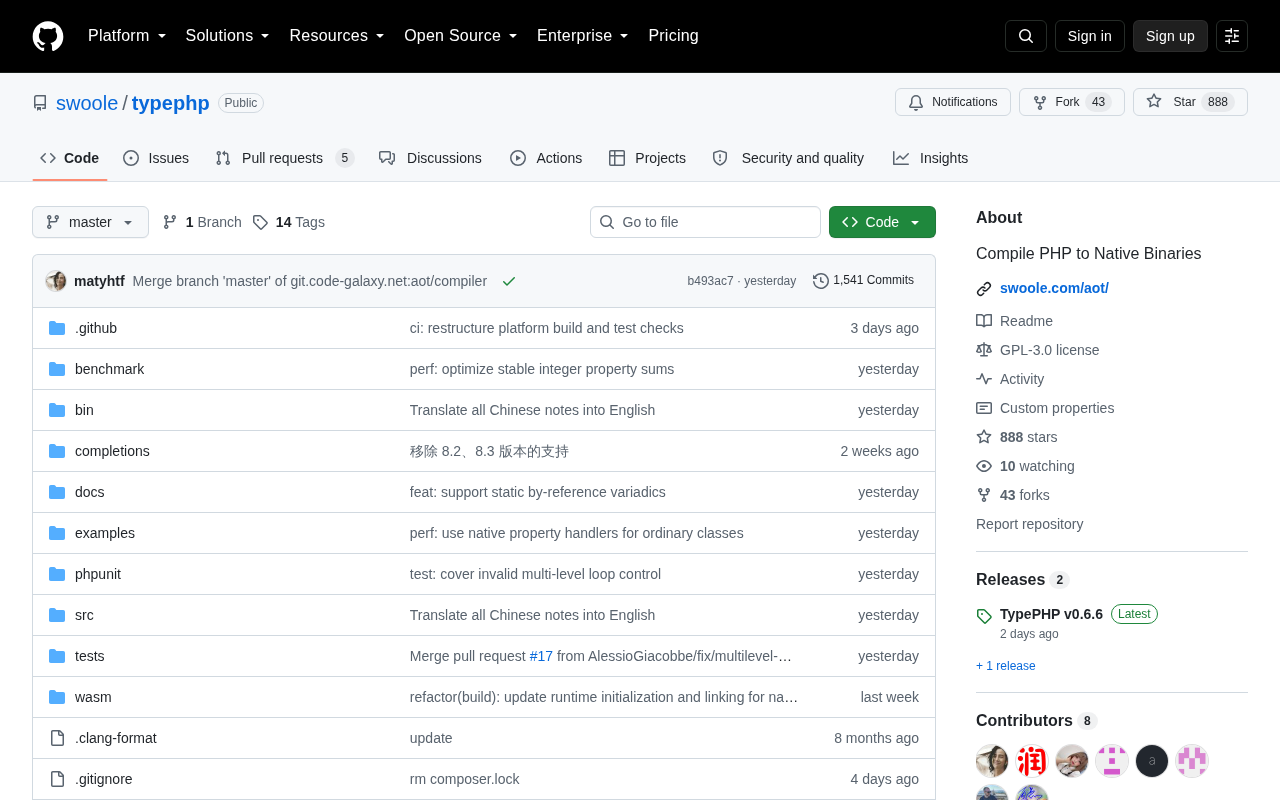
One notable detail: TypePHP comes from the Swoole team. Swoole is already the most well-known high-performance network communication engine in the PHP ecosystem, bringing modern capabilities like coroutines and asynchronous I/O to PHP. Having a team with years of deep experience in PHP internals driving a native compilation initiative adds significant credibility and technical weight to the project.
What Does Compiling to Native Binaries Mean?
From Interpreted Execution to Native Runtime
Traditional PHP execution relies on the Zend engine to parse and execute script code line by line. Before running, code must go through lexical analysis, syntax parsing, and intermediate bytecode (Opcode) generation. Even with the OPcache caching mechanism, there's still a performance overhead from interpreted execution.
Compiling PHP into native binaries can theoretically deliver benefits on several levels:
- Dramatically faster startup: No need to repeatedly parse scripts at runtime — the binary executes machine code directly.
- Significantly higher execution efficiency: The compilation process enables deeper static optimizations, eliminating dynamic runtime overhead.
- Greatly simplified deployment: A single executable file eliminates the dependency on a full PHP runtime environment, achieving Go-like "one binary to rule them all" distribution.
The Meaning of "Type": Static Typing as a Prerequisite for Compilation
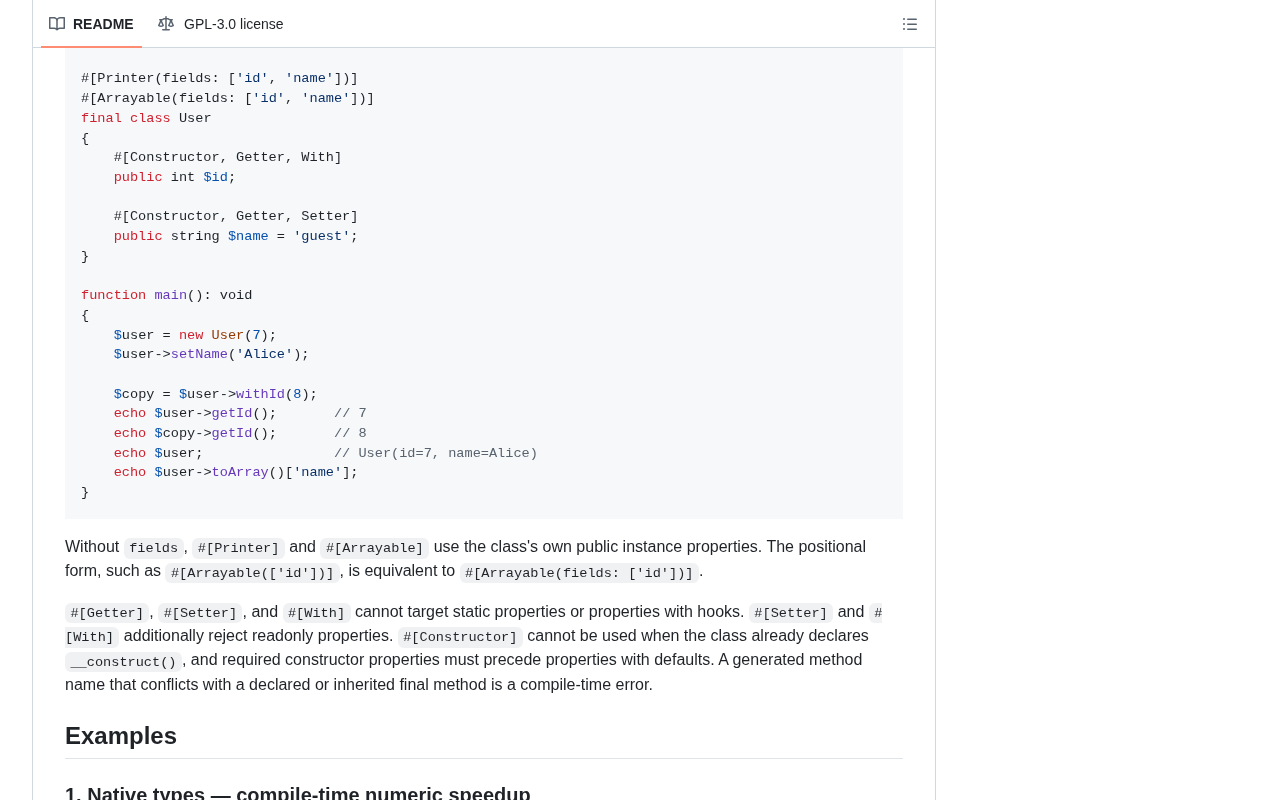
From the project name TypePHP, we can infer that it introduces or strengthens a type system. To efficiently compile dynamically-typed PHP into native code, explicit type information is almost indispensable — only when the compiler can determine variable types at compile time can it generate efficient machine code and avoid the overhead of runtime dynamic type checking.
This approach mirrors how TypeScript introduced static typing to JavaScript, and it's the common path many scripting languages follow on the road to "compilation-based acceleration."
Technical Value and Ecosystem Significance
Filling PHP's Gaps in CLI and Distribution Scenarios
PHP has long been at a disadvantage in CLI tools, long-running processes, and command-line programs. If developers want to distribute a PHP-based tool, they typically need the target machine to have the corresponding PHP version pre-installed — far less convenient than Go's single-file distribution model.
If TypePHP reaches maturity, it will enable PHP developers to write high-performance, easily distributable native programs in a language they already know, expanding PHP's application boundaries.
Deep Synergy with the Swoole Ecosystem
Combined with Swoole's expertise in coroutines and asynchronous networking, TypePHP has the potential to form a complete "high-performance PHP" technology stack:
- Use Swoole to handle high-concurrency network services with coroutine and async I/O capabilities
- Use TypePHP to compile for near-native execution efficiency
For teams already building microservices and long-running services with Swoole, TypePHP is a natural technological extension.
A Balanced View: Opportunities and Challenges
Despite the exciting prospects, it's important to remain realistic about an emerging project:
- Compatibility challenges: PHP's extensive dynamic features (magic methods, dynamic properties, eval, reflection, etc.) pose significant hurdles for static compilation. How much of PHP's syntax and feature set TypePHP can support will directly determine its practical value.
- Ecosystem maturity remains to be seen: The current 884 Stars indicate the project is still in its early stages. Toolchain stability, documentation completeness, and community support all need time to mature.
- Performance gains require validation: The performance improvements from compilation vary greatly across different application scenarios. The benefits for web request handling versus compute-intensive tasks could be vastly different — real benchmark data is needed for verification.
Conclusion
TypePHP represents an active exploration by the PHP community to address two core demands: performance optimization and deployment simplicity. With the Swoole team's technical backing and strong developer interest, this project is worth keeping on every PHP developer's radar.
It may not immediately change PHP's development paradigm, but the direction it points toward — enabling dynamic languages to enjoy the benefits of native compilation — is undeniably a major trend in programming language evolution. For PHP developers who pursue peak performance, swoole/typephp deserves a spot on your technology watch list.
Related articles

Chain of Thought Isn't Just for AI: How Humans Can Use CoT to Improve Thinking Quality
Chain of Thought isn't just a prompt trick for large models. Starting from a Hacker News discussion, this article analyzes why CoT works for human thinking too, breaks down actionable ways to transfer it, and highlights the key differences between human CoT and machine CoT.
Cloudflare Teams Up with OpenAI: Closi…
Cloudflare Teams Up with OpenAI: Closing the Loop from Vulnerability Discovery to Defense with AI
Cloudflare uses OpenAI Daybreak to investigate security vulnerabilities and generate reviewable remediation plans, while developers use Codex to boost coding efficiency and quality.

Orca Multi-Agent Orchestration in Practice: A Guide to Parallel Collaboration with Claude and Codex
Orca is Stable AI's free open-source agent workbench supporting 34 agents like Claude Code and Codex in parallel. Learn its Git worktree isolation, multi-model orchestration, and mobile management.