U.S. Universal Healthcare Study: Could Save $1 Trillion Annually and 114,000 Lives

Study claims U.S. universal healthcare could save $1 trillion/year and 114,000 lives, sparking heated debate.
A universal healthcare study sparked intense Hacker News discussion with its claim that U.S. universal coverage could save $1 trillion annually while saving 114,000 lives. The savings stem from eliminating administrative overhead in the fragmented insurance system and enabling preventive care. While supporters cite other nations' success, skeptics question model assumptions, transition costs, and political feasibility.
A Healthcare Economics Study Sparking Heated Debate
Recently, a study on Universal Health Coverage (UHC) sparked widespread discussion on Hacker News, garnering 693 upvotes and over 786 comments. The study presents a striking conclusion: implementing universal healthcare in the United States could not only save approximately 114,000 lives per year but also potentially cut spending by as much as $1 trillion.
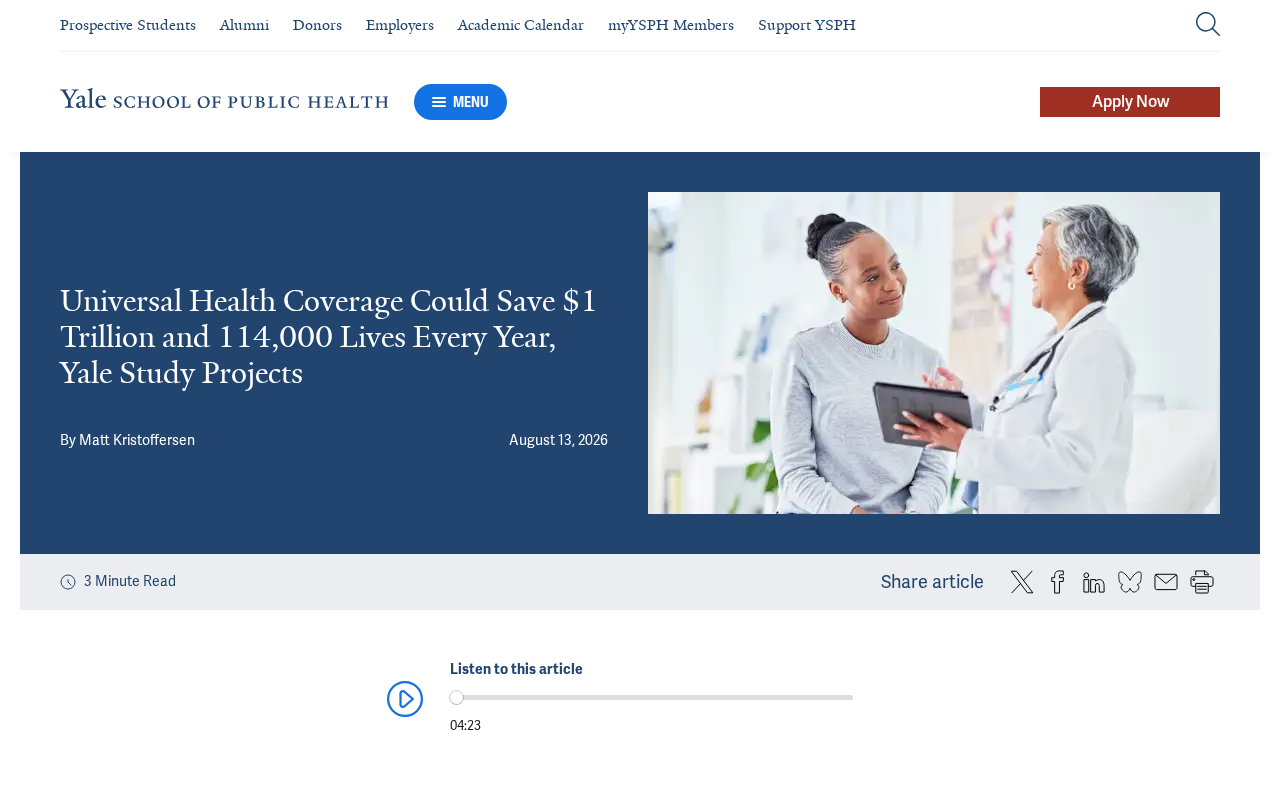
At first glance, this conclusion seems counterintuitive—most people assume that "covering more people" means "spending more money." But the study argues precisely the opposite: a more comprehensive, unified healthcare system could actually cost less in total than the current fragmented U.S. healthcare system. This is the core reason it has ignited fierce debate in technology and economics discussion communities.
The Fragmented State of the U.S. Healthcare System
To understand why this conclusion might hold, one must first understand the unique structure of the U.S. healthcare system. The United States is the only major developed economy in the world that has not achieved universal healthcare coverage. Its payment system consists of multiple independent components: the federal Medicare program for those 65 and older, the Medicaid program for low-income groups, employer-sponsored commercial insurance, individually purchased insurance, and the Veterans Affairs healthcare system, among others. This multi-layered, multi-stakeholder structure leaves approximately 26 million Americans completely uninsured, with tens of millions more "underinsured"—nominally covered but unable to afford care when needed due to high deductibles and copayment ratios. It is precisely this fragmentation that lays the groundwork for the administrative cost bloat and lack of preventive care discussed below.
Why "Covering More People" Could Actually Save Money
The Administrative Cost Black Hole
One of the major chronic problems with the current U.S. healthcare system is its extraordinarily high administrative costs. Due to the existence of numerous private insurance companies, varying reimbursement rules, and complex billing and claims processes, healthcare institutions must employ massive administrative teams to handle bills and insurance disputes. Researchers argue that a unified universal healthcare system could dramatically reduce these redundant expenses—this is one of the key sources behind the "cost savings" conclusion.
The severity of this problem can be illustrated with data: according to multiple studies, administrative costs account for approximately 34% of total healthcare expenditure in the U.S., far exceeding other developed nations. In Canada's single-payer system, administrative costs account for only about 17%. Specifically, each physician in the U.S. requires several dedicated administrative staff members to handle billing codes, prior authorization requests, and claims disputes across different insurance companies. The ICD-10 coding system contains over 70,000 diagnostic codes, and different insurers have varying coverage conditions and reimbursement rates for the same treatment. This complexity forces healthcare institutions to invest enormous resources in non-clinical activities. If these administrative costs were reduced to the average level of other developed countries, the savings would amount to hundreds of billions of dollars.
The Economic Value of Preventive Care
Another key piece of logic lies in prevention. When people delay seeking medical care due to lack of insurance, minor ailments often escalate into serious conditions, eventually becoming high-cost situations requiring emergency care or long-term treatment. Universal coverage means more people can access preventive and primary care services early, thereby avoiding expensive late-stage treatments. The study's estimate of "saving 114,000 lives" is largely built on the premise of "timely access to medical care."
The economic logic of preventive care can be illustrated with specific numbers: a routine physical exam and early screening typically costs a few hundred dollars, while the average cost of an emergency cardiac hospitalization exceeds $50,000, and late-stage cancer treatment can reach hundreds of thousands of dollars. U.S. emergency rooms (ERs) often serve as the "safety net of last resort"—the federal EMTALA law requires emergency rooms to treat any patient regardless of their ability to pay. This leads many uninsured individuals to use the ER as a substitute for primary care, while a single ER visit costs 5-10 times more than a community clinic visit. This structural inefficiency is another important source of potential cost savings from universal coverage.
Different Paths to Universal Healthcare
It's worth noting that there isn't just one way to achieve universal healthcare. The Single-Payer model, like Canada's system, has the government serve as the sole insurance payer, with all medical expenses funded through taxation and paid uniformly by the government to healthcare providers. The Multi-Payer model, like Germany's and the Netherlands' systems, retains multiple insurance institutions but achieves universal coverage through strict regulation—everyone must be insured, and insurers cannot deny coverage or price based on health status. The proposals currently being discussed in the U.S. range from the aggressive Medicare-for-All to the moderate Public Option, with different proposals presenting different trade-offs between cost-saving potential and political feasibility.
Diverging Views in the Hacker News Community
As a community primarily composed of engineers and tech professionals, the discussion on Hacker News displayed typically diverse perspectives, with opinions far from unanimous across the 786 comments.
Core Arguments from Supporters
Supporters widely cited empirical data from other developed nations. Many European countries, Canada, Japan, and others have achieved universal coverage while maintaining significantly lower per capita healthcare spending than the U.S., with better performance on key health indicators such as life expectancy and infant mortality. These real-world cases were used to support the feasibility of the study's conclusions.
Main Concerns from Skeptics
Skeptics raised reservations from multiple angles:
- Reliability of model assumptions: Some commenters pointed out that such studies are highly dependent on economic models and assumed parameters. Both "saving $1 trillion" and "saving 114,000 lives" are estimates, and actual implementation results may deviate from model predictions.
- Transition costs and political reality: Even if it saves money in the long run, the transition costs from the existing system to universal healthcare, resistance from vested interests, and political feasibility are real obstacles that cannot be ignored.
- Healthcare resources and wait times: Some worried that universal coverage could lead to a surge in demand, resulting in longer queue times—a commonly cited criticism of countries with publicly funded healthcare.
How to Rationally Evaluate Healthcare Economics Research
For readers with a technical background, this type of study provides an excellent case for thinking about how to evaluate policy conclusions derived from complex system modeling.
First, pay attention to data sources and methodology. Rounded conclusions like "$1 trillion" and "114,000 people" are essentially median estimates from modeling numerous variables. Understanding their confidence intervals and sensitivity analyses matters more than memorizing the specific numbers. Sensitivity Analysis is a key method for evaluating model robustness in healthcare economics research—researchers systematically vary key parameters in the model, such as the proportion of administrative cost savings, drug price negotiation discount rates, and elasticity coefficients for new healthcare demand, to observe whether the final conclusions still hold. Monte Carlo simulations generate probability distributions of results by randomly sampling parameters thousands of times. Quality policy research reports not only point estimates but also confidence intervals, such as "savings between $600 billion and $1.4 trillion, with a median estimate of $1 trillion." Readers should pay particular attention to which assumptions the conclusions are most sensitive to.
Second, distinguish between technical feasibility and political feasibility. A study may demonstrate that a given approach is economically superior, but that doesn't automatically mean it can be smoothly implemented. The costs of system migration, path dependence, and redistribution of interests are often the real bottlenecks. For tech professionals, the difficulty of transforming the U.S. healthcare system is analogous to migrating a large legacy system. The entire healthcare industry has built a massive ecosystem around the existing insurance framework: insurance brokers, medical billing coders, claims processing companies, hospital revenue cycle management software—the health insurance industry alone directly employs over 500,000 people. This path dependence means that even if a new system is theoretically superior, the migration process itself generates enormous friction costs and social impact. This is similar to the challenges enterprises face when migrating from monolithic architectures to microservices—the technically correct direction doesn't mean the migration path will be smooth.
Finally, cross-national comparisons require caution. Different countries have vast differences in population structure, healthcare culture, and fiscal systems, making simple application of other countries' experiences limited. However, these cases at least demonstrate that "universal coverage" and "high expenditure" are not necessarily linked.
Conclusion
Regardless of whether the final conclusions hold up, the reason this study generated nearly 800 comments in a tech community is that it touches on an issue everyone cares about: how to provide better healthcare coverage to more people at lower cost. It reminds us that healthcare system design is fundamentally a complex systems optimization problem—objective functions, constraints, and trade-offs are all indispensable. The numbers may be debatable, but the pursuit of a more efficient and equitable healthcare system is worth ongoing discussion.
Related articles

Workbuddy for Absolute Beginners: How a Desktop AI Agent Fits Into Real Workflows
A beginner's guide to the Workbuddy desktop AI agent: installation, claiming credits, file management, and building automated workflows—compared with CodeX for fit and cost, helping professionals shift from AI question-askers to AI managers.

OpenAI's New Agent Stack: Computer Use, Decisions API, and Ultra-Fast Workflows
OpenAI Dev Day unveiled a new agent stack: Computer Use outperforms humans, Decisions API delivers ultra-low-latency classification via Luna, Agents API opens the same Computer Use capabilities, and GPT-6.1 Sol costs only one-seventh of Astra. Core updates, benchmark data, and developer insights.

Liang Wenfeng Open-Sources DeepInfo Inference Framework, Takes On U.S. Ban
DeepSeek open-sources its DeepInfo inference framework after its models, featuring GPU/CPU cross-pipelining, small-model prediction with large-model verification, and full Huawei Ascend and NVIDIA chip support—facing the U.S. federal ban head-on. This article analyzes its significance for AI deployment and open-source strategy.