Uber Deploys ChatGPT Work Company-Wide: 30,000 Employees Gain Access to OpenAI Enterprise Edition
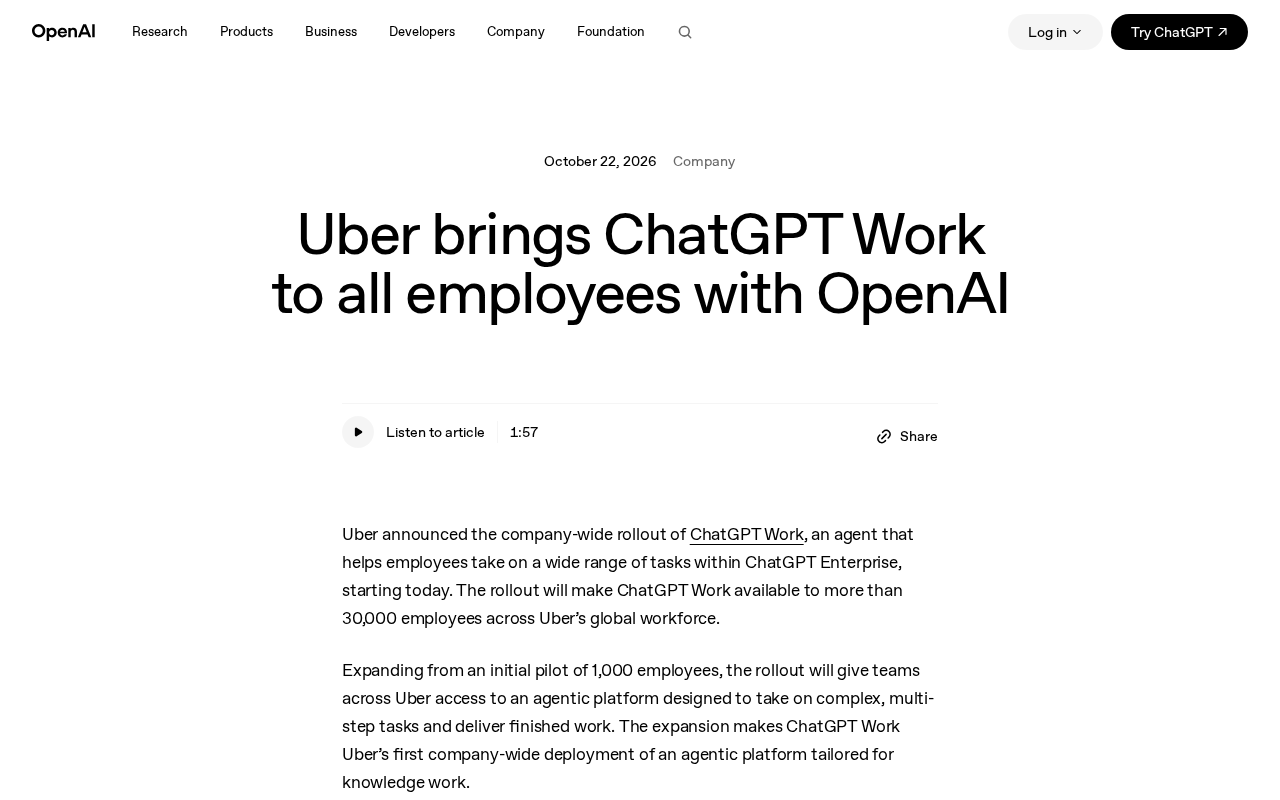
Uber rolls out ChatGPT Work to 30,000+ employees, marking enterprise AI's move from pilot to scale.
Uber is expanding ChatGPT Work to more than 30,000 employees, covering research, data analysis, presentations, and end-to-end complex workflows—a flagship case of large-scale generative AI deployment. The piece examines the value of integrating AI into workflows, the demonstration effect on enterprise procurement, and governance challenges like data security and output consistency.
Uber Deploys ChatGPT Work Company-Wide: 30,000 Employees Gain Access to OpenAI Enterprise Edition
Enterprise AI competition is shifting from "pilots" to "full-scale rollouts." Uber recently announced it is expanding ChatGPT Work to more than 30,000 employees, covering use cases such as research, data analysis, presentation creation, and execution of complex workflows. This move makes Uber a representative case of large-scale generative AI deployment among large enterprises.
From Pilot to Company-Wide: Uber's Path to AI at Scale
Uber's partnership with OpenAI did not happen overnight. The company had previously run limited internal tests of AI tools, and extending ChatGPT Work to over 30,000 people means generative AI has formally entered its day-to-day office infrastructure.
What stands out is the sheer scale of the deployment: 30,000 employees is close to the total headcount of many mid-sized companies. For a company with as many business lines as Uber—ride-hailing, food delivery, freight, and advertising—giving employees across different functions access to the same AI work platform is itself an organizational experiment.
According to official descriptions, ChatGPT Work handles tasks inside Uber including research and investigation, data analysis, presentation creation, and end-to-end complex workflows. What these scenarios share is that they previously required cross-tool and cross-team collaboration, and are now consolidated into a single conversational entry point.
What ChatGPT Work Actually Solves
ChatGPT Work is OpenAI's product form aimed at enterprise scenarios, and its core selling point is not pure conversational ability but its integration with work processes. Based on the use cases Uber has disclosed, this can be broken down into several layers:
Research and information synthesis: Employees can use it to quickly digest industry materials and competitor developments, reducing the time spent searching from scratch.
Data analysis: It lowers the barrier to data querying and interpretation, enabling non-technical roles to complete basic analytical tasks.
Presentations and documents: Organizing scattered content into structured reporting materials is a high-frequency but time-consuming part of knowledge workers' jobs.
Complex workflows: This is the part with more room for imagination—letting AI chain together multiple steps and replace some repetitive process operations.
These use cases are not new, but when an organization of 30,000 people uses the same set of tools uniformly, collaboration methods, knowledge accumulation, and permission management all change accordingly.
Differences between the enterprise and consumer editions: ChatGPT Work belongs to OpenAI's product line for organizational customers, and its key differences from the individual subscription version lie in management capabilities and data boundaries. The enterprise edition typically commits not to use customer data for model training, offers single sign-on (SSO), role-based access control, usage analytics and audit logs, and supports organization-level configuration of model versions and feature toggles. For a heavily regulated public company like Uber, whether employee conversation data can be isolated within an auditable scope often influences procurement decisions more than the model's reasoning ability itself. This is also why the article emphasizes that "uniform use of the same set of tools" changes permission management and knowledge accumulation—it consolidates personal AI usage scattered across teams into a governable enterprise asset.
End-to-end workflows and tool calling: Behind "complex workflows" is the model's ability to call external tools and execute multi-step tasks, commonly referred to in the industry as agents or function calling. It allows the model, within a conversation, to be authorized to access internal systems, execute queries, and chain together multiple operation steps, rather than merely generating text. For enterprises, the value of such capabilities lies in automating processes that previously required people to manually move data between multiple systems; the risk lies in the permission boundaries of each call, failure retries, and traceability of results. Uber listing this among its core use cases shows that enterprise procurement is shifting its focus from "generating content" to "executing tasks," which also explains why governance mechanisms become a prerequisite for large-scale deployment.
The Demonstration Effect on Enterprise AI Procurement
Uber's decision sends a clear signal: top companies' trust in generative AI is shifting from "experiment" to "default configuration."
For enterprise customers, choosing a product like ChatGPT Work is about the degree of integration with existing office systems, data governance capabilities, and the vendor's continuous iteration. For OpenAI, a flagship customer like Uber has dual value—it is both a source of revenue and an opportunity to refine the product in real large-scale scenarios.
This case may also put pressure on peers. When competitors begin embedding AI into company-wide workflows, efficiency gaps will gradually show up in daily operations, pushing more enterprises to move from "whether to use it" to "how to use it well."
Concerns about Scale
Company-wide deployment is not without challenges. Having 30,000 people using it simultaneously means issues such as data security boundaries, permission control, and consistency of output quality will all be amplified. The accuracy of AI-generated content, standards for handling sensitive information, and correct employee usage of the tools all require supporting governance mechanisms.
Moreover, tool adoption does not equal value realization. The real dividing line is whether employees use AI for high-value tasks rather than merely as a faster search box. The effectiveness of Uber's deployment will ultimately depend on whether it can distill measurable efficiency gains within business processes.
Output quality consistency and evaluation: When 30,000 people use the same tool, output quality no longer depends on the prompting skills of a few "power users" but on whether the organization can establish unified prompt templates, knowledge bases, and evaluation standards. Generative models suffer from hallucination—generating content that seems plausible but is inconsistent with the facts—which especially requires human review in data analysis and reporting scenarios. Enterprises typically reduce risk by anchoring answers to internal documents through retrieval-augmented generation (RAG), setting sensitive-information filters, and retaining human review for high-risk scenarios. The "value realization" challenge the article describes is essentially whether scattered individual usage can be transformed into measurable, reusable process improvements.
Conclusion
Uber extending ChatGPT Work to more than 30,000 employees is a landmark move in the shift of enterprise-grade generative AI from pilot to scale. It demonstrates top companies' acceptance of AI office tools while also bringing governance and effectiveness issues in large-scale deployment to the forefront. What is worth watching next is whether such company-wide deployments can deliver convincing answers in efficiency data.
One-line Summary
Uber expands ChatGPT Work to over 30,000 employees, marking enterprise AI's shift from pilot to company-wide deployment at scale.
Paragraph Summary
Uber announced it is expanding ChatGPT Work to more than 30,000 employees, covering scenarios such as research and investigation, data analysis, presentation creation, and end-to-end complex workflows, making it a representative case of large-scale generative AI deployment among large enterprises. The article notes that ChatGPT Work's core value lies not in pure conversation but in integration with work processes, reducing the cost of cross-tool and cross-team collaboration. For OpenAI, Uber is both a source of revenue and an opportunity to refine the product in real large-scale scenarios; for peers, it creates efficiency competition pressure, pushing more enterprises to move from "whether to use it" to "how to use it well." At the same time, the article also cautions that company-wide deployment faces governance challenges such as data security boundaries, permission control, and output quality consistency, and that tool adoption does not equal value realization.
Related articles

Workbuddy for Absolute Beginners: How a Desktop AI Agent Fits Into Real Workflows
A beginner's guide to the Workbuddy desktop AI agent: installation, claiming credits, file management, and building automated workflows—compared with CodeX for fit and cost, helping professionals shift from AI question-askers to AI managers.

OpenAI's New Agent Stack: Computer Use, Decisions API, and Ultra-Fast Workflows
OpenAI Dev Day unveiled a new agent stack: Computer Use outperforms humans, Decisions API delivers ultra-low-latency classification via Luna, Agents API opens the same Computer Use capabilities, and GPT-6.1 Sol costs only one-seventh of Astra. Core updates, benchmark data, and developer insights.

Liang Wenfeng Open-Sources DeepInfo Inference Framework, Takes On U.S. Ban
DeepSeek open-sources its DeepInfo inference framework after its models, featuring GPU/CPU cross-pipelining, small-model prediction with large-model verification, and full Huawei Ascend and NVIDIA chip support—facing the U.S. federal ban head-on. This article analyzes its significance for AI deployment and open-source strategy.