Uber Partners with Nuro and Lucid to Launch Fully Driverless Robotaxi Road Testing

Uber teams up with Nuro and Lucid to launch fully driverless robotaxi road testing in San Francisco, returning to the robotaxi race via partnerships.
The three-way alliance of Uber, Nuro, and Lucid has begun public road testing of fully driverless robotaxis in the San Francisco Bay Area, with employee rides to follow. The division of labor is complementary: Lucid provides the premium EV platform, Nuro contributes autonomous driving system capabilities, and Uber brings its ride-hailing network and operational experience. This marks a key step for Uber to return to the driverless taxi frontier as a platform player after selling its self-driving division, shifting from technology R&D to capacity aggregation and distribution. Fully driverless testing faces constraints including regulatory approval, safety records, and public acceptance, with details like fleet size undisclosed. Industry competition is shifting from technical prowess to operational scalability, and whether the alliance model succeeds will influence other mobility platforms' strategic choices.
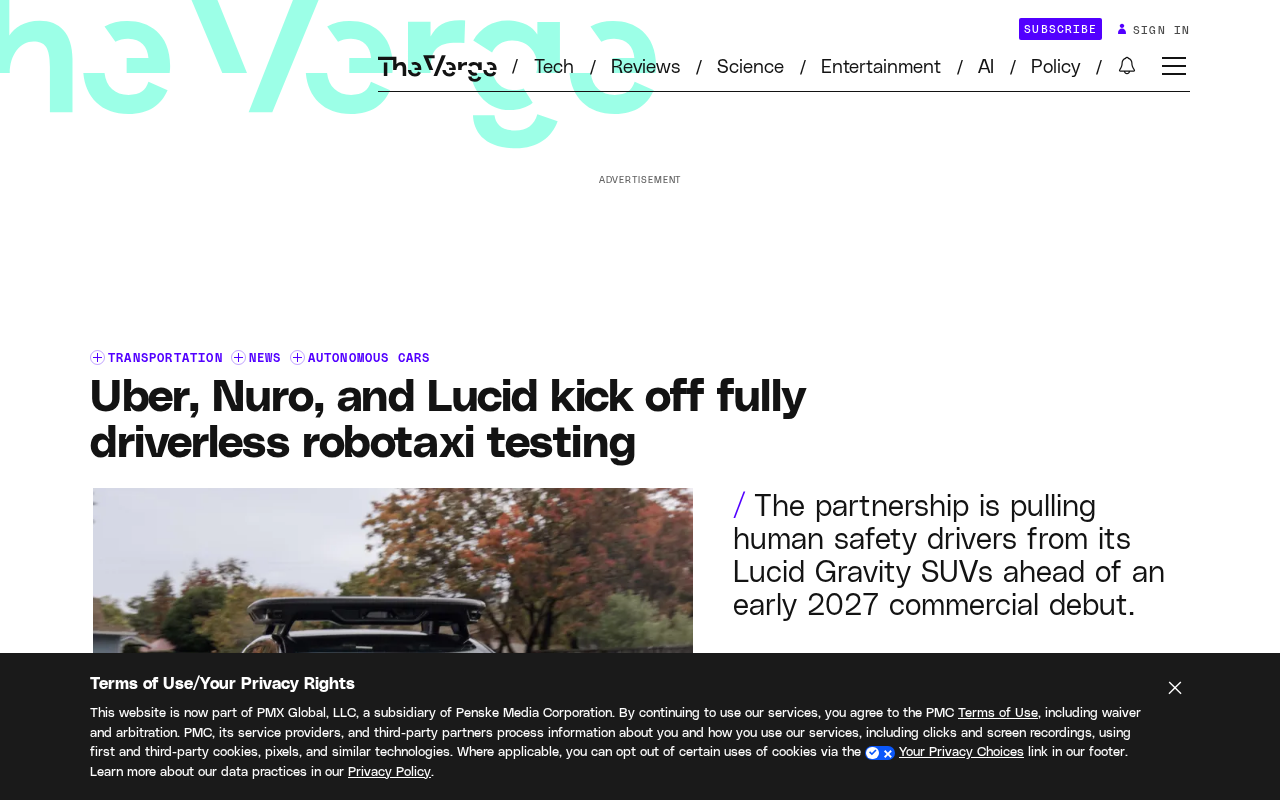
Uber's ambitions in autonomous driving are accelerating once again. According to RSS sources, the three-way alliance of Uber, Nuro, and Lucid has begun public road testing of fully driverless robotaxis in the San Francisco Bay Area, with employee-only rides set to follow shortly. This move marks Uber's aggressive return to the robotaxi race through partnerships, after abandoning its own self-driving program.
A Three-Way Alliance: A Complementary Puzzle Where Each Party Gets What It Needs
The partnership was first announced in July 2025 and has now entered a substantive road-testing phase. The division of labor across the three parties forms a complete autonomous driving deployment chain: Lucid provides the premium electric vehicle platform, Nuro contributes its autonomous driving system expertise built up in the unmanned delivery space, and Uber brings its vast ride-hailing network, user traffic, and operational experience.
The cleverness of this combination lies in the fact that no single party needs to build full-stack capabilities from scratch. Lucid doesn't need to divert resources into developing autonomous driving software, Nuro doesn't need to build its own mobility platform, and Uber avoids repeating the mistakes of its self-developed hardware efforts. Compared to Waymo's vertically integrated, asset-heavy model, Uber has chosen a lighter, faster partnership path.
Robotaxi (driverless taxi) refers to vehicles that complete all driving tasks through autonomous driving systems and provide on-demand mobility services to the public. Unlike ordinary driver assistance, robotaxis typically require SAE-defined Level 4 high automation—within a specific operational design domain, the vehicle can drive fully autonomously without human intervention. Its commercialization chain covers four links: vehicle platform, autonomous driving software, operational dispatch, and regulatory permits—any missing link makes it difficult to close the loop. This also explains why Uber chose to ally with Lucid and Nuro: the three parties respectively fill in the platform, software, and operations pieces of the puzzle, avoiding the asset-heavy risk of a single company bearing full-stack R&D.
From Safety Driver to Fully Driverless: A Critical Step
The core highlight of this testing is "fully driverless"—vehicles no longer have a safety driver in the driver's seat. This is the highest-threshold step in the commercialization of autonomous driving, and also the intersection of regulation and public trust. According to the original report, testing first began on public roads in the San Francisco Bay Area, with employee-exclusive ride services to launch shortly after testing.
For Uber, this step carries special symbolic significance. Uber previously sold its self-driving division, which was once seen as its exit from the field. Now, through its alliance with Nuro and Lucid, Uber has returned to the forefront of driverless taxis as a platform player, with a clear strategic intent: not to make heavy technical investments, but to become the aggregator and distributor of autonomous driving capacity.
Safety driver is a standard role during the autonomous driving road-testing phase, typically seated in the driver's seat, ready to take over the vehicle at any time to handle edge cases the system cannot manage. The leap from "with safety driver" to "fully driverless" is not just about removing a person—it means companies must prove to regulators that the system's failure risk within designated areas is low enough to be acceptable, and establish supporting mechanisms such as remote monitoring and emergency response. This stage is often the longest and most strictly regulated gateway in autonomous driving commercialization, and a key node in building public trust.
Competitive Landscape and Unresolved Challenges
The San Francisco Bay Area is already a dense testing ground for autonomous driving, with players like Waymo already operating driverless taxi services in the region. The entry of the Uber alliance means competition in this market will shift from technical validation to operational scale and cost efficiency. Whether Uber's ride-hailing network can bring stable order density to the driverless fleet will be the key to its differentiated advantage.
However, the advancement of fully driverless testing still faces real constraints. The pace of regulatory approvals, safety records in complex urban road conditions, and public acceptance of vehicles without safety drivers are all variables that need to be validated step by step. The original report did not disclose details such as fleet size or testing mileage, and the absence of this information means it is still difficult for outsiders to assess the actual pace of progress.
Waymo's vertically integrated model refers to Waymo, under Google's parent company Alphabet, developing its own autonomous driving software (Waymo Driver), sensor hardware, and fleet operations simultaneously, forming an end-to-end closed loop. The advantage of this model lies in deep hardware-software synergy and a complete data loop, but the cost is massive capital investment and expansion speed constrained by the pace of building its own fleet. In contrast, Uber's alliance model outsources technology R&D to partners while focusing on traffic distribution and operational dispatch—an asset-light path. The core difference between the two models: the former bets on long-term moats built by technological barriers, while the latter bets on scale and speed brought by network effects.
Signal Significance for the Industry
Uber's move sends a clear signal: competition in autonomous driving is shifting from "who has the best technology" to "who can fastest turn technology into a service that can be scaled operationally." Whether the alliance model can work will directly influence the choices of other mobility platforms—whether to continue in-house development or pivot to partnering with autonomous driving technology companies.
For Nuro and Lucid, the tie-up with Uber is equally a commercialization validation. Nuro is transitioning from unmanned delivery to passenger transport, and Lucid is extending from premium EVs to the robotaxi scenario—both need real operational data to prove their platform value. The interests of all three parties are highly aligned here, which makes every step of progress in fully driverless testing worth continued attention.
Related articles

Michael Nielsen Takes Down His Classic Neural Network Textbook, Sparking Community Discussion
Michael Nielsen's classic free textbook Neural Networks and Deep Learning has been taken offline, sparking discussion on Hacker News about the reasons and impact.

Inside the AI Training Data Market: The Trade-off Between Exclusivity and Discounts
G2i founder Gabe Greenberg reveals the dual-track pricing of the AI training data market: labs pay a premium for exclusive data or accept discounts that allow others to buy it.

SessionGraph: Unifying All Coding Agent Sessions in One Interactive Graph
SessionGraph aggregates coding agent sessions into an interactive graph, helping developers review, debug, and manage AI coding workflows across sessions. This article examines its positioning, value, and open questions.