Uber Partners with Pony.ai to Bring Robotaxi to London

Uber and Pony.ai advance Robotaxi deployment in London, with complex roads and regulation as key challenges.
Uber and autonomous driving company Pony.ai are pushing forward with a Robotaxi service in London, now in the final stages of regulatory approval and operational preparation. Their partnership follows a "platform + technology" model: Uber provides traffic and dispatch capabilities, while Pony.ai supplies the L4 autonomous driving system. London's narrow streets, dense pedestrians, and diverse road users place extreme demands on the system's generalization capability, and local regulations were not designed for autonomous driving. Initially, vehicles will have safety drivers, transitioning to driverless operation after extensive testing. Fleet size, service areas, and pricing remain unannounced. This marks a significant step for Robotaxi entering a core European city.
London's streets are about to welcome a fleet of driverless taxis. Uber and autonomous driving company Pony.ai are pushing forward with plans to launch a Robotaxi service in London, and the two parties have now entered the final stages of regulatory approval and operational preparation.
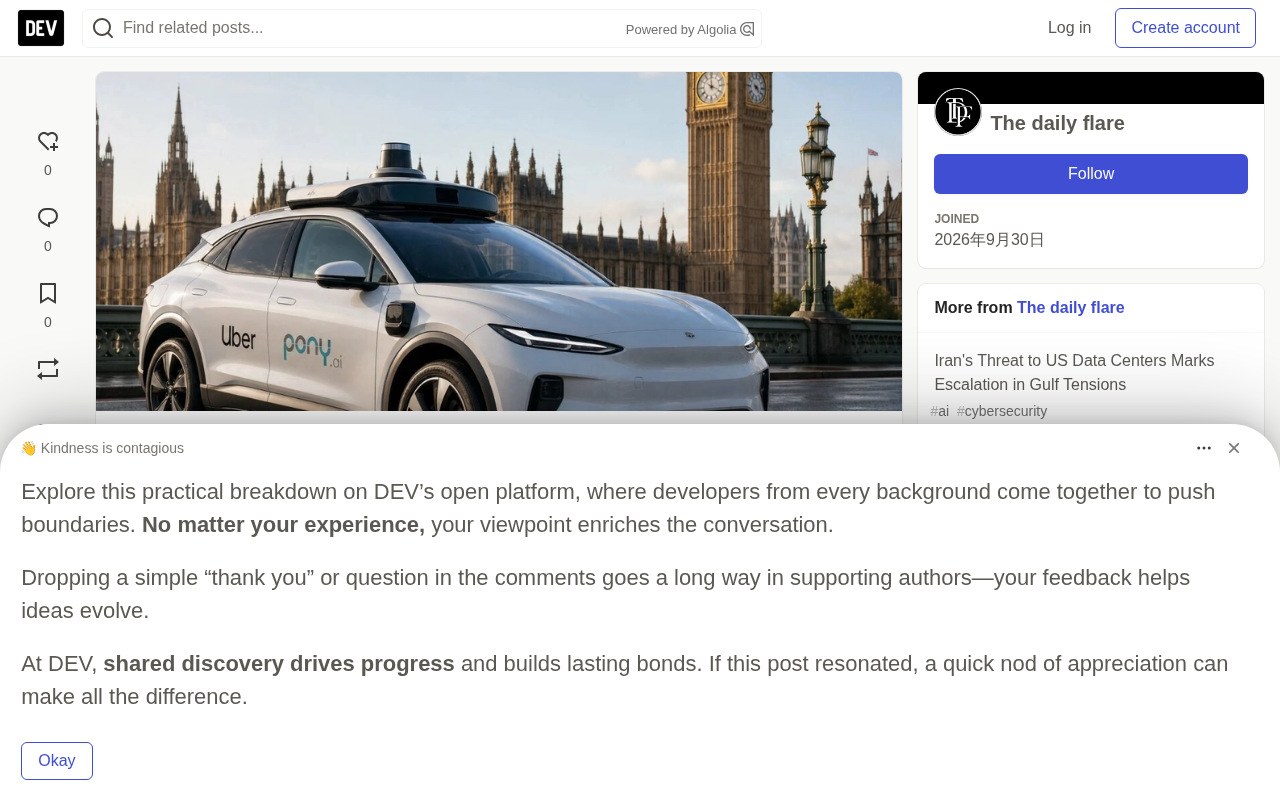
The Logic Behind the Partnership
Uber's operational experience and user base as a mobility platform, combined with Pony.ai's accumulated autonomous driving technology, form the foundation of this collaboration. The two companies have previously completed pilot autonomous operations in other cities, and London is a new node on their global expansion roadmap.
This "platform + technology" pairing is becoming increasingly common in the autonomous driving industry. Mobility platforms command traffic and dispatch capabilities, while autonomous driving companies provide the core perception and decision-making systems — each side gets what it needs. For Uber, autonomy is a key path to reducing driver costs and improving profit margins; for Pony.ai, plugging into Uber's network means faster commercialization.
Robotaxi (autonomous taxi) refers to vehicles that provide on-demand passenger services through L4-level or higher autonomous driving systems without human driver intervention. Under the SAE (Society of Automotive Engineers) classification, L4 means a vehicle can drive fully autonomously within a specific Operational Design Domain (ODD) without human takeover; L5 is fully autonomous driving with no scenario restrictions. Robotaxi is seen as a disruptive form of mobility because it can theoretically eliminate the driver — the largest labor cost item — dramatically lowering per-kilometer operating costs while improving vehicle utilization through around-the-clock dispatch. Major global players currently include Waymo, Cruise, Baidu Apollo Go, Pony.ai, and WeRide.
Pony.ai is an autonomous driving company founded in 2016 by Peng Jun and Lou Tiancheng, core members of the former Baidu autonomous driving team. It has R&D and testing teams in both China and the United States, focusing on L4-level full-stack autonomous driving technology covering perception, prediction, planning, and control modules. The company has previously operated Robotaxis in Guangzhou, Beijing, Shenzhen, and other cities, and has partnerships with automakers including Toyota and FAW. Pony.ai's technical approach emphasizes multi-sensor fusion (LiDAR, cameras, millimeter-wave radar) combined with proprietary algorithms, contrasting with Tesla's insistence on a pure vision approach.
Why London Is Difficult
London's road environment places extremely high demands on autonomous driving systems. Narrow streets, dense pedestrians, complex roundabouts, and cyclists and motorcyclists appearing at any moment — these scenarios are far more complex than highways or closed campuses. The original text notes that the partnership will focus on addressing "heavy traffic, diverse road users, and intricate navigation requirements," relying on advanced technology and real-time data analysis to overcome these obstacles.
London's regulatory framework was also not tailor-made for autonomous driving. Although the UK has made progress on autonomous driving legislation in recent years, actual Robotaxi operations still require multiple layers of approval. The two companies say they are working with local regulations to complete compliance work, but the specific approval timeline and operational areas have not yet been announced.
The "generalization capability" mentioned here is one of the core challenges in the autonomous driving industry. Generalization refers to the ability of an algorithm and model to operate safely in cities, weather conditions, and road structures it has never seen during training. Autonomous driving systems typically rely on large amounts of real-world road test data for training, but if a model overfits to the specific scenarios of one city (such as Phoenix's regular grid road network and sparse pedestrians), performance may decline noticeably when transferred to a city like London with irregular road networks, high pedestrian density, and frequent rain. There are usually two approaches to solving generalization: one is to collect data in as many different cities as possible, and the other is to adopt end-to-end large models to improve understanding of unknown scenarios. London is considered a "tough nut to crack" precisely because it pushes the system's generalization capability to near its limits.
How the Safety Framework Is Built
In response to public concerns about autonomous driving safety, Uber and Pony.ai plan to proceed in phases. In the initial phase, vehicles will be equipped with safety drivers — someone sitting in the driver's seat ready to take over at any time. At the same time, the companies have committed to extensive testing and building a comprehensive safety compliance system.
This approach is standard practice in the industry. Companies like Waymo and Cruise also adopted similar strategies in their early operations — first accumulating real-world road data with safety operators on board, then gradually transitioning to fully driverless operation. For an extremely complex city like London, the safety driver's presence may last longer than in cities like Phoenix.
Safety Driver is a common transitional role in the journey from autonomous driving testing to commercialization. They sit in the driver's seat, hands usually hovering near the steering wheel, ready to intervene when the system requests takeover or when they judge the system's behavior to be abnormal. Safety drivers generally require specialized training to become familiar with the system boundaries, takeover procedures, and emergency operations of the vehicle they operate. The significance of this role is twofold: first, at the legal and regulatory level, many regions require certified personnel to be present when autonomous vehicles are tested on public roads; second, at the data level, safety drivers' takeover records help engineers identify weak scenarios in the system and feed back into model iteration. As the system's performance in a given area stabilizes and regulations gradually open up, safety drivers will be replaced by remote monitoring or removed entirely.
Key Questions Still Unclear
Several core pieces of information are still missing: what the initial fleet size will be, which specific areas will be served, and how pricing will be set. These details directly affect user experience and market reception. London's existing public transit system (the Tube, buses, black cabs) is very mature, and for Robotaxi to break into this market, price and service coverage are key variables.
The original text also points out that the launch of Robotaxi may help "reducing congestion and lowering emissions," but this requires sufficiently high vehicle utilization rates and electrification as a foundation. If Robotaxi simply increases the total number of vehicles on the road, congestion and emissions problems may not necessarily be alleviated.
Regarding Robotaxi's impact on congestion and emissions, industry research has reached inconsistent conclusions. Supporters argue that Robotaxi, combined with high vehicle utilization and ride-sharing dispatch, can reduce private car ownership and thereby lower overall road occupancy; but critics point out that if Robotaxi pricing is low enough, it may actually induce more travel demand, creating "induced traffic," while empty cruising (driving to pick up passengers or waiting for orders) also increases wasted mileage. Moreover, emission reduction effects are only significant when the Robotaxi fleet is electrified at scale — otherwise it merely transfers emissions from private cars to the operating fleet. Therefore, the original text's phrasing about "reducing congestion and lowering emissions" is closer to a potential benefit rather than an inevitable outcome, and it requires supporting policies, pricing, and operational strategies to materialize.
The Bigger Picture
London has been exploring ways to improve urban transportation, and autonomous driving is one such path. Globally, from San Francisco to Beijing, from Dubai to Tokyo, Robotaxi deployment is accelerating. Uber and Pony.ai's London plan is an important move in this wave for a core European city.
But the challenges are equally clear: the uncertainty of regulatory approval, public acceptance, and the technology's generalization capability across different urban scenarios — these factors will all affect the final outcome. Whether London can become a benchmark city for Robotaxi in Europe remains to be seen in the actual developments over the coming months.
One-line Summary
Uber and Pony.ai push forward Robotaxi deployment in London, with complex road conditions and regulation as the main challenges.
Paragraph Summary
Uber and autonomous driving company Pony.ai are advancing plans to launch a Robotaxi service in London, currently in the final stages of regulatory approval and operational preparation. Their partnership follows a "platform + technology" model: Uber provides traffic and dispatch capabilities, while Pony.ai provides the L4-level autonomous driving system. London's narrow streets, dense pedestrians, and diverse road users place extremely high demands on the system's generalization capability, and local regulations were not tailor-made for autonomous driving. On the safety front, initial vehicles will be equipped with safety drivers, accumulating data through extensive testing before gradually transitioning to driverless operation. Key details such as fleet size, service areas, and pricing have not yet been announced. This move is an important step for Robotaxi entering a core European city.
Related articles

@ai-sdk/vue 3.0.306 Patch Release Syncs with [email protected] Update
@ai-sdk/vue 3.0.306 released, synced with [email protected]. A routine patch release for the Vercel AI SDK ecosystem with no public API changes; the Vue adapter layer stays version-aligned with the core package.

Gemini 4 Argon API Launches: The Era of Million-Token Output Begins
Google launches Gemini 4 Argon with sparse MoE architecture, up to 1M output tokens, and a 68.90% Vals Index score, available across API, AI Studio, and the Gemini app.

DukaanAI: Turning Product Photos into Inventory Lists with Open-Source AI
DukaanAI is an AI inventory tool for small retailers that turns product photos into inventory entries using the open-source Gemma 3 model, with local inference, editable fields, and CSV export.