UGC People: Add Human Reaction Hooks to Your App Demo Videos

UGC People gives indie developers ready-made human reaction hooks to make app demo videos stop the scroll.
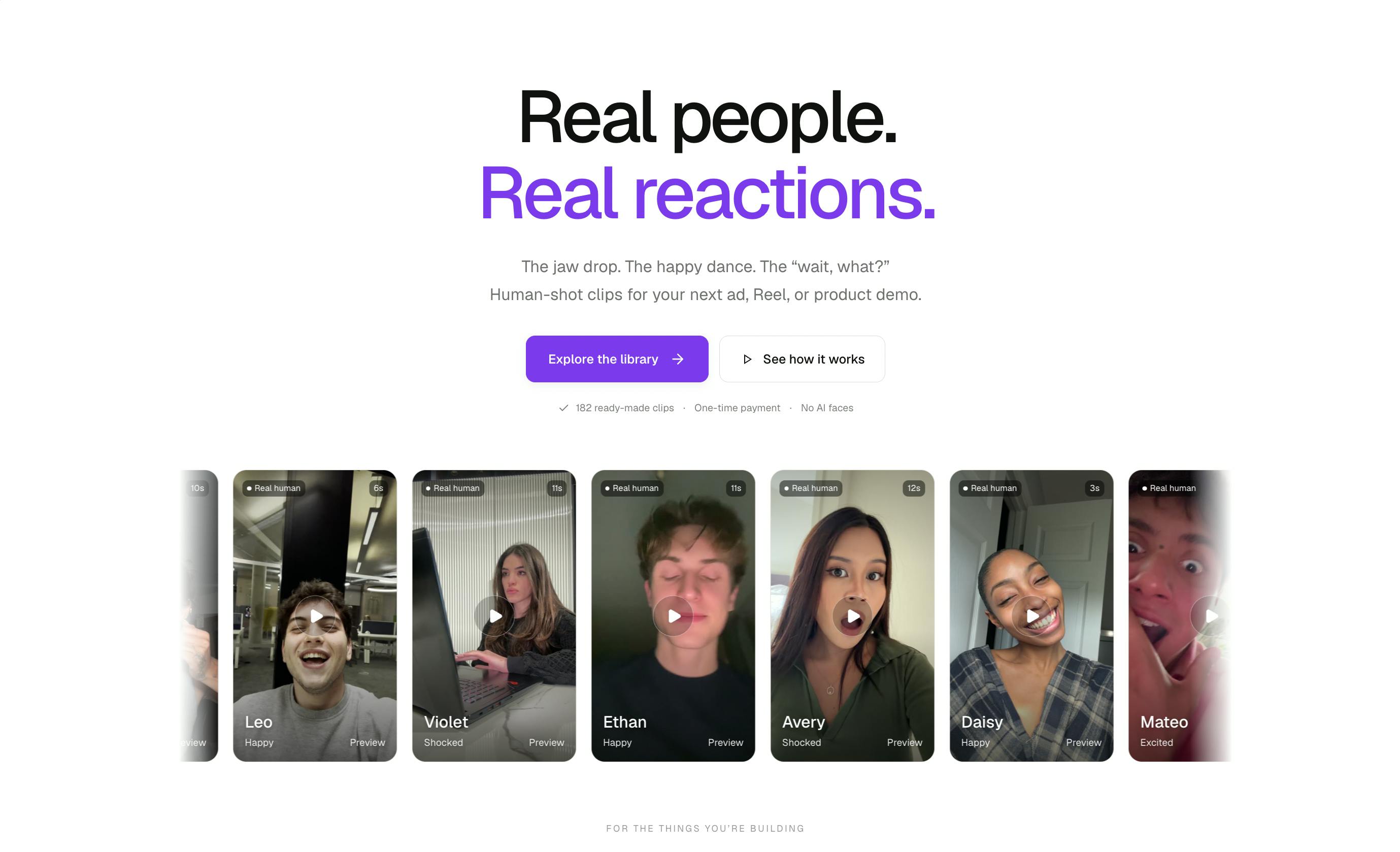
UGC People is a content marketing tool for indie developers and small teams, offering 182 human-filmed reaction clips and B-roll assets to prepend to existing product demos — creating the classic short-form structure of "human pain point → product solution." It uses a one-time purchase model and supports local editing. The tool precisely targets the gap for developers who need authentic-feeling openings but lack the budget to shoot UGC content themselves. However, its shared 182-clip library risks homogenization and hook fatigue at scale, and generic reactions may not map cleanly to every product's specific context. Currently it's seeing modest traction on Product Hunt, positioning it as a niche, focused utility rather than a breakout product.
The Overlooked Marketing Pain Point: Great Demos That Nobody Watches
Many product teams have faced this awkward reality: you pour time and effort into a polished product demo — clean visuals, clear feature walkthrough — only to post it on social media and watch it sink without a ripple. The problem usually isn't the demo itself. It's the opening. Viewers swipe away within the first three seconds, never even reaching the part where you show the solution.
UGC People, a new tool that appeared on Product Hunt, targets exactly this gap. Its positioning is straightforward: provide "human reaction hooks" for your existing app demos, so your content leads with genuine human emotion before it ever shows the product.
The Core Logic: Show the Problem Before the Solution
UGC People's underlying approach aligns with the classic structure of short-form video marketing: present the pain point first, then deliver the remedy. The tool offers real, human-filmed reaction clips designed to open a video with the "problem" — someone frowning at a screen, venting frustration, or looking completely lost — before cutting to your product and showing how it fixes things.
This "Hook → Transition → Product" narrative formula is essentially borrowing the authenticity of UGC (user-generated content) aesthetics to soften the hard edge of a pure product demo. Compared to a slickly edited official demo, an opening with real human emotion is far more likely to stop someone mid-scroll.
According to the product page, UGC People currently offers 182 human-filmed clips and B-roll footage. Users browse the library, pick a hook that fits, prepend it to their existing demo, and cut it all together into a finished video.
UGC (User Generated Content) originally referred to content created and shared organically by everyday users — as opposed to polished, brand-produced material. In marketing, UGC-style content works because its rawness signals authenticity, which earns trust. Rough, unpolished footage from a real person often lands harder than a highly produced ad, because it bypasses the viewer's "this is an ad" mental defense. In recent years, brands have begun deliberately mimicking this aesthetic at scale — producing what's sometimes called "pseudo-UGC" or "UGC-style" content: visually lo-fi in form, but carefully planned in substance. TikTok and Instagram Reels algorithms also tend to favor authentic, face-to-camera content with strong engagement, reinforcing this trend. UGC People essentially commodifies this playbook, giving small teams who can't afford to shoot their own footage a ready-made authenticity wrapper.
Workflow and Business Model
The entire workflow is designed to be lightweight:
- Browse the library: Choose from 182 human reaction clips and B-roll footage
- Add the hook: Use the selected clip as the opening "teaser" of your video
- Cut to product: Follow it with your existing app demo footage
- Edit locally: Download the assets and finish post-production in whatever editing software you already use
The business model is worth noting: one-time payment, no subscription. In a landscape where SaaS tools almost universally default to recurring billing, a lifetime-access pricing model is friendlier to small teams and indie developers — you're buying a reusable asset library, not signing up for an ongoing service. The product also offers 10 sample previews so users can evaluate the footage quality before committing.
The Real Problem It Solves — and Its Limitations
From a marketing standpoint, the pain point UGC People addresses is genuine. Indie developers and small startups rarely have the budget to hire real people for UGC-style shoots, and most existing stock footage libraries are generic commercial assets that weren't designed with the specific scenario of "app demo hook" in mind. UGC People standardizes and productizes the "human reaction" element, lowering the barrier to execution.
That said, the limitations of this approach are equally apparent. 182 clips isn't a large library. If many creators end up using the same footage, audiences will start experiencing déjà vu — and that familiarity actively undermines the authenticity that makes UGC-style content effective in the first place. There's also the mismatch problem: reaction clips filmed generically may not align precisely with any given product's specific pain points, and a forced hook can feel awkward rather than compelling.
Based on its Product Hunt performance — 7 upvotes, ranked #12 — the tool is still in early stages with a modest initial reception. It reads more like a focused, "small but useful" solution to a niche problem than a disruptive product.
"Hook fatigue" is a well-documented phenomenon in short-form video marketing. Once a particular opening formula gets widely copied, audiences develop a kind of conditioned immunity — they swipe faster, not slower. Early hooks like "Have you ever experienced this problem?" voiceovers and "POV: You are..." text overlays each went through the full cycle from novelty to overuse to irrelevance. For a tool that relies on a fixed asset library, this risk is especially acute. With 182 clips shared among creators globally, if a handful of "crowd-favorite" reaction clips get used repeatedly, viewers who recognize the footage will immediately associate it with advertising — completely neutralizing the authenticity advantage. This is precisely why a library's ability to continuously refresh its content often matters more to long-term value than its initial size.
Takeaway
UGC People represents a pragmatic direction for content marketing tools: instead of trying to do everything, it productizes one specific step — the human hook at the start of a video — into a ready-to-use asset service. For developers who already have a solid product demo but struggle to make the opening compelling, it offers a low-cost option. Whether it's worth paying for ultimately comes down to what those 10 preview samples look like — because in the attention economy, the first three seconds usually determine whether anyone sticks around for the next few minutes.
Related articles

Workbuddy for Absolute Beginners: How a Desktop AI Agent Fits Into Real Workflows
A beginner's guide to the Workbuddy desktop AI agent: installation, claiming credits, file management, and building automated workflows—compared with CodeX for fit and cost, helping professionals shift from AI question-askers to AI managers.

OpenAI's New Agent Stack: Computer Use, Decisions API, and Ultra-Fast Workflows
OpenAI Dev Day unveiled a new agent stack: Computer Use outperforms humans, Decisions API delivers ultra-low-latency classification via Luna, Agents API opens the same Computer Use capabilities, and GPT-6.1 Sol costs only one-seventh of Astra. Core updates, benchmark data, and developer insights.

Liang Wenfeng Open-Sources DeepInfo Inference Framework, Takes On U.S. Ban
DeepSeek open-sources its DeepInfo inference framework after its models, featuring GPU/CPU cross-pipelining, small-model prediction with large-model verification, and full Huawei Ascend and NVIDIA chip support—facing the U.S. federal ban head-on. This article analyzes its significance for AI deployment and open-source strategy.