UGREEN MagFlow Pro Liquid-Cooled Power Bank Review: Is the Visible Coolant Design Worth $149?
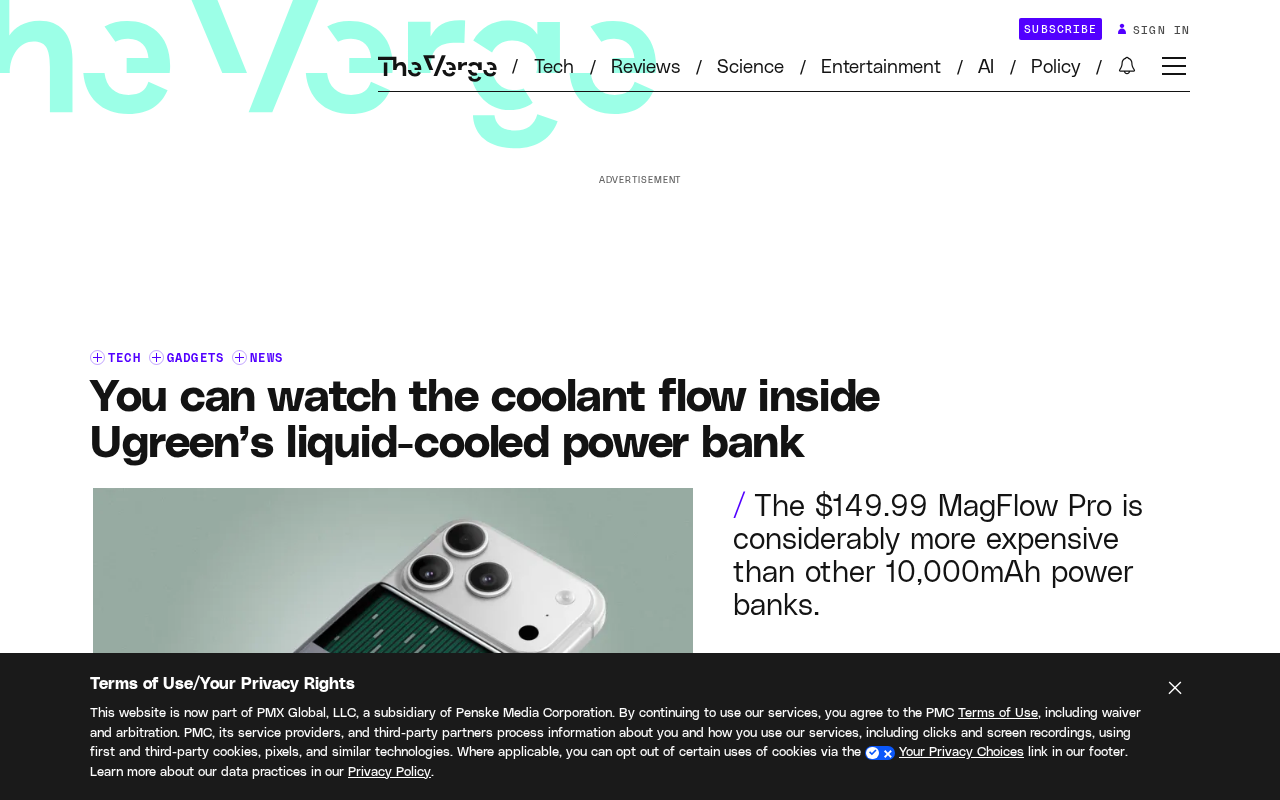
UGREEN's $149.99 liquid-cooled MagSafe power bank is bold but faces tough questions on pricing and practicality.
UGREEN's MagFlow Pro brings PC-style liquid cooling and a transparent Cyber Window to a 10,000mAh MagSafe power bank, priced at $149.99. While the CryoPulse cooling tech has real merit for high-wattage fast charging, the premium over typical $40–$70 competitors targets tech enthusiasts rather than mainstream buyers. The product signals UGREEN's brand-elevation strategy and reflects a broader trend of over-engineering in mature accessory categories.
When Power Banks Start Showing Off: UGREEN MagFlow Pro's Liquid-Cooling Innovation
Does your power bank have "CryoPulse" cooling technology? Does it have a "Cyber Window" that lets you watch coolant flowing inside? If the answer to both is no, UGREEN might want you to take another look at your current charging gear.
UGREEN's newly launched MagFlow Pro MagSafe power bank takes the liquid-cooling concept — previously the domain of high-end PC builds — and puts it inside a 10,000mAh portable charger. The product goes on sale today at $149.99, a price that firmly places it at the very top end of the market for a power bank of this capacity.
It's worth noting that UGREEN was founded in 2012 and headquartered in Shenzhen. The company started out making basic accessories like cables and adapters, building a massive user base on cross-border e-commerce platforms like Amazon through competitive pricing. After its IPO on the Shenzhen Stock Exchange's ChiNext board in 2023, UGREEN accelerated its push upmarket, rolling out product lines like NASSync private cloud storage and premium GaN chargers. The MagFlow Pro represents another key move in UGREEN's transformation from "white-label accessory supplier" to "tech lifestyle brand." The $149.99 price tag is less about maximizing unit sales and more about using a flagship product to elevate the brand's perceived technology image and set a higher price anchor in consumers' minds.
"Visible" Cooling: Gimmick or Genuine Innovation?
Cyber Window Transparent Design
The most eye-catching feature of this product is undoubtedly its "Cyber Window" design. Through a transparent viewing panel, users can directly observe the internal coolant flow. This exposed industrial design clearly draws from the aesthetic trends of the custom PC water-cooling market — turning what's normally hidden inside a case into a visual selling point.
To understand the origins of this design language, it helps to look at the evolution of PC water cooling. Liquid-cooling technology has over two decades of history in the PC space. The core principle leverages the significantly higher specific heat capacity and thermal conductivity of liquids (typically a mixture of deionized water and ethylene glycol) compared to air. A pump drives the coolant in a loop between heat-generating components and radiators, efficiently transferring heat from the source to areas with greater surface area for dissipation. In PC building culture, transparent tubing, colored coolant, and RGB lighting have long evolved from purely engineering solutions into a form of visual art. What UGREEN is essentially doing is a cross-pollination of the visual culture from the PC DIY community with mobile accessories.
For consumer electronics, this is a fairly bold move. Traditional power banks aim for slim, discreet, and reliable. UGREEN goes in the opposite direction, turning thermal management — an engineering concern — into a product feature worth showing off.
CryoPulse Liquid Cooling: Real-World Thermal Performance
Marketing language aside, there is genuine technical logic behind applying liquid cooling to a power bank. High-wattage fast charging is currently the core competitive battleground for portable chargers, and heat is fast charging's biggest enemy. Batteries generate significant heat during high-current charge and discharge cycles. Excessive temperatures not only reduce charging efficiency but also accelerate battery degradation and create safety risks.
It's important to understand the heat generation mechanism behind fast charging. Current mainstream fast-charging protocols include USB PD (Power Delivery), Qualcomm QC (Quick Charge), and various proprietary protocols from phone manufacturers. The core approach is to increase charging power by raising voltage or current. But according to Joule's law (Q=I²Rt), heat increases exponentially as current rises. In a power bank scenario, high-current discharge causes heat generation not only in the battery cells themselves but also in the power conversion circuitry (DC-DC converters) and wireless charging coils. Traditional power banks rely on passive solutions like graphite thermal pads, aluminum alloy housings, or copper foil heat spreaders. These work adequately at power levels below 30W, but as fast-charging wattages climb higher, passive cooling is approaching its physical limits.
The thermal challenge is even more acute for MagSafe power banks. MagSafe is the magnetic charging standard Apple introduced with the iPhone 12 series, using a ring-shaped magnet array on the back of the phone for precise alignment with charging accessories and transmitting power via the Qi wireless charging protocol. However, the inherent energy conversion efficiency of wireless charging is typically only 75%–85%, meaning a substantial portion of electrical energy is lost as heat. This makes thermal management a far more prominent engineering challenge in MagSafe power banks than in their wired counterparts.
UGREEN's CryoPulse liquid-cooling solution can theoretically dissipate heat more efficiently than traditional passive or graphite-based approaches, maintaining high power output while keeping cell temperatures in check. For portable chargers that support high-wattage fast charging, this is a technically meaningful direction.
The $149.99 Pricing Debate: Is the Liquid-Cooling Premium Justified?
The $149.99 price tag is the elephant in the room. Mainstream 10,000mAh MagSafe power banks generally fall in the $40–$70 range, and even premium products within the Apple MagSafe ecosystem rarely break the $100 mark.
The premium on this UGREEN product clearly doesn't come from capacity — 10,000mAh is only slightly above average by today's standards. A significant portion of the price is attributable to the two differentiating features: liquid-cooling technology and the transparent visual design.
This raises a question worth considering: In a highly commoditized, price-sensitive category like power banks, can technology innovation and design command a premium?
- From the average consumer's perspective: Budget-conscious buyers will almost certainly pass. The same money could get you a higher-capacity, more feature-rich product combination.
- From the tech enthusiast's perspective: A power bank where you can watch coolant flowing has inherent collectibility and social media appeal — and this crowd may be exactly the target market UGREEN is aiming for.
What the UGREEN MagFlow Pro Reveals About Charging Accessory Trends
The launch of the UGREEN MagFlow Pro reflects a clear trend in the consumer electronics accessories market: when core functionality reaches saturation, manufacturers turn to over-engineering and emotionally driven design to create differentiation.
"Over-engineering" in traditional engineering typically refers to designing a product beyond its actual use requirements and is often seen as wasteful. But in consumer electronics, it's becoming a deliberate product strategy. When a category matures and the gaps in core specs (capacity, charging speed) narrow to the point where consumers can barely tell the difference, manufacturers pivot to beyond-spec designs that generate psychological premiums and buzz.
This closely mirrors the evolution of enthusiast communities around mechanical keyboards, PC builds, and custom peripherals — products are no longer just tools but vehicles for personal expression and technical aesthetics. The mechanical keyboard market is a textbook example: what started as functional peripherals evolved into "desktop art" featuring CNC-milled aluminum cases, multi-layer sound-dampening foam, and gasket-mount structures, with price points climbing from under a hundred dollars to several thousand. The UGREEN MagFlow Pro's liquid-cooling approach follows similar logic — the technology itself is sound, but much of its value lies in emotional resonance and social currency. A liquid-cooled power bank may be overkill in practical terms, but it successfully transforms a mundane product category into something that generates conversation.
A Clear-Eyed Look at Liquid-Cooled Power Bank Technology
It's important to stay grounded. The visible coolant flow is primarily a visual marketing tool, and the actual magnitude of its thermal performance improvement needs to be validated with rigorous teardown and testing data. Notably, in the smartphone space, liquid-cooling concepts have been widely adopted since around 2015. But the heat pipes and vapor chambers used in phones are essentially passive liquid-cooling solutions based on phase-change cycling of a working fluid inside a sealed chamber — structurally quite different from the UGREEN MagFlow Pro's system with its visibly flowing liquid. Consumers should be aware of the actual thermal performance differences between the various approaches marketed under the "liquid cooling" umbrella.
Whether a 10,000mAh power bank under normal usage scenarios truly needs such a heavy-duty liquid-cooling solution is a practical question consumers should seriously weigh before making a purchase decision.
Verdict: Is the UGREEN Liquid-Cooled Power Bank Worth Buying?
The UGREEN MagFlow Pro is an innovative product whose market performance remains to be seen. It showcases the manufacturer's ambition in both technology and design, bringing the hardcore concept of liquid cooling into the portable charger space. But the $149.99 price tag means it's destined to be a differentiated product for tech enthusiasts and gadget lovers, not a mass-market volume seller.
Regardless, it proves at least one thing: even in a seemingly mundane category like power banks, there's still room to tell a new story through design and technology.
Related articles

Is the Agent Harness Dead? Cursor's Early Engineer Breaks Down the Real Architecture of AI Coding Agents
Cursor early engineer Jediah breaks down the real architecture of the agent harness: why "the harness is dead" is only half right, how the data flywheel lets the harness obsolete itself, and how Grokbot, software factories, and primitive design open new frontiers for agents.

Python Visitor Pattern and Better Alternatives Explained
A deep dive into Python's visitor pattern and four alternatives: method pattern, pattern matching, dictionary mapping, and functools.singledispatch. Choose the best decoupling design by change frequency.

357 Days of Deep Experience: Why Omarchy Made Me Stop Distro-Hopping
A 357-day deep dive into Omarchy: 59-second install, out-of-the-box audio and GPU support, the Quattro QuickShell rewrite migration pains, and why Arch users should try it.