UK Green Party Abandons Longstanding Anti-Nuclear Stance: A Realist Turn

The UK Green Party abandons its longstanding anti-nuclear stance, making a pragmatic turn under climate and energy pressures.
The UK Green Party has abandoned its longstanding opposition to nuclear power, sparking heated discussion with 216 points and 276 comments on Hacker News. The article traces the historical binding of the Greens with the anti-nuclear movement—accidents like Chernobyl shaped a generation's collective memory, and anti-nuclear was long a non-negotiable core identity label. The shift is driven by the realistic tension between climate goals, energy security, and supply stability: intermittent renewables alone cannot meet both emissions reduction and baseload needs, and nuclear is being revalued as a low-carbon dispatchable source. The controversy: mature pragmatism or betrayal of principles? The shift may provide a legitimacy template for other hesitant political forces while exacerbating the "climate first" vs. "ecology first" divide within the environmental camp; specific policy details remain unclear.
Title
UK Green Party Abandons Longstanding Anti-Nuclear Stance: A Realist Turn
Meta Description
The UK Green Party has abandoned its longstanding opposition to nuclear power, sparking heated discussion on Hacker News. This article analyzes the energy realities behind this shift, the internal divisions within the environmental movement, and its potential impact on European energy politics.
Article Content
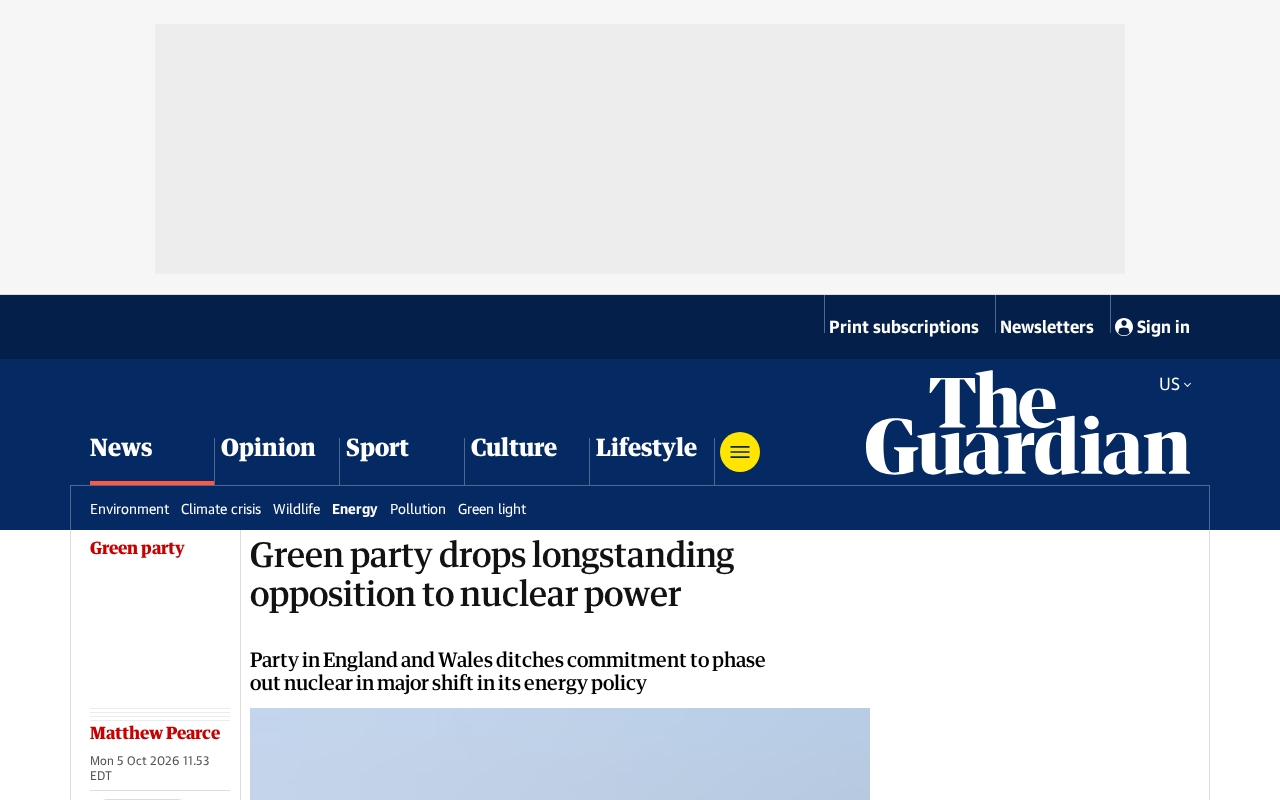
The UK Green Party is undergoing a landmark policy shift—according to The Guardian, the party has abandoned its long-held opposition to nuclear power. The news quickly sparked discussion on Hacker News, garnering 216 points of热度 and 276 comments, underscoring its controversial and topical nature. For a party founded on environmentalism, moving from "anti-nuclear" to "tolerating or even supporting nuclear energy" is less a collapse of faith than a pragmatic adjustment forced by energy realities and climate goals.
Why the Green Party Was Once Firmly Anti-Nuclear
To understand the weight of this shift, one must first return to the party's historical stance. Since its inception, the European Green movement has been deeply intertwined with the anti-nuclear movement; nuclear accidents such as Chernobyl formed the collective memory of an entire generation of environmental activists. In their narrative, nuclear energy meant irreversible ecological risks, radioactive waste that is difficult to dispose of, and a highly centralized energy power structure—naturally at odds with the Greens' vision of decentralized, community-based energy.
Therefore, "opposing nuclear power" has long been one of the non-negotiable bottom lines in the Green Party's policy platform. Abandoning this stance amounts to a concession on the party's most core identity label, which is why the news immediately drew extensive discussion.
The Historical Binding of the European Green Movement and the Anti-Nuclear Movement
The European Green movement was born in the 1970s-80s, its rise almost synchronous with the wave of anti-nuclear protests sweeping Western Europe at the time. The oil crises of the 1970s pushed countries to vigorously develop nuclear power, while the 1979 Three Mile Island accident in the US and the 1986 Chernobyl accident in the Soviet Union completely ignited public fear of nuclear safety. When the German Green Party (Die Grünen) was founded in 1980, anti-nuclear was one of its four pillars; after the Chernobyl accident in 1986, it further drove German society to form a powerful anti-nuclear consensus. This historical background explains why anti-nuclear is not merely a policy option for the Greens but the cornerstone of their identity—abandoning anti-nuclear is tantamount to challenging the party's self-definition over the past half-century.
The Energy Realities Behind the Shift
From public information, this policy adjustment is not an isolated event but part of a broader shift in European energy politics. Under the triple constraints of climate goals, energy security, and electricity price pressures, multiple political forces that were previously skeptical of nuclear energy are reassessing their positions. The reality facing the Greens is: if fossil fuel dependence is to be drastically reduced within a limited time frame, relying solely on intermittent renewable supply makes it difficult to simultaneously meet the dual requirements of emissions reduction and stable power supply.
Nuclear energy's attributes as a low-carbon, dispatchable baseload power source are being revalued in this framework. Abandoning the opposition stance means the Greens are willing to include nuclear energy in the "transition toolbox" rather than continuing to treat it as an option that must be excluded. This is a shift in thinking from "principle first" to "results first."
Baseload Power and the Intermittency of Renewables
Baseload power refers to power sources that can stably output 24 hours a day and meet the minimum load demand of the grid, traditionally borne by coal, natural gas, and nuclear power. Wind and solar are intermittent sources, whose output is affected by weather and day-night cycles and cannot be dispatched on demand. As the share of renewables rises, the grid needs supporting energy storage facilities or dispatchable power sources to fill the supply-demand gap. Although nuclear power plants have long construction cycles and huge investments, once operational they can provide stable low-carbon baseload electricity—this is precisely the realistic reason the Greens are forced to re-examine nuclear energy as the emissions reduction time window tightens.
Controversy: Compromise or Betrayal
The 276 comments on Hacker News reflect the two poles of this debate. Supporters see this as a sign of the Greens' maturity—the time window for the climate crisis is extremely narrow, and any technology that can accelerate decarbonization should not be precluded by ideology; opponents believe that the Greens' retreat on key principles will weaken its credibility as a moral benchmark for the environmental movement and open political space for nuclear industry expansion.
Interestingly, such divisions are nothing new within the environmental movement. The "split" over nuclear energy has lasted for decades, from early blanket opposition to some environmentalists publicly supporting nuclear power in recent years—the spectrum is becoming more complex. The Greens' choice is, to some extent, an institutionalized manifestation of this spectrum's evolution.
The Splintered Spectrum Within the Environmental Movement Over Nuclear Energy
The environmental movement's attitude toward nuclear energy is not monolithic but a continuously evolving spectrum. Early activists with an "ecology first" platform viewed nuclear power as an ecological threat on par with fossil fuels; but after entering the 21st century, some environmentalists represented by James Lovelock began to publicly support nuclear energy, arguing that the threat of climate change far outweighs the risk of nuclear accidents. This "climate first" line gained more adherents in the 2010s, especially evident in the energy security controversy triggered by Germany's shutdown of its last three nuclear power plants in 2022. The UK Green Party's shift is precisely the institutionalized manifestation of this spectrum moving from the margins to the mainstream.
Impact on Energy Politics
The softening of the Greens' stance may produce chain effects beyond a single party. On one hand, it provides a "legitimacy template for turning" for other political forces hesitant about nuclear energy—if even the Greens can accept it, the moral cost of opposing nuclear energy decreases accordingly; on the other hand, it may also exacerbate divisions within the environmental camp, making the tension between the "climate first" and "ecology first" lines more explicit.
That said, current public reports only involve the abandonment of the stance and do not yet include specific policy details, such as what scale of nuclear projects the Greens will support, whether safety and waste disposal conditions will be attached, etc. These details will determine whether this shift is a symbolic gesture adjustment or a substantive policy reconstruction.
Conclusion
The UK Green Party's abandonment of its longstanding anti-nuclear stance is a product of the collision between environmental politics and real energy constraints. It exposes the long-standing line divisions within the green movement and reflects that under the pressure of climate goals, ideological purity is giving way to executable emissions reduction pathways. The ultimate effect of this shift still depends on subsequent policy details and the solidity of intra-party consensus.
One-line Summary
The UK Green Party abandons its longstanding anti-nuclear stance, making a pragmatic turn under the pressure of climate goals and energy realities.
Paragraph Summary
The UK Green Party has abandoned its long-held opposition to nuclear power, sparking heated discussion on Hacker News with 216 points and 276 comments. The article traces the historical binding of the Greens with the anti-nuclear movement—accidents like Chernobyl shaped the collective memory of a generation of environmental activists, and anti-nuclear was long a non-negotiable core identity label for the party. The driving force behind the shift comes from the realistic tension between climate goals, energy security, and supply stability: intermittent renewables alone cannot simultaneously meet emissions reduction and baseload supply needs, and nuclear energy is being revalued as a low-carbon dispatchable power source. The controversy lies in whether this is mature pragmatism or a betrayal of principles. The article notes that this shift may provide a legitimacy template for other hesitant political forces while exacerbating the line division between "climate first" and "ecology first" within the environmental camp; specific policy details remain unclear.
Related articles
 Tech Frontiers
Coldframe: A Honeypot Disguised as a Supermarket Freezer Controller
Coldframe is a honeypot disguised as Danfoss AK-SM 800A and Dixell XWEB freezer controllers, built as a single Python file that detects CVE-2025-41450 attempts and is identified as real devices on Shodan.
 Tech Frontiers
GRFNet: A Lightweight PyTorch Model Designed for Multichannel Time-Series Classification
GRFNet is a lightweight PyTorch model for multichannel time-series classification, originating from EEG decoding research. With only 3,847 parameters, it is based on the ROCKET architecture, combining random convolution kernels with learnable spatial filters, supports arbitrary input lengths, and will soon be evaluated on the PhysioNet dataset.
 Tech Frontiers
CUDA-Accelerated Rocket League Simulator: A Player-Made Hardcore Experiment
A Reddit post shows a "100% Accurate" Rocket League simulator accelerated with CUDA. We analyze its technical context, CUDA's value in game physics simulation, and the significance and limitations of such community projects.