UK Invests £40 Million to Crack the Robot Adoption Problem

UK commits £40M to eight regional robotics hubs to close the adoption gap, not fund more R&D.
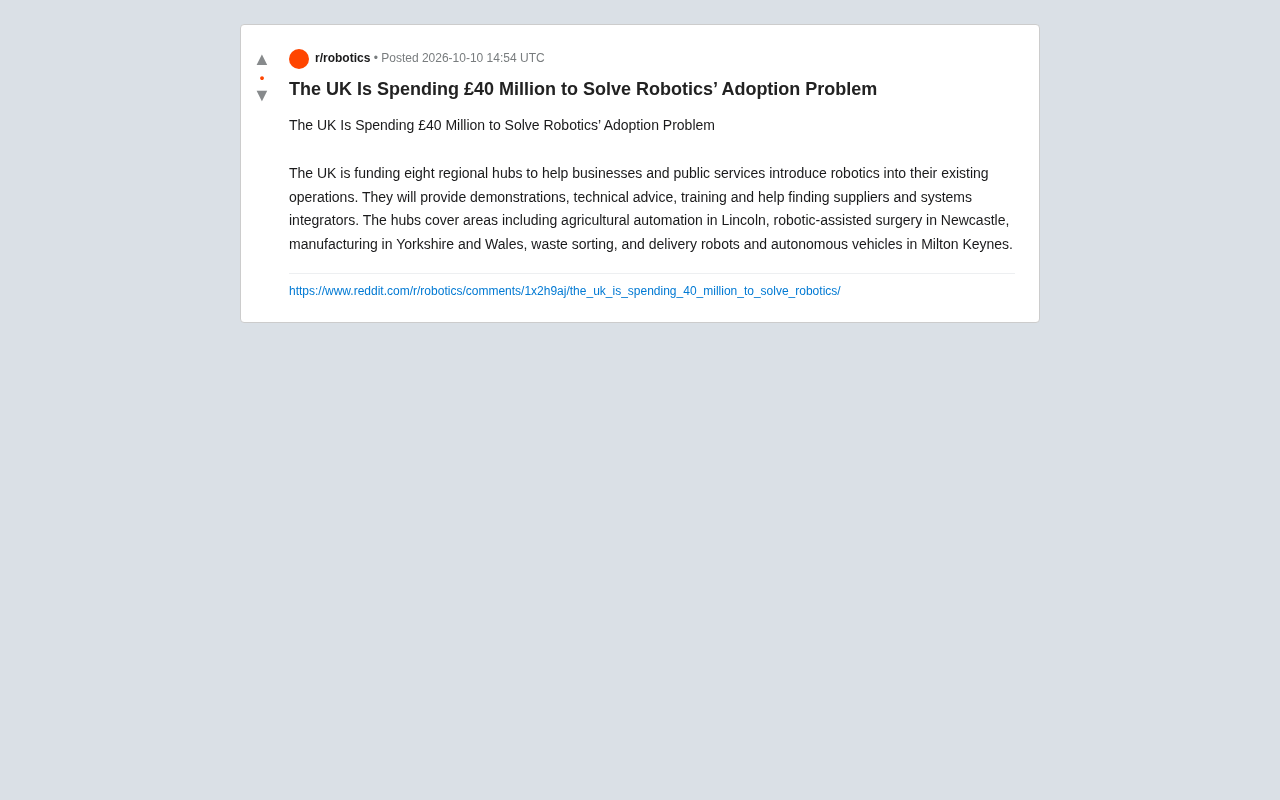
The UK government is funding eight regional robotics hubs with £40 million, targeting vertical sectors including agricultural automation, robot-assisted surgery, manufacturing, delivery, and waste sorting. The initiative focuses not on developing more advanced robots, but on closing the "adoption gap" — the barrier that stops SMEs from deploying technology that already exists, due to a lack of demos, consulting, training, and system integrators. The article argues that technology readiness and adoption readiness follow different curves, and the UK's pragmatic, deployment-first approach offers a valuable model for global robotics policymaking.
Using £40 Million to Bridge Robotics' "Last Mile"
Robotics technology is advancing faster than most people realize — yet scaling up robot deployment in real factories, farms, and hospitals remains stubbornly difficult. The UK government is targeting this "adoption gap" with a focused investment: according to widely circulated reports, the UK will commit £40 million to fund eight regional robotics hubs, helping businesses and public service organizations integrate robots into their existing operations.
The core logic behind this funding isn't about developing more advanced robots. It's about solving a more pragmatic problem: the technology already exists — so why aren't companies using it? The answer usually isn't the technology itself, but the missing middle layer — a lack of live demonstrations, technical advisors, training programs, and accessible suppliers and system integrators.
Eight Regional Hubs, Each With a Distinct Focus
Rather than spreading resources thin, the UK has divided its investment across eight regional hubs, each targeting specific application areas based on local industry needs:
- Lincoln: Agricultural automation. Eastern England is a traditional farming heartland, and agricultural robots hold enormous potential for seeding, harvesting, and crop monitoring.
- Newcastle: Robot-assisted surgery. Medical robotics represents one of the highest-barrier, most heavily regulated domains — a dedicated hub should help accelerate clinical deployment.
- Yorkshire & Wales: Manufacturing automation. This is the most mature area for robot adoption and carries the greatest potential for boosting employment and production capacity.
- Milton Keynes: Delivery robots and autonomous vehicles. The city has long served as a testbed for autonomous driving and last-mile delivery in the UK.
- Additional focus areas include waste sorting and related scenarios.
This sector-by-sector approach reflects a shift in the UK's thinking about robotics — from "general-purpose breakthroughs" to "deep vertical deployment." The logic of robot adoption varies dramatically across industries: agriculture demands environmental adaptability, healthcare prioritizes precision and safety, manufacturing focuses on scalability and ROI, and delivery must contend with the unpredictability of public roads.
The Real Problem: An Adoption Gap, Not a Technology Gap
What makes this initiative particularly noteworthy is that it targets adoption rather than innovation. For years, robotics investment across most countries has concentrated on lab-based R&D and frontier technologies. But what actually prevents industry-wide scaling is often the enormous gap between a working prototype and a functioning production line.
The services these hubs provide — demonstrations, technical advice, training, and connections to suppliers and system integrators — are fundamentally about filling a "trust and knowledge" void. For a small or medium-sized business that has never deployed a robot, the biggest barriers aren't the cost of equipment. They are:
- Not knowing whether robots can solve their specific problem;
- Not knowing how to adapt existing workflows to accommodate robots;
- Lacking staff who can operate and maintain the systems;
- Having no way to find a reliable integrator to handle deployment.
By letting companies see robots in action at a hands-on demonstration center — and then providing tailored consulting and training — these hubs lower both the psychological and knowledge barriers to adoption. Compared to pure R&D subsidies, this approach may deliver more direct, tangible impact on actual industry uptake.
This phenomenon is known in industrial economics as the "Valley of Death" — the funding and resource vacuum that exists between lab-stage technology and market-scale deployment. In robotics, this chasm is especially pronounced. An industrial robotic arm technology may have been technically mature for years, yet the "last mile" work — system integration, on-site calibration, employee training, process redesign — typically requires specialist system integrators (SIs). Qualified robotics system integrators are in short supply globally, and in regions with concentrations of small and medium-sized enterprises, such service providers are nearly nonexistent. By establishing regional hubs, the government is effectively stepping in as a temporary system integrator — helping businesses go from "seeing a robot" to "successfully using a robot" — with the expectation of gradually stepping back as the local market ecosystem matures.
Lessons for the Global Robotics Industry
The UK's approach offers a useful reference point for a global market currently caught up in robotics hype. Today's industry conversation is dominated by humanoid robots and embodied intelligence — but in practice, what most businesses need isn't a science-fiction-style general-purpose robot. They need purpose-built automation solutions that address concrete pain points with a clear return on investment.
Looking at how industries typically develop, technology readiness and adoption readiness follow two very different curves. The UK has chosen to invest in the latter, using a relatively modest sum — £40 million is not a large figure by national industrial policy standards — to catalyze regional ecosystems. It's a pragmatic strategy.
Of course, based on this brief report alone, it's difficult to assess the actual effectiveness of these hubs. Spread across eight centers, £40 million averages out to just £5 million each — whether that's enough to build sustained service capacity remains to be seen. But the policy orientation itself — prioritizing real-world deployment over headline-grabbing technology — is well worth considering by policymakers designing robotics strategies elsewhere.
The gap between technology readiness and adoption readiness has a widely cited measurement framework in robotics: data from the International Federation of Robotics (IFR) consistently shows robot density (the number of robots per 10,000 manufacturing workers) varies by tenfold or more across countries. Leading nations like South Korea and Singapore exceed 1,000 units per 10,000 workers, while most developing economies fall below 100. This disparity doesn't stem purely from differences in technology access — it more accurately reflects differences in local system integration ecosystems, the skill base of industrial workers, and business owners' understanding of automation ROI. The UK's decision to intervene in these "soft" factors through regional hubs closely aligns with the "adoption environment building" approach that the IFR has repeatedly emphasized in its recent reports.
Conclusion
The next wave of growth in the robotics industry may not come from a breakthrough technology, but from finding more effective ways to get existing technology into the hands of the businesses that actually need it. The UK's investment is modest in size, but it puts a spotlight on a critically underappreciated bottleneck. For companies navigating automation transitions and for policymakers shaping industrial strategy, this is a case worth watching closely.
Related articles

Chain of Thought Isn't Just for AI: How Humans Can Use CoT to Improve Thinking Quality
Chain of Thought isn't just a prompt trick for large models. Starting from a Hacker News discussion, this article analyzes why CoT works for human thinking too, breaks down actionable ways to transfer it, and highlights the key differences between human CoT and machine CoT.
Cloudflare Teams Up with OpenAI: Closi…
Cloudflare Teams Up with OpenAI: Closing the Loop from Vulnerability Discovery to Defense with AI
Cloudflare uses OpenAI Daybreak to investigate security vulnerabilities and generate reviewable remediation plans, while developers use Codex to boost coding efficiency and quality.

Orca Multi-Agent Orchestration in Practice: A Guide to Parallel Collaboration with Claude and Codex
Orca is Stable AI's free open-source agent workbench supporting 34 agents like Claude Code and Codex in parallel. Learn its Git worktree isolation, multi-model orchestration, and mobile management.