Ukraine's Fortress Belt: Why Russia Struggles to Take the Donbas
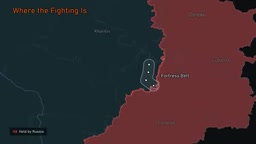
The focus of the Russia-Ukraine battlefield remains in the Donbas, where the Fortress Belt makes Russian advances slow and costly.
Based on a military analysis program, this article outlines the front-line landscape after the Russia-Ukraine war entered the attritional phase. Fighting is concentrated mainly in eastern and southeastern Ukraine, with the Donbas the most intensely contested area. The core concept "Fortress Belt" refers to Ukraine's defense-in-depth system built over years from multiple cities and supporting chains, where Russian forces grind forward point by point and suffer heavy daily losses. Donetsk urban clusters still held by Ukraine, such as Slavyansk and Kramatorsk, are seen as key nodes for the next phase. Meanwhile, in Zaporozhye and Lyman, Ukrainian forces contest the initiative through "creeping" offensives and local operations. The article attributes Russia's stalled advance to defense in depth, asymmetric costs, and Ukraine's local counterattack capability, while noting the judgment comes from a single interview source.
As the Russia-Ukraine war enters its attritional phase, the offensive and defensive dynamics in the Donbas have become a key window for observing the trajectory of the entire conflict. In a military analysis program on YouTube, two long-time battlefield observers, Mike and Preston, discussed the "Fortress Belt," explaining why Russia advances slowly and at high cost in this direction. This article is based on that interview and outlines the current front-line landscape and the logic of the contest between the two sides.
The Full Front Line: The Main Battlefield Remains in the East and Southeast
According to Preston's description in the program, fighting is still concentrated mainly in eastern and southeastern Ukraine. The capital, Kyiv, is located in the center of the country and does not directly face Russian infantry and short-range drone attacks, but it still endures long-range drone and missile strikes every day.
Looking from north to south, there are Russian infiltrators in the Sumy direction, and fighting is also taking place within Kharkiv. Further south lies the Donbas region, composed of Luhansk and Donetsk, which is the most intensely contested area in the entire war. Continuing south is Zaporozhye, and then Kherson on the Black Sea.
This distribution across depth shows that Russia's strike methods have clear layered characteristics: close-range ground combat is concentrated in the east, while long-range strikes cover a broader area including Kyiv, with the western region being attacked relatively less frequently.
The Fortress Belt: A Defense in Depth Reinforced Again and Again
The core concept in the program is the "Fortress Belt." Preston described it as an area that Ukraine has carefully developed and that is extremely brutal for Russia to advance through, with Russian forces paying a heavy price in personnel there every day.
According to Mike's supplement, several types of combat zones of different natures can be distinguished along the current front line: one is low-intensity cross-border operations in which Russian forces try to establish small buffer zones in border areas; another is sustained exchanges of fire around Kupyansk and the Kharkiv region; and the focus of Russia's offensive efforts remains an attempt to seize the remaining part of the Donbas.

This judgment means that Russia has not abandoned its established territorial goals, but its method of advance has shifted from rapid maneuver to point-by-point grinding, with a severely unbalanced relationship between speed and cost.
The term "Fortress Belt" is not a strict military term, but a generalized description of the defense-in-depth system Ukraine has built in the Donbas since 2014. Its core feature is the conversion of cities, towns, villages, and industrial facilities into mutually supporting defensive nodes, connected by trenches, anti-tank ditches, minefields, and pre-registered fire strike zones. Unlike a single fortress, this system emphasizes multi-layered blocking and elastic withdrawal; even if the attacker breaks through the first line of defense, it will be exposed to crossfire from subsequent nodes. Urban buildings themselves provide sturdy cover, enabling defenders to tie down large attacking forces with relatively few troops, which is also an important structural reason why Russian forces advance slowly and suffer concentrated casualties in this direction.
The Donetsk Urban Cluster: The Key Node of the Next Phase
In the interview, Mike specifically listed the major cities in the Donetsk region still controlled by Ukraine: Slavyansk, Kramatorsk, Druzhkivka, and Konstantinovka. Because the latter's name is too long, it is colloquially called "Konstakha" by front-line soldiers.
West of these urban clusters is Dobropylia, which has now become an important anchor of Ukraine's defense system, with a series of cities behind it forming a second line of support.
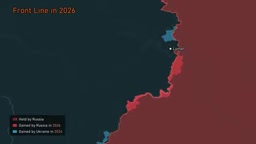
These urban clusters are adjacent to one another and rely on each other, forming the core framework of the Fortress Belt. For Russian forces, capturing any one of them could trigger a chain reaction of defensive reorganization, which is also a structural reason why advancing in this direction is especially difficult.
Zaporozhye and Lyman: Ukrainian Forces Still Contesting the Initiative
Unlike the passive defense in the Donbas direction, Zaporozhye was described by the two observers as a "fairly dynamic" area. Here, Russian forces are trying to advance west of Zaporozhye, while Ukrainian forces have long held the initiative in the northeastern direction.
According to Preston, a tactical grouping composed of Ukrainian air assault brigades continues "creeping" offensives in this direction and has made considerable progress. In addition, the area around Lyman is where the Ukrainian Third Army Corps is carrying out the "Vivaldi" offensive operation, which has also achieved success.
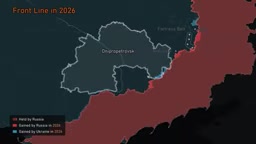
The two observers stressed that the significance of these two areas lies in the fact that Ukrainian forces are not merely defending passively, but are actively contesting the initiative and have largely erased the gains Russia had previously made.
The "creeping" offensive mentioned in the text refers to continuously pressing forward in small-unit formations, along multiple axes, and with low depth, rather than concentrating armored forces for large-scale breakthroughs. This tactic relies on coordination between drone reconnaissance and artillery fire adjustment, with the aim of gradually eroding the opponent's positions and forcing them to continually redeploy reserves while avoiding high casualties. Its advantages are dispersed risk and easy consolidation of gains; its disadvantages are slow progress and high demands on logistics and communications coordination. Operation code names such as "Vivaldi" mentioned in the text are internal names given by Ukrainian forces to their local offensive operations and usually do not correspond to publicly disclosed operational-level objectives; outsiders mostly use them to refer to continuous combat operations in a certain direction.
Analysis: Why the Fortress Belt Is Difficult to Break Through
Based on the interview content, the reasons Russia is stalled in the Donbas can be understood at three levels.
First is the combined effect of fortifications and urban clusters. The Fortress Belt is not a single-point fortress, but a system in depth composed of multiple cities and the chains behind them, making it difficult for an attacker to shake the whole through a single breakthrough.
Second is the asymmetry of the cost structure. Preston repeatedly emphasized that Russian forces suffer heavy personnel losses "day after day," and this attrition is difficult to sustain without a decisive breakthrough.
Third is the Ukrainian military's ability to counterattack in local directions. The examples of Zaporozhye and Lyman show that Ukrainian forces still retain the resources and command capability to organize offensive operations and can reverse the situation in specific directions.
It should be noted that the above judgments all come from a single interview source and represent the analytical perspective of battlefield observers; specific changes in the front line still need to be cross-verified with multiple sources.
A war of attrition refers to a situation in which both sides do not seek to decide victory through maneuver and breakthrough, but instead try to gain advantage by continuously killing the opponent's personnel and destroying equipment and weakening its war potential. In this mode, the indicator of progress is no longer how much territory is captured, but the exchange ratio—that is, the ratio of one's own losses to the opponent's losses. When the attacker continues to suffer high casualties without a decisive breakthrough, pressure on personnel replenishment, equipment repair, and ammunition supply keeps accumulating, and the pace of operations slows accordingly. This is also why analysts emphasize the "asymmetry of the cost structure": the defender, relying on fortifications and urban cover, can often exchange smaller losses for larger losses on the attacker's side.
One-line Summary
Russian battlefield focus remains in the Donbas, where the Fortress Belt makes Russian advances slow and costly.
Paragraph Summary
Based on a military analysis program, this article outlines the front-line landscape after the Russia-Ukraine war entered the attritional phase. Fighting is currently concentrated mainly in eastern and southeastern Ukraine, with the Donbas being the most intensely contested area. The program's core concept, the "Fortress Belt," refers to a defense-in-depth system Ukraine has developed over years, composed of multiple cities and supporting chains behind them, where Russian forces grind forward point by point and suffer heavy personnel losses every day. The urban clusters still held by Ukraine in Donetsk, such as Slavyansk and Kramatorsk, are regarded as key nodes for the next phase. At the same time, in the Zaporozhye and Lyman directions, Ukrainian forces are contesting the initiative through "creeping" offensives and local operations. The article attributes Russia's stalled advance to three factors: defense in depth, asymmetric costs, and Ukraine's local counterattack capability, while noting that this judgment comes from a single interview source.
Related articles

How the Grok Team Hits 11,000 PRs a Month: Replacing Manual Review with Deterministic Constraints
Inside the Grok team's formula for 11,000 monthly PRs at a 0.5% rollback rate: Lint rules, type systems, and formal verification as deterministic constraints.

Is Spacetime Made of Something? Six Possible Answers from Quantum Gravity
Is spacetime made of something? This article surveys the main candidate answers from quantum gravity: spacetime may be fundamental, geometry quantized, causal relations prior to distance, spacetime an emergent state of matter, geometry derived from string theory, or no spacetime atoms needed at all.

After GTA 6, Where Does the Game Industry Go?
The Vergecast talks with Game File's Stephen Totilo about GTA 6's impact on gaming: billion-dollar budgets, console market struggles, cloud gaming tests, and the future of microtransactions—and whether it marks the end of an era.