Ukulele Play-Along Guide: Strumming and Singing "How Far I'll Go"

A segment-by-segment guide to ukulele play-along strumming and singing using "How Far I'll Go" as an example.
The article analyzes a Bilibili ukulele play-along video for "How Far I'll Go," explaining why the song suits beginners: relaxed melody, simple chords, and short lyric phrases with ample breathing room. It breaks down four core lyric lines—covering low-register control, breathing points, and rhythm training for parallel structures—and recommends looping in sections, rhythm before vocals, and referencing the original recording.
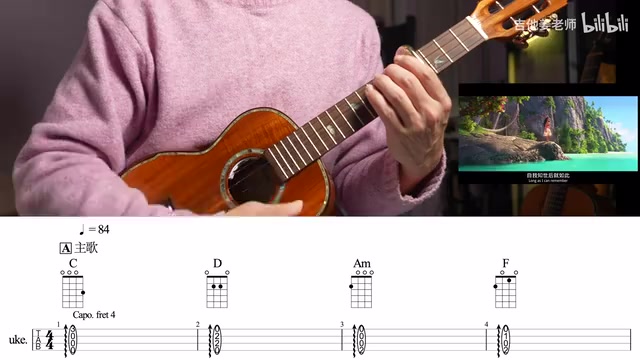
"How Far I'll Go" is the theme song from the Disney animated film Moana. Its melody is expansive and its chord progression is simple, making it an excellent choice for ukulele beginners practicing strumming and singing. This play-along video on Bilibili uses segments of the song as material, with synchronized lyric subtitles so learners can follow along on screen—playing phrase by phrase and singing line by line.
Why This Song Works Well for Ukulele Play-Along
The ukulele has only four strings and requires little finger pressure, so the easiest songs for beginners tend to be pop tunes with a relaxed tempo and highly repetitive chords. In the verse of "How Far I'll Go," the emotion is restrained and the lyrics consist mainly of short phrases, with ample breathing room between lines—so when strumming and singing, you're less likely to end up in that chaotic state of "hands can't keep up, voice can't follow."
From a play-along perspective, the video divides the lyrics by musical phrase and displays them in sync on screen. Learners don't need to figure out where the lyrics fall against the chords—just sing whatever line is showing. This "lyrics as score" approach lowers the barrier of reading notation.
Breaking Down the Play-Along Segments
Line 1: The Emotional Starting Point
The screen starts with "I could be the perfect daughter." This line sits in a lower register, so it's best supported with light strumming or arpeggios. Focus on clear diction and steady rhythm rather than volume. A common beginner mistake is to strum hard right from the start—the result is that the vocals get drowned out and the rhythm tends to rush.
Line 2: Returning to the Water Imagery

"But I come back to the water" is the emotional turning point of this lyric section. When practicing, treat this line as a breathing point: pull back slightly on the first half, then open up on the second half. If you're using arpeggios with your right hand, make sure each string rings clearly and independently—don't let the notes blur together.
Arpeggio refers to playing the individual notes of a chord in sequence rather than strumming them all at once. Common arpeggio patterns on ukulele include "4-3-2-1" or alternating "root-3rd string-2nd string-1st string," which make the accompaniment line clearer and better suited to lyrical passages. When practicing, keep each finger's role fixed (usually the thumb handles the 4th and 3rd strings, while the index and middle fingers handle the 2nd and 1st strings), maintain a consistent finger angle, and let each note ring naturally without masking the others. At the beginner stage, start at an extremely slow tempo to ensure every string sounds independently, then gradually speed up to avoid blurring.
Lines 3 and 4: Rhythm Training with Parallel Structures
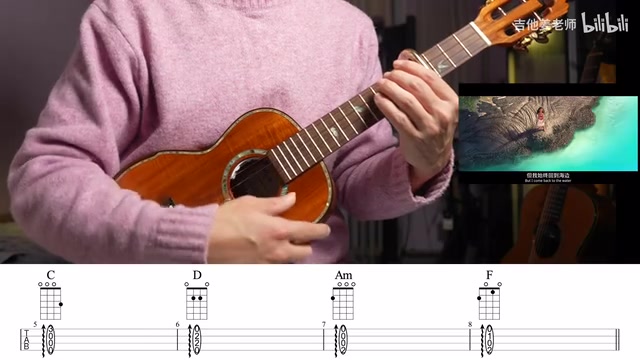
"Every turn I take, every trail I track" and "Every path I make, every road lead" form a clear parallel structure—repeated sentence patterns with regular rhythm. This type of phrasing is especially friendly for strumming practice: each short line corresponds to a fixed strumming pattern, and a few repetitions build muscle memory.
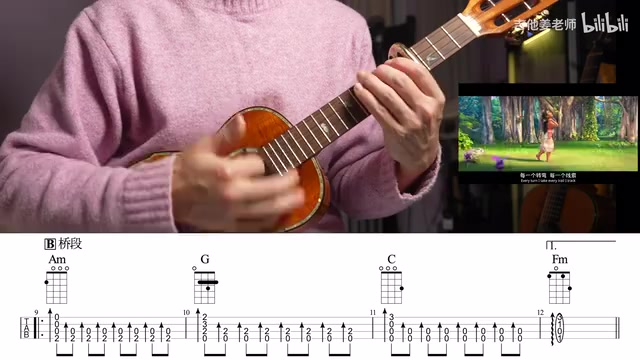
When practicing, you can start by not singing at all—just play the right-hand rhythm and make each strum's timing even. Once your hands are steady, layer the vocals back in. The transitions between the two lines are prone to rushing, so it's best to slow down and loop these two lines on their own.
Strumming pattern refers to the combination of up and down strums within a fixed beat, commonly something like "down-down-up-down-up-down-up" corresponding to a mix of quarter and eighth notes. The key to ukulele strumming is a relaxed wrist—let wrist rotation drive the fingers rather than using the whole arm. When practicing, start by strumming open strings only to make the pattern's timing even, then apply it to the chord progression. For parallel phrases, keeping the same strumming pattern repeated helps build stable muscle memory. Practice with a metronome starting from a slow tempo, making sure every strum lands on the beat to avoid rushing or dragging.
Practice Method Recommendations
Loop in sections rather than running through the whole song. The video divides subtitles by musical phrase, which naturally suits working on one small section at a time. Practice each section until you can play and sing it with your eyes closed, then move on to the next.
Rhythm first, vocals second. The core challenge of ukulele strumming and singing is coordinating the right-hand rhythm with the vocal performance. Until the right hand becomes automatic, singing will constantly interfere with the rhythm.
Use the original recording as a reference. The play-along video is a learning tool—ultimately you should return to the original song to hear the phrasing and breathing positions, and place the sections you learned back into the full song context.
A metronome is a fundamental tool for practicing rhythmic stability, especially for those whose strumming-and-singing coordination isn't yet automatic. When using one, first set the tempo to 60%–70% of the target speed, making sure every beat of your right-hand strumming or arpeggios lands precisely on the metronome click, then gradually increase. If a particular section frequently goes wrong after speeding up, it means the current tempo hasn't been consolidated—go back to the previous level and keep looping. A metronome also helps reveal rushing, which occurs most often at the transitions between parallel phrases and becomes more obvious at slow tempos.
Who It's For and Its Limitations
This video is positioned as a play-along for song segments, focusing on a few core lyric lines. It's suitable for complete beginners or those just starting out with strumming and singing to build confidence, and works well as a daily warm-up exercise. However, it doesn't cover the complete song form, intro and interlude handling, or chord arrangement ideas—to play the full song, you'll need to combine it with other sheet music and teaching resources.
Treat the play-along video as an entry point rather than a destination. Practice slowly with a metronome, then gradually increase speed—that's the most sensible way to use this kind of short-form video tutorial.
One-line Summary
Using segments from "How Far I'll Go" as an example, this article explains how to break down and practice ukulele play-along strumming and singing.
Paragraph Summary
The article discusses a Bilibili ukulele play-along video for "How Far I'll Go" and analyzes why the song suits beginner strumming and singing: relaxed melody, simple chords, short lyric phrases, and ample breathing room. The video presents lyrics line by line with synchronized subtitles, lowering the barrier of reading notation. The article breaks down the practice points for four core lyric lines, including low-register control, breathing point handling, and rhythm training for parallel structures, and recommends looping in sections, rhythm before vocals, and using the original recording for reference. It concludes that the video only covers song segments and is suitable for beginners building confidence, but full-song performance still requires other sheet music and teaching resources.
Related articles

English Version of 'Thank You for Your Love' Gains Traction on Bilibili: A Cross-Cultural Rendition of a Classic Love Song
The English version of 'Thank You for Your Love,' titled 'I'll give you all my love,' trends on Bilibili with rewritten lyrics about giving all your love. This article analyzes its emotional expression, cross-cultural adaptation strategy, and differences from the Chinese original.

Claude Code vs Cursor vs GitHub Copilot: How to Choose Among the Three Major AI Coding Tools
A clear explanation of Claude Code, Cursor, and GitHub Copilot through the lens of 'degree of delegation': Copilot embeds in your editor for autocomplete, Cursor is an AI-first full editor with multi-file batch editing, and Claude Code executes tasks end-to-end in the terminal. Includes selection advice.

Behind the Viral Dynamic Comic Commentary: Deconstructing the Narrative of Family Finance and Emotional Conflict
Deconstructing a Bilibili dynamic comic episode on family financial conflict: how dense dialogue and emotional hooks retain viewers, and where AI script generation falls short in narrative coherence.