Ultrafast Experience: The AI Tool You Can Never Go Back From

Speed is replacing capability as AI tools' invisible moat, and users' 'can't go back' experience is irreversible.
A four-word tweet, "Ultrafast is so fast I do not ever want to go back," reflects the migration of competitive focus in AI products. The article points out that when response speed approaches instant, users' flow isn't interrupted, and waiting disappears from the interaction. This "can't go back" phrasing is not a recommendation but an exclusionary statement, meaning users' adaptation to interaction rhythm is irreversible and migration costs far exceed expectations. There's a trade-off between speed and capability: opponents argue fast responses sacrifice reasoning depth, while supporters argue most everyday tasks don't require the deepest reasoning. If speed becomes a core dimension, AI tools may diverge into lightweight instant and heavyweight cloud paths, with users switching by scenario. Speed is shifting from a bonus point to an entry ticket.
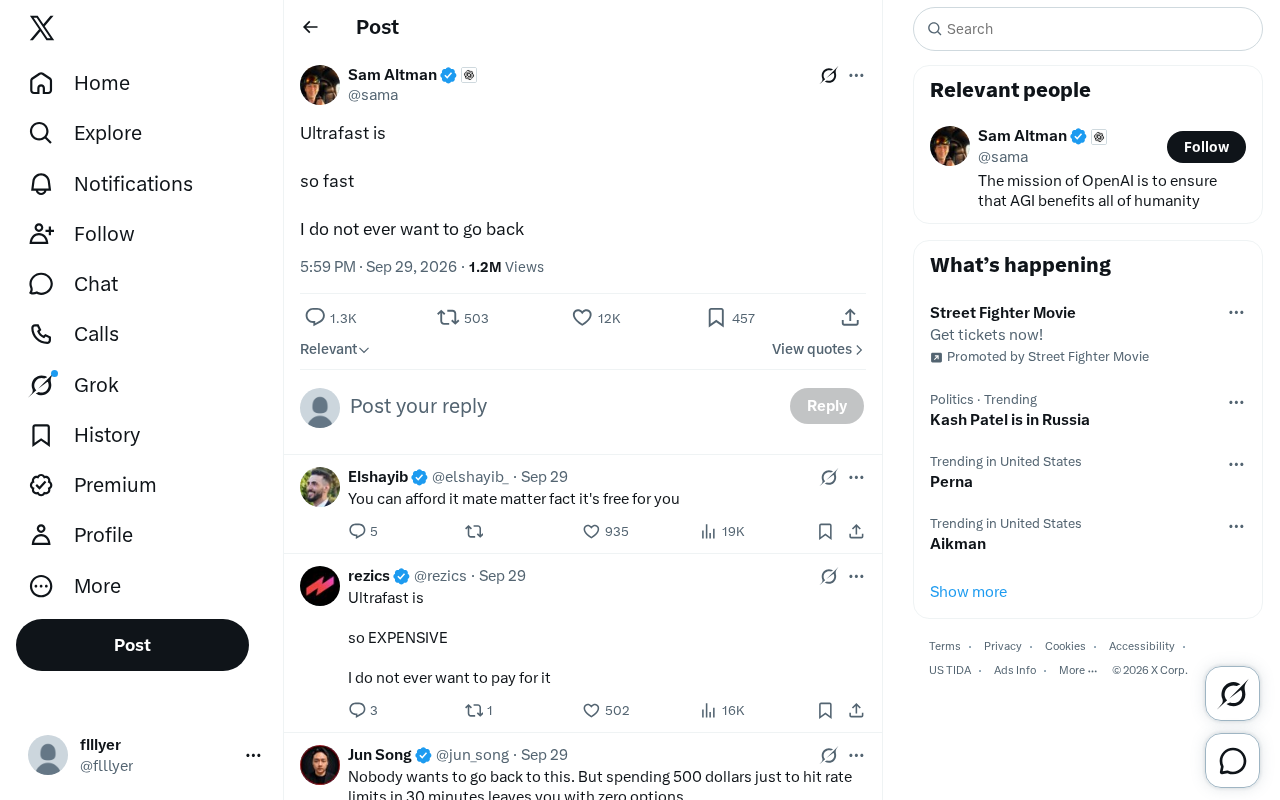
"Ultrafast is so fast I do not ever want to go back." This short tweet struck a chord across social platforms. No technical specs, no performance benchmarks—just a near-instinctive exclamation: once you've used it, you can never go back. This way of expressing things reveals an underrated dimension in today's AI tool competition: speed itself is becoming a product moat.
Why Speed Has Become an Invisible Moat for AI Tools
Over the past two years, competition in AI products has centered on model capabilities—stronger reasoning, longer context, more comprehensive multimodality. But what users actually feel in practice is often a different story. A lightweight model that returns results in 200 milliseconds may be more "addictive" in terms of interaction experience than a powerful model that requires a 5-second wait.
The logic behind this isn't complicated. When response speed approaches instant feedback, the user's train of thought isn't interrupted. Writing, debugging code, looking up information—these tasks require a continuous flow state, and any wait exceeding 2 seconds causes cognitive disruption. Tools like Ultrafast seize on exactly this pain point: it may not be the most capable, but it makes the act of "waiting" disappear from the interaction.
The concept of "Flow" mentioned in the text was proposed by psychologist Mihaly Csikszentmihalyi, referring to a state where a person is fully immersed in an activity, highly focused, and unaware of time passing. Creative tasks like programming and writing especially depend on the continuity of flow. Research shows that after a cognitive interruption, it takes an average of about 23 minutes to return to the original depth of focus. In the context of AI-assisted tools, the time cost of waiting for a response isn't just the seconds wasted—it's the hidden cost of re-entering a thinking state. This is precisely why the experiential gap between millisecond-level and second-level responses is far greater than the numbers themselves suggest—it affects not efficiency, but the ability to sustain continuous thought.
"Can't Go Back" Is a Genuine Product Review
The phrase "I do not ever want to go back" in the tweet deserves a closer look. It's not "it's useful," nor "I recommend it," but rather an exclusionary statement—the user can no longer accept the old way of doing things.
In the AI programming space, this experience is especially common. According to feedback from multiple developers on social platforms, once you get used to millisecond-level code completion and instant reasoning, switching back to tools that require waiting several seconds produces noticeable frustration. It's similar to the feeling of switching from a mechanical hard drive to an SSD: it's not that the SSD is "better," but that the HDD becomes "unbearable."
What does this irreversibility mean for products? It means that once a speed advantage is established, user migration costs will far exceed expectations. Features can be caught up, but users' adaptation to interaction rhythm is irreversible.
Multi-Source Perspectives: The Trade-off Between Speed and Capability
The discussion around tools like Ultrafast isn't one-sided. According to feedback from multiple users on X and Reddit, fast responses sometimes come at the cost of reasoning depth—output quality on complex tasks may not match slower large models.
But another camp argues that most everyday tasks don't require the deepest reasoning. Writing an email, generating boilerplate code, translating a sentence—in these scenarios, the efficiency gains from speed far outweigh the slight quality gap. The disagreement between the two sides essentially answers the same question: How much waiting time are you willing to pay for how much extra quality?
The answer to this question is shifting from "quality first" to "speed first." At least for lightweight tasks, most users' scales have already tipped toward the latter.
"Model distillation" and "quantization" are two key technologies currently enabling fast inference. Model distillation refers to training a small "student model" using the outputs of a large "teacher model," allowing the former to approximate the latter's performance with fewer parameters, at the cost of some degradation in complex reasoning. Quantization compresses model weights from 32-bit floating point to 8-bit or even 4-bit integers, significantly reducing memory usage and computation time, though precision loss becomes noticeable under extreme compression. Together, these two technologies determine the upper speed limit and lower capability bound of lightweight models. Understanding them helps clarify: speed advantages are not purely engineering optimizations, but rather trade-offs made on capability ceilings in specific ways. Therefore, the "speed vs. capability" trade-off is not a temporary phenomenon, but a structural choice at the architectural level.
The Impact of the Speed Race on the AI Product Landscape
If speed truly becomes a core competitive dimension, it will affect not just user experience, but also product architecture and business models.
Improving inference speed depends on several layers: model distillation and lightweight quantization, specialized inference hardware, edge deployment, and caching strategies. These technological directions suggest that AI tools may diverge from "large, comprehensive cloud models" into two paths: "lightweight, local, instant" and "heavyweight, cloud-based, on-demand." Users would switch between them depending on the scenario rather than relying on a single tool.
The reason this Ultrafast tweet resonated may be precisely because it foreshadows this divergence: future AI tools don't necessarily need to be the smartest, but they must be fast enough—fast enough that users forget they're waiting for an AI.
"Edge deployment" refers to moving model inference from remote cloud servers to users' local devices (such as laptops, phones, or dedicated chips). Its advantage is eliminating network round-trip latency, compressing response times from hundreds of milliseconds to within tens of milliseconds, while also improving data privacy. But edge devices have limited compute power and memory, typically only able to run lightweight models that have been distilled and quantized. The opposite of edge deployment is on-demand cloud invocation of large models, which are more capable but have higher latency and cost. The divergence of these two paths means AI products need to redesign their interaction paradigms: lightweight tools pursue "frictionless invocation," while heavyweight tools need to manage user expectations during waits through streaming output, progress indicators, and other means.
Conclusion
A four-word tweet reflects the migration of competitive focus in AI products. Capability still matters, but speed is shifting from a "bonus point" to an "entry ticket." For developers and product teams, the question worth pondering isn't "Is my model strong enough?" but "Can users get results in the gaps between their thoughts?"
Original tweet: "Ultrafast is so fast I do not ever want to go back."
Related articles

WorkBuddy Full Guide: How an AI Coworker Takes Over Workplace Automation
What is WorkBuddy? This article analyzes the core capabilities of this full-scenario AI agent: autonomous execution with deliverable results, local file processing, multi-agent parallelism, and workplace automation workflows, helping you judge its essential difference from ordinary AI chat tools.

The Truth About AI Agents: A Hundred Lines of Code + an LLM, Deconstructing the Agent's Underlying Logic
AI agents aren't a new AI species—just a language model plus tools, a loop, and a goal. Here's the underlying logic: how 100 lines of Python hit a 75% fix rate, why the harness beats the model, and Gartner's "agent washing."

AI Agent Deployment: Three Things Developers Should Do
AI Agent deployment doesn't require rushing into multi-agent systems. This article outlines an actionable deployment path and engineering acceptance thresholds for developers, covering human baselines, bounded single-agent scope, and a controlled code-modification loop.