Umami Manager 3.0: Website Analytics in Your Pocket on iPhone and iPad
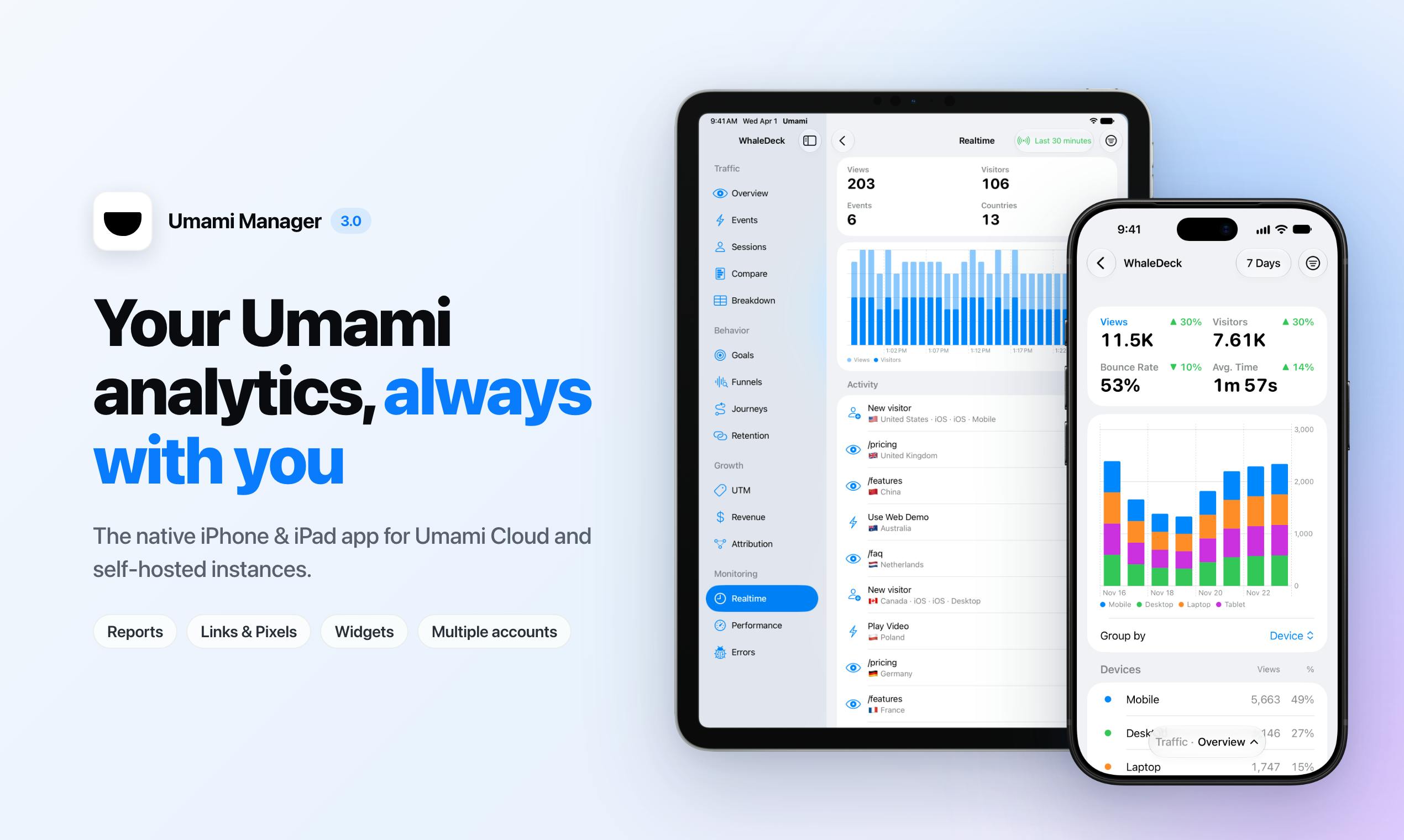
Umami Manager 3.0 brings self-hosted Umami analytics reports and widgets to a native iPhone/iPad app.
Umami Manager 3.0 is a native iOS app launched on Product Hunt that provides a mobile management entry point for the open-source analytics platform Umami. It supports both cloud and self-hosted deployments, letting privacy-conscious users view reports on their phone without exporting data. Version 3.0 deepens reporting with events, sessions, comparisons, segments, attribution, Web Vitals, errors, and real-time dimensions, and separates links and pixels into their own tab. Widgets support any website, link, pixel, and metric; multi-window works on iPad and iPhone Duo, and cross-account management covers websites, teams, and users. It suits operators already using Umami who need mobile access. A 7-day free trial is offered but subscription pricing isn't disclosed; given limited Product Hunt traction, users wanting stability or full admin features may want to wait.
Umami Manager 3.0: Website Analytics in Your Pocket on iPhone and iPad
For users of self-hosted analytics tools, there's an awkward reality: you have the data, but viewing it all happens through a browser. The open-source analytics platform Umami is known for being privacy-friendly and self-hostable, yet its admin interface has never felt particularly smooth on mobile. Umami Manager, launched on Product Hunt, aims to fill that gap—bringing Umami's reports, links, and widgets into iPhone and iPad through a native iOS app.
Privacy-first analytics needs a native entry point
Umami has always positioned itself as a lightweight alternative to Google Analytics: cookie-free, self-hostable, and with little privacy-compliance burden. The user profile for this kind of tool is clear—indie developers, small teams, and site owners who care about data sovereignty. They're willing to tinker with servers but often don't have the energy to build a separate mobile experience just for viewing data.
Umami Manager's product logic is built on this gap. It supports both cloud and self-hosted Umami deployments, meaning self-hosted users can get a complete mobile view without exporting data to a third party. For users who chose Umami specifically for privacy, this matters more than the number of features: an analytics tool shouldn't itself become a new data-leak entry point.
What version 3.0 adds
According to the Product Hunt page, the core change in 3.0 is a deeper reporting system. New report types cover events, sessions, comparisons, segments, attribution, Web Vitals, errors, and real-time data—dimensions that roughly map to how site owners troubleshoot day to day: where traffic comes from, what users do on the page, whether performance is dragging things down, and whether errors are occurring.
Links and pixels have been split into their own tab, suggesting the product treats tracking and analytics as two distinct workflows. Widgets support any website, link, pixel, and metric—arguably the most valuable part on mobile: putting key numbers on your home screen fits mobile usage habits better than opening the app and digging through reports each time.
Multi-window support covers iPad and iPhone Duo, and combined with cross-account management of websites, teams, and users, it targets multi-site operators—people maintaining several projects who don't want to switch accounts repeatedly.
Native experience and multi-account management
"Native" is a selling point the product emphasizes repeatedly. For analytics tools, native means widgets, multi-window, and system-level interactions that web apps struggle to implement reliably. Given that Umami itself is a web-first product, the existence of a third-party native client effectively fills in use cases the official offering doesn't cover.
Cross-account management of websites, teams, and users pushes the app from a personal dashboard toward a lightweight admin console. Team managers can view and adjust members and permissions on their phone without returning to a computer.
Who should use it, and who can wait
The target user is quite clear: site operators already using Umami who need mobile access. A 7-day free trial lowers the barrier to trying it, but the materials don't disclose subscription pricing, so long-term cost needs to be confirmed on the official website.
It's worth noting that on Product Hunt the product received 67 upvotes and 1 comment, ranking 15th—limited discussion. There are also no publicly available screenshots to reference interface details. If you depend on the stability of an official client, or your team is large and needs more complete management features, you may want to wait and see. If you simply want core metrics on your home screen at all times, it's worth a try.
For the self-hosted analytics ecosystem, the emergence of a third-party native client is itself a positive signal—it shows Umami's user base is large enough to support surrounding tools.
Product Hunt is a tech product launch platform that uses user voting; vote counts reflect community attention on launch day, not a quality score. Ranking 15th means it sits in the upper-middle range among products launched that day, but 67 upvotes and 1 comment indicate low discussion volume—too small a sample to form a reputation judgment. For indie developers or small products, early vote counts are heavily influenced by launch timing, community engagement, and other factors, so they shouldn't be used directly as a basis for choosing a tool.
Related articles

Why Learn Python in the AI Era? A Deep Dive with the Author of 'Python Crash Course'
Eric Matthes, author of 'Python Crash Course', discusses why Python remains essential in the AI era, the democratization and risks of AI coding tools, and the value of human creators.

Convex Skill Allegedly Uploads User App Ideas to Remote Servers Without Consent
Convex backend skill allegedly sends user app ideas to remote servers without disclosure, sparking Hacker News debate. We analyze the privacy risks and transparency issues.

The Coding Data Market Booms: How Frontier Labs Buy Training Data
The coding data market is rapidly expanding, with frontier labs as major buyers. This article analyzes the types of data traded, labs' procurement logic, and concerns such as licensing compliance and data contamination.