UN "Killer Robot" Talks Stall Again: Why Autonomous Weapons Regulation Is Hard to Break Through

UN autonomous weapons talks yielded only agreement to "begin discussing options" after a week, with no substantive framework.
A week of UN consultations in Geneva on autonomous weapons rules ended with only a procedural consensus to "begin discussing options," without a substantive framework. Countries disagree on definitions and on whether to ban first or discuss first, with conflicting security demands as the core obstacle. The procedural consensus preserves a channel for follow-up but exposes multilateral limits in governing new technologies.
Talks End Without Results, Only Agreeing to "Begin Discussing Options"
At the United Nations meeting held in Geneva this week, diplomats from various countries held consultations on the rules governing the use of autonomous weapons systems—commonly known as "killer robots." However, the week-long negotiations produced little. According to NPR, representatives ultimately reached only a procedural consensus: agreeing to "begin discussing various options." This outcome means the international community has still not formed a substantive framework on whether and how to constrain lethal autonomous weapons.
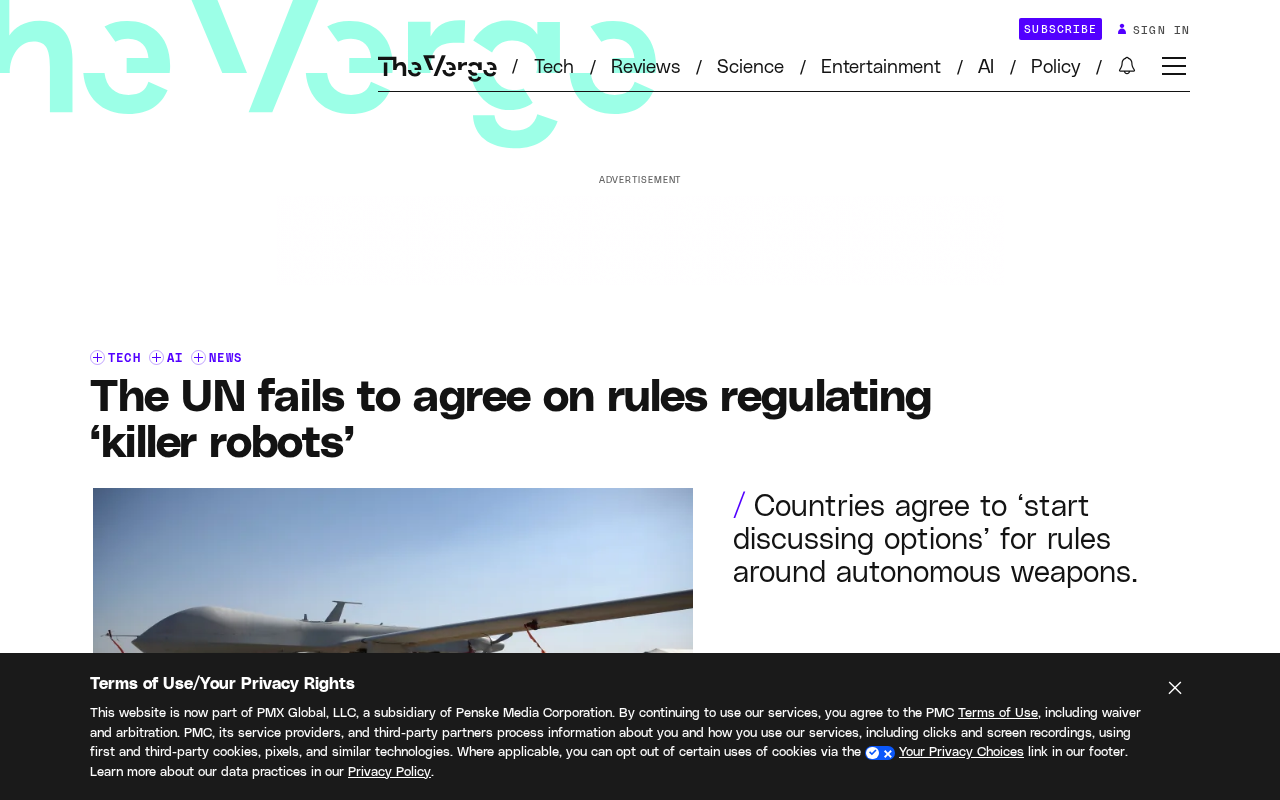
The starting point of the negotiations was not low. Before the meeting, many parties had warned about the potential risks of autonomous weapons, but divisions quickly emerged at the negotiating table. The weakness of the final text's wording precisely reflects the gaps in positions on core issues.
Technology Runs Ahead of Rules
"Killer robots" are not a science fiction concept. They refer to weapons systems capable of selecting and attacking targets without real-time human intervention. The controversy centers on whether delegating life-and-death judgments to algorithms crosses moral and legal red lines.
NPR's report noted that before the negotiations formally began, the relevant issues had already attracted widespread attention. But a week of discussion failed to translate into consensus, indicating a clear misalignment between the pace of technological development and the rhythm of diplomatic maneuvering. As weapons systems become increasingly autonomous, regulators find it difficult even to align on "what to discuss."
Lethal autonomous weapons systems (LAWS) is the formal term in international arms control discussions, with its core characteristic being differing degrees of "autonomy." Among existing weapons, close-in weapon systems or loitering munitions possess certain automatic modes but are typically still configured by humans with rules of engagement and retain veto power. The more controversial "fully autonomous" systems refer to those capable of autonomously identifying, selecting, and attacking targets in dynamic battlefield environments without real-time confirmation by human operators. Institutions such as the International Committee of the Red Cross argue that such systems may violate the principles of distinction and proportionality—algorithms struggle to reliably distinguish combatants from civilians in complex environments and to make judgments consistent with humanitarian law regarding collateral damage. Currently, there is no treaty specifically targeting LAWS, and whether existing international humanitarian law is sufficient to cover their use is precisely one of the focal points of debate.
Root of Divisions: Definitions, Red Lines, and Security Demands
The difficulty in advancing negotiations is no mystery. Countries have not unified their definitions of "autonomous weapons," and interpretations differ on which systems should be subject to regulation and which constitute acceptable automation.
The deeper contradiction lies in conflicting security demands. Some countries favor establishing binding prohibitions first, while others worry that premature restrictions would weaken their defense capabilities or believe existing international humanitarian law already provides sufficient coverage. This opposition between "ban first or discuss first" positions meant the meeting could only conclude with the vaguest wording.
"Legally binding bans" and "political declarations" are two paths with different efficacy in arms control. The former, such as the Convention on Cluster Munitions, creates international legal obligations for states parties requiring domestic legislative implementation; the latter, such as certain export control arrangements, reflects only political commitments with weaker binding force. Some countries and NGOs advocate a "preemptive prohibition" model—banning the development and use of new weapons systems through treaty before deployment; others believe a Group of Governmental Experts should first be established under the framework of the Convention on Certain Conventional Weapons (CCW) to gradually clarify concepts before discussing rules. This "ban first or discuss first" divergence is essentially an institutional choice between the precautionary principle and gradualism, and directly determines that the Geneva negotiations could only conclude with procedural wording.
Value and Limits of Procedural Consensus
Agreeing to "begin discussing options" is not meaningless. It at least preserves a channel for subsequent negotiations and prevents the issue from being completely shelved. But for those following the arms control process, this formulation also exposes the limitations of multilateral mechanisms: when the consensus threshold is too high, meeting outcomes easily degrade into the lowest common denominator in wording.
From a broader perspective, the dilemma of autonomous weapons regulation is not an isolated case. International rule-making in emerging technology fields generally faces challenges such as ambiguous definitions, dispersed interests, and verification difficulties. This week's negotiations in Geneva are merely the latest footnote to this structural problem.
Next Steps
What is certain now is that the negotiations have not collapsed, but there is still considerable distance to forming rules. Whether subsequent discussions can move from "options" to "framework" depends on whether major military powers are willing to make concessions on definitions and red lines. Until then, the proliferation and deployment of autonomous weapons will not wait for the diplomatic process.
For technology observers, these negotiations provide a sample worth tracking: when the decision-making speed of algorithms far exceeds the pace of human deliberation, how should international governance respond? Geneva's answer, for now, is—continue discussing.
One-line Summary
UN autonomous weapons talks produced only agreement to "begin discussing options" after a week, with no substantive framework reached.
Paragraph Summary
A week of UN consultations in Geneva on rules for autonomous weapons systems ended with only a procedural consensus to "begin discussing options," without a substantive framework. The starting point was not low, but countries hold differing definitions of "autonomous weapons" and are divided over "ban first or discuss first." Conflicting security demands are the core obstacle, with some countries fearing premature restrictions would weaken defense capabilities. The procedural consensus preserves a channel for follow-up but exposes the limits of multilateral mechanisms in governing new technologies. The autonomous weapons regulatory dilemma reflects common challenges in international rule-making for emerging technologies: ambiguous definitions, dispersed interests, and verification difficulties. Whether subsequent talks can move from "options" to "framework" depends on whether major military powers are willing to compromise on definitions and red lines.
Related articles

DevWorkflow 5.0: From Idea to Launch with the AI Five-Step Method
DevWorkflow 5.0 is a Claude Code plugin that uses a five-step process to take AI-assisted development from idea to launch. It asks you before every decision, preventing AI from adding tables and fields on its own, keeping docs and code consistent, and stopping merges before tests are written. Supports multiple platforms and languages, for individual developers and small teams.

How Do Hermes Agent's .md Files Work? A Breakdown of the Core Mechanism
Explaining Hermes Agent's .hermes directory mechanism: user.md stores personal info, memory.md records details worth remembering, soul.md defines the Agent's personality. Learn how these pure Markdown files keep the Agent consistent across sessions.

Upload2Shell: A Deep Dive into File Upload Vulnerabilities
An in-depth analysis of Upload2Shell (CVE-2026-125396): how file upload flaws escalate into remote command execution, covering type validation bypass, storage and execution permissions, and defenses like server-side validation and directory permission configuration.