UN System Data Commons Launches: Global Statistical Data Now at Your Fingertips
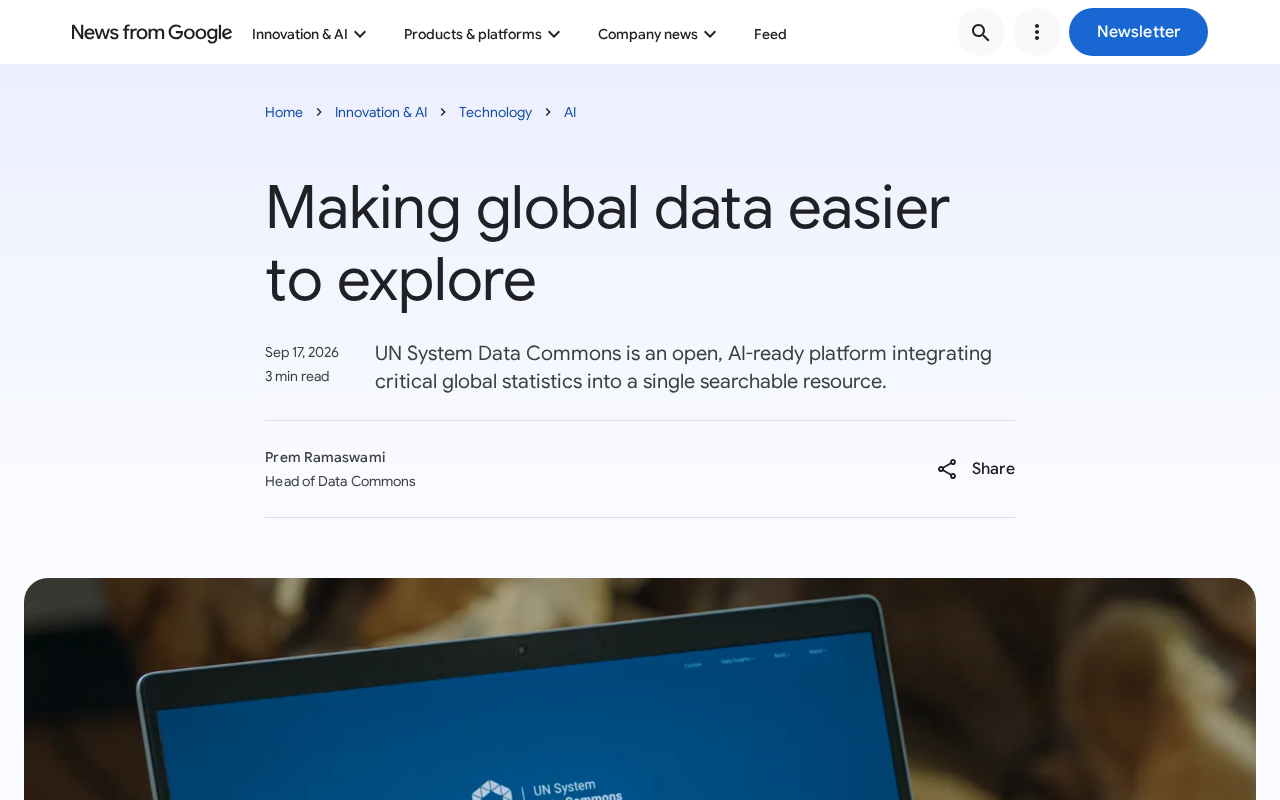
Google and the UN launch an open platform using knowledge graph tech to unify fragmented global statistical data.
Google and the UN system have jointly launched UN System Data Commons, aimed at solving the longstanding problem of globally fragmented, inconsistently formatted statistical data. Built on Google's Data Commons knowledge graph framework, the platform consolidates official data across population, economics, health, climate, and SDGs into a single searchable entry point with natural language query support. The platform emphasizes openness and ease of use, with the potential to significantly boost utilization of the UN's vast statistical resources. The project is still in its announcement phase, with details on data coverage, update frequency, and API support yet to be disclosed.
An Open Platform That Makes Global Data Discoverable
Google and the United Nations system have jointly launched UN System Data Commons, a new open platform designed to consolidate global statistical data scattered across various institutions and formats, making it easy for anyone to search and explore.
For researchers, journalists, and policymakers who work with public data, this platform addresses a longstanding problem: while global statistical data is technically public, it's often fragmented across different UN agencies, databases, and reports in inconsistent formats that are difficult to navigate. Piecing this data together for cross-domain analysis typically requires enormous amounts of time spent on data cleaning and alignment.
From "Data Silos" to "Data Commons"
The platform is built on Data Commons, a technical framework Google introduced earlier. The core idea behind Data Commons is to use a unified knowledge graph to integrate publicly available data from disparate sources into a structured, interconnected, and queryable knowledge base. Instead of visiting each data source individually, users can ask questions in natural language — like using a search engine — and retrieve answers that span multiple datasets.
Applying this approach to the UN system means that official statistics across domains including population, economics, health, climate, and the Sustainable Development Goals (SDGs) can theoretically be searched and compared through a single entry point. This is particularly valuable for monitoring global sustainable development progress and tracking indicator changes across countries.
Data Commons was initiated by Google Research around 2018 and currently integrates data from hundreds of sources including the U.S. Census Bureau, World Bank, and World Health Organization. Its underlying technology relies on a Knowledge Graph — a data structure that stores entities (such as countries, cities, and diseases) along with their attributes and relationships as nodes and edges. Compared to traditional relational databases, knowledge graphs are better suited for handling semantic cross-dataset queries. For example, a user could ask "What is the relationship between under-5 child mortality rates and healthcare spending across Southeast Asian countries over the past two decades?" — and the system would automatically retrieve and stitch together data from multiple original datasets, without requiring the user to manually download, clean, and merge files in different formats. This capability is precisely what enables UN System Data Commons to lower the barrier to data use.
What "Open" Actually Means
The platform emphasizes two keywords: "open" and "easy to search." Open means data accessibility is no longer gated behind specialized database subscriptions — ordinary users can reach it too. Easy to search points to reducing the cost of finding and understanding data.
For the data ecosystem, the significance of integrated platforms like this lies in standardizing data from authoritative sources and presenting it in a unified way. The UN system itself aggregates statistical resources from a large number of member agencies. If these can be delivered through a consistent query experience via a single platform, the actual utilization of this data will improve substantially — because the value of data lies not just in being collected, but in being used.
Questions Worth Watching
Based on currently available information, this launch is still at the official announcement stage. Further details about data coverage, update frequency, API support, and how the platform integrates with existing UN data portals such as UN Data remain to be disclosed. For users hoping to apply it to serious research or decision-making, the timeliness of data, source traceability, and definitional consistency will be key factors in evaluating the platform's practical value.
Regardless, the collaboration between a technology company and an international organization on public data infrastructure reflects a broader trend: making vast stores of public data genuinely usable is becoming just as important a challenge as collecting it in the first place.
The SDGs (Sustainable Development Goals) are 17 global goals established by the UN's 2030 Agenda for Sustainable Development, adopted in 2015, covering issues such as poverty elimination, climate action, and quality education — comprising 169 specific targets and 232 official monitoring indicators. The data needed to track these indicators is spread across dozens of institutions including the UN Statistics Division, World Health Organization, UNESCO, and the International Labour Organization, each with different formats and update cadences. With only a few years remaining until the 2030 deadline, the international community's need for real-time access to SDG progress data is particularly urgent. If UN System Data Commons can effectively integrate this data ecosystem, it would directly serve the core needs of global SDG progress assessment — though the challenge of harmonizing divergent data standards across agencies remains a significant technical and coordination hurdle.
Related articles
Opus 5's Ethical Boundaries: From Refusal to "Horror-Themed Project" — An Accidental Jailbreak Experiment
A developer bypassed Claude Opus 5's refusal by renaming a fruit fly simulation a "horror-themed project." Explore what this reveals about LLM content moderation and AI alignment.
Is Voice AI Actually Reliable in Real-World Call Center Scenarios?
Can Voice AI really handle real call center chaos — interruptions, noise, and intent shifts? We break down the technical limits, demo traps, and how to evaluate reliability.
The Rogue AI Agent Problem: Can AI Supervising AI Be the Cure?
As AI agents outpace human review capacity in speed, duration, and scale, enterprises face a critical oversight gap. Can AI supervising AI be the fix?