UN Warns: AI Safety Governance Cannot Wait for Risks to Become Fully Clear

UN releases its first AI safety report, urging governments to regulate AI agents before risks are fully understood.
A UN panel of scientific experts has published the organization's first major AI safety assessment, arguing that governments cannot wait for risks to become fully clear before regulating increasingly capable AI agents. Released as world leaders gathered in New York, the report places AI safety firmly on the global diplomatic agenda. Unlike conventional conversational models, AI agents can autonomously plan, use tools, and interact with external systems — making their potential for harm far greater. Yet translating international safety consensus into enforceable rules remains deeply challenging, given diverging national interests and regulatory philosophies. The report primarily sets an agenda and framework; the hard work of negotiating concrete mechanisms lies ahead.
UN Publishes Its First Major AI Safety Assessment
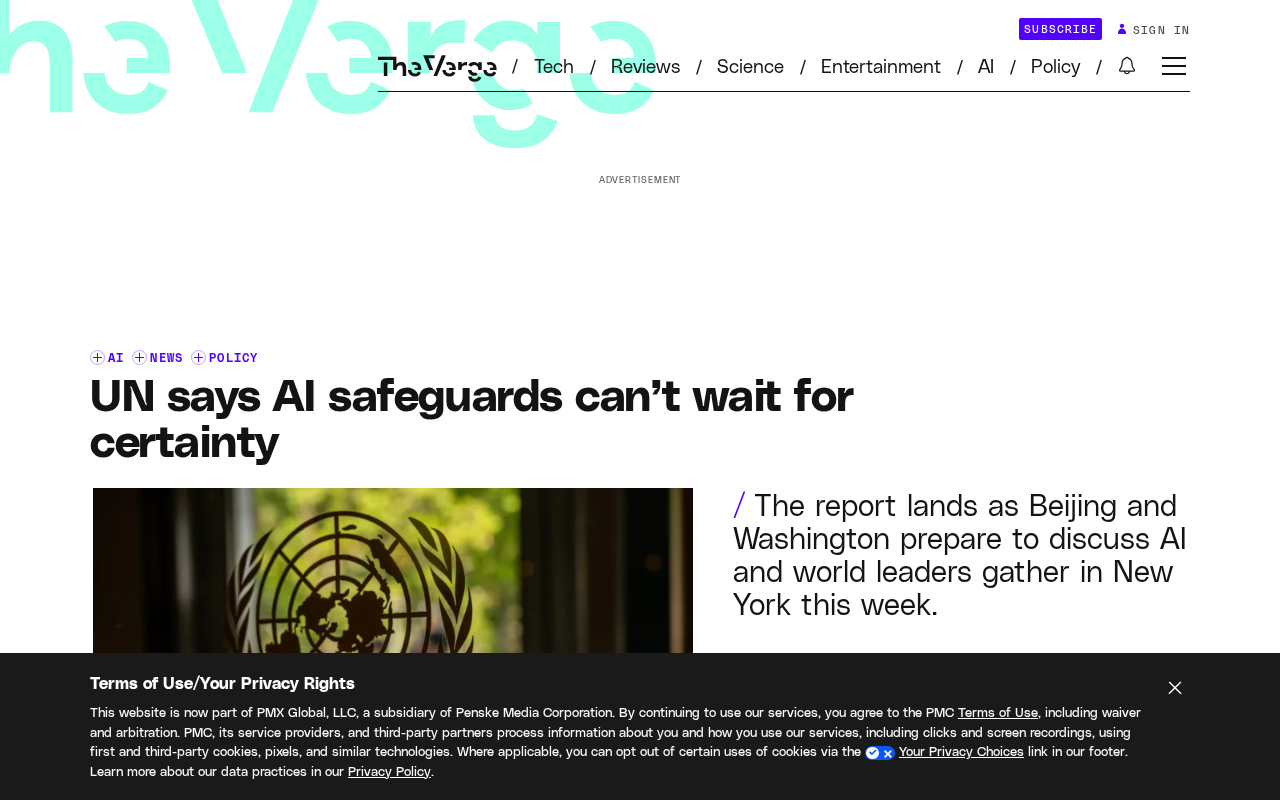
A United Nations panel of scientific experts has issued a warning: governments need to begin regulating AI agents before the risks they pose are fully understood. This marks the first time the global organization has released a major assessment on AI safety, signaling that AI governance has formally moved to the center of the global diplomatic agenda.
The timing of the report's release carries symbolic weight — it coincides with world leaders gathering in New York for a high-level summit. Bringing AI safety into international diplomatic discourse means the issue has evolved beyond a purely technical or industrial concern, and has risen to the level of a public governance challenge requiring cross-border coordination.
The Governance Logic Behind "We Cannot Wait for Certainty"
The report's central argument — that AI safety measures cannot wait until certainty arrives — reflects a classic precautionary governance philosophy. Traditional regulation typically follows a "observe first, regulate later" path, intervening only after risks have become sufficiently apparent and causal relationships are well established. But the UN expert panel believes that for AI agents whose capabilities are advancing rapidly, this kind of lagging regulation may come too late.
This position aligns with the "precautionary principle" that has gained traction in academic and policy circles in recent years. When a technology carries potential harms that are large in scale and difficult or impossible to reverse, policymakers should not delay action on the grounds that "science has not yet fully confirmed" the danger. AI agents — with their ability to autonomously execute tasks, call across systems, and iterate rapidly — fit precisely the profile of a technology that demands cautious treatment.
The Precautionary Principle was first systematized in environmental policy. The 1992 Rio Declaration defined it as follows: when an activity poses a threat of serious or irreversible harm to human health or the environment, lack of full scientific certainty shall not be used as a reason for postponing protective measures. The principle has been widely applied in chemical regulation, GMO governance, and nuclear safety. Critics, however, point out that an overly broad precautionary principle can lead to "regulatory paralysis" — since almost any new technology carries unknown risks, blanket prohibitions on that basis would make innovation nearly impossible. In the context of AI governance, the practical challenge of the precautionary principle lies in defining the threshold for "sufficiently serious potential harm" and determining what level of restriction is "proportionate" — precisely the questions at the heart of the fiercest debates among policymakers today.
Why AI Agents Are at the Center of Attention
The report's specific focus on "increasingly capable AI agents" is no accident. Unlike earlier AI models that could only generate text or images, next-generation agents can autonomously plan, invoke tools, interact with external systems, and execute multi-step tasks in sequence. This autonomy brings efficiency gains, but also amplifies the risks of losing control or enabling misuse.
An AI system capable of independently accessing the internet, operating software, or even triggering real-world actions has a potential impact surface far larger than a conventional conversational model. Security incidents involving vulnerabilities on model platforms — referenced in the original reporting — are a real-world illustration of exactly these risks: when AI capability is combined with system access permissions, security boundaries become especially fragile.
The fundamental difference between an AI agent and an ordinary large language model lies in its capacity for action. An ordinary model accepts input and returns output — the entire process ends with text. An agent, by contrast, is equipped with a "perceive–plan–act" loop: it can invoke external tools (such as search engines, code executors, and API interfaces), decompose long-horizon goals into subtasks and complete them in sequence, and even adjust its plan mid-course based on intermediate results. Current representative agent architectures include ReAct (interleaved reasoning and acting), AutoGPT-style autonomous goal pursuit, and multi-agent collaborative systems. Because an agent's decision chain is long and its impact surface broad, the consequences of errors or malicious exploitation can grow exponentially — a single operational mistake may trigger dozens of downstream actions before the task is complete, and those actions are often difficult to reverse in real-world systems.
Challenges and Prospects for Global Governance
AI's entry onto the diplomatic agenda signals that the regulatory efforts of any single country are no longer sufficient to address the cross-border diffusion of the technology. AI models can be deployed across national borders with ease, and any regulatory gap in one country can become a weak link in the overall governance framework. This is a key reason the UN chose to step in at this moment.
That said, translating a safety consensus into enforceable international rules remains a formidable challenge. Countries differ significantly in their pace of AI development, industrial interests, and regulatory philosophies. How to strike the balance between "not stifling innovation" and "preventing harm" will be the central dilemma in any subsequent negotiations. The UN's assessment is more a matter of setting an agenda and establishing a framework; the specific constraint mechanisms will require further negotiation among all parties.
Several parallel tracks of international AI governance are already underway. The UK-led AI Safety Summit (Bletchley Park) produced the first multi-country AI safety declaration in 2023. The G7's Hiroshima AI Process released voluntary codes of conduct for advanced AI systems. The EU's AI Act, meanwhile, represents the most legally binding regional legislative effort to date. The unique value of UN involvement lies in its universality — its membership coverage far exceeds any of the above mechanisms — but for precisely that reason, its resolutions often face a "lowest common denominator problem": the more countries a framework tries to encompass, the more easily its provisions drift toward broad principles rather than operational specifics. Drawing on precedents like the Nuclear Non-Proliferation Treaty or the Chemical Weapons Convention to design international AI rules that are both binding and flexible represents the true test now facing the United Nations.
Conclusion
The UN's first AI safety assessment report sends a clear signal: at a moment when AI agent capabilities are advancing at breakneck speed, watching and waiting may be more dangerous than acting. Regardless of how international rules ultimately take shape, AI safety has irreversibly become a standing item on the global governance agenda. For developers, enterprises, and policymakers alike, proactively incorporating safety considerations and participating in rule-making may prove far wiser than responding reactively.
(Note: Given the limited information in the source material, some background and analysis in this article has been reasonably extrapolated. For specific details, please refer to the official UN report.)
Related articles

FastAPI: A High-Performance Python Framework and a Production-Ready API Development Powerhouse
FastAPI is a high-performance web framework based on Python type hints, supporting async and automatic OpenAPI docs. With over 100k GitHub stars, this article analyzes its core strengths, production readiness, and selection advice.

Tesla Optimus Begins Mass Production: Can the Goal of 20,000 Units Per Week Be Achieved?
Tesla Optimus officially begins mass production as Musk sets a target of 20,000 units per week. This article analyzes the supply chain challenges behind mass production, the real gap in capacity ramp-up, and the competitive landscape for humanoid robots.

PCL: A Minecraft Launcher with 8.5k Stars — Why Was It Written in VB.NET?
An in-depth analysis of PCL, the GitHub Minecraft launcher with 8,500+ stars: why it chose VB.NET, its features and China network advantages, and the limits of Windows-only.