Uncle Bob's Swarm-Forge: A Minimalist Framework for Orchestrating Multi-AI Agents with Clojure

Uncle Bob's Clojure-based swarm-forge brings Clean Code principles to multi-AI agent orchestration.
Robert C. Martin (Uncle Bob) has open-sourced swarm-forge, a minimalist multi-AI agent coordination framework written in Clojure. Leveraging immutable data structures and functional programming principles, it offers a lightweight alternative to heavyweight Python frameworks like LangGraph and AutoGen. The project's rapid popularity signals growing demand for simple, composable orchestration tools in the multi-agent era.
Uncle Bob's New AI Project: What Is swarm-forge?
Almost no one in the software engineering world is unfamiliar with Robert C. Martin — known as "Uncle Bob." As the author of Clean Code and Clean Architecture, and one of the co-signers of the Agile Manifesto, he has been a standard-bearer for software design and craftsmanship for decades.
Robert C. Martin has been active in the software industry since the 1970s. The SOLID principles he championed (Single Responsibility, Open-Closed, Liskov Substitution, Interface Segregation, Dependency Inversion) have become cornerstones of object-oriented design. The Agile Manifesto he co-authored in 2001 drove the entire software industry's transition from waterfall to iterative development. In recent years, he has gradually shifted from the object-oriented camp toward functional programming, arguing that immutability and referential transparency in the functional paradigm can fundamentally address software complexity in the age of concurrency — a philosophical shift that directly influenced swarm-forge's technology choices.
Now, this veteran engineer has turned his attention to today's hottest domain: orchestrating AI Agents. AI agents are software entities capable of perceiving their environment, formulating plans, and autonomously taking actions to achieve goals. Unlike traditional LLM API calls, agents possess capabilities such as Memory, Tool Use, Planning, and Reflection. Since 2023, as the reasoning capabilities of large models like GPT-4 and Claude have strengthened, agents have moved from academic concepts to engineering practice. Typical architectures include the ReAct (Reasoning + Acting) pattern and the Plan-and-Execute pattern, while multi-agent systems build upon these with role division, message passing, and coordination mechanisms.
His new project swarm-forge quickly went viral on GitHub, amassing over 1,900 Stars and more than 200 Forks in a short time, with 81 new Stars in a single day — clear evidence of its popularity. The project's positioning is remarkably restrained — the official description is just one sentence: "A simple tool for coordinating several AI agents."
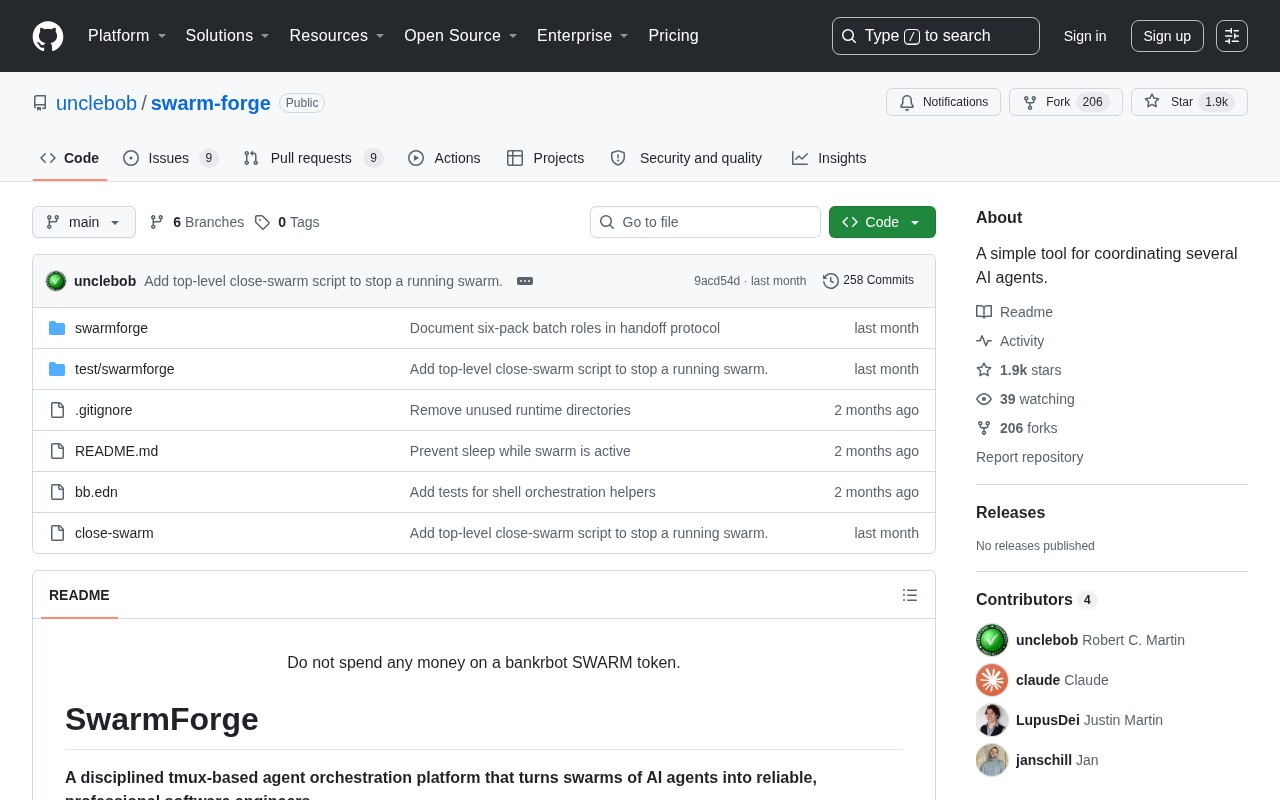
Here's a notable detail: the project is written in Clojure. This choice itself bears Uncle Bob's unmistakable signature — in recent years, he has publicly praised the Lisp family and functional programming on multiple occasions, arguing that immutable data and pure functions have inherent advantages when tackling complex systems. And multi-agent coordination is precisely a scenario rife with complex state and interleaved concurrency.
Why We Need Multi-Agent Coordination Frameworks
From Monolithic LLM Calls to Agent Swarm Collaboration
Over the past two years, the paradigm for AI applications has been evolving from "one-shot calls to a large model" toward "multiple agents collaborating with division of labor." A single LLM excels at completing well-bounded tasks, but often falls short when facing complex workflows that require planning, execution, verification, and reflection. The industry's prevailing approach is to have multiple specialized agents work together like a team — some responsible for decomposing tasks, some for coding, and some for review.
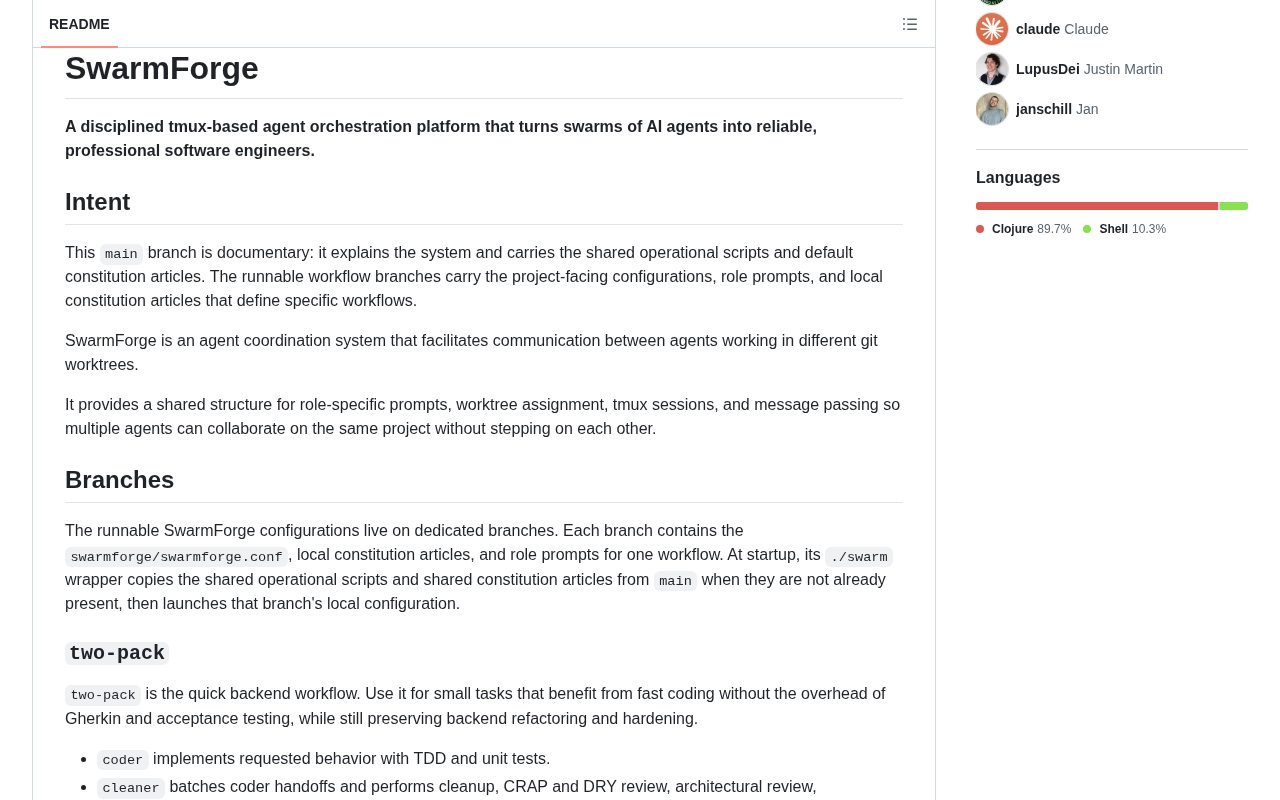
This is exactly the problem swarm-forge aims to solve. The word "swarm" vividly describes how multiple agents collaborate like a swarm of bees, while "forge" suggests its identity as a tool for crafting agent collaboration workflows.
The Design Philosophy Behind "Simple"
The emphasis on simple throughout the project description aligns perfectly with Uncle Bob's longstanding engineering philosophy. In his view, "simple" doesn't mean "easy" — it refers to structural simplicity, single responsibility, and minimal dependencies.
This distinction originates from Rich Hickey (the creator of Clojure) in his classic talk Simple Made Easy at the 2011 Strange Loop conference. Hickey pointed out that Simple is an objective structural property — whether a component does only one thing and whether it's decoupled from other concerns. Easy is subjective — it depends on the user's background and experience. The software industry has over-pursued Easy (convenient frameworks, syntactic sugar) while neglecting Simple's fundamental value for long-term maintainability. This philosophy has profoundly influenced library design style in the Clojure community, and Uncle Bob is clearly a devoted adherent.
At a time when multi-agent frameworks are generally trending toward being "large and comprehensive," swarm-forge takes the opposite approach, attempting to accomplish orchestration and message passing between agents with minimal core abstractions. Current mainstream multi-agent frameworks each have their own focus: LangGraph (LangChain ecosystem) uses directed graph abstractions to define agent workflows with support for conditional branches and loops; Microsoft's AutoGen focuses on multi-agent conversations and human-AI collaboration with rich dialogue patterns; CrewAI emphasizes Role-Playing, letting developers define agent collaboration using the metaphor of team building. There's also OpenAI's Swarm (an experimental project that also uses the "swarm" name) emphasizing lightweight orchestration. These frameworks are predominantly written in Python with relatively high abstraction levels, bringing convenience but also introducing additional complexity and debugging difficulty.
swarm-forge's "less is more" approach holds considerable appeal for developers tired of heavyweight frameworks.
Clojure's Unique Advantages in AI Agent Orchestration
Immutable Data Structures Ensure Concurrency Safety
One of the core challenges in multi-agent systems is state management: multiple agents running concurrently, sharing or passing context, where the slightest misstep can lead to race conditions and state chaos that's nearly impossible to debug.
In multi-agent systems, Race Conditions are among the most insidious and dangerous sources of defects. When multiple agents simultaneously read from and write to shared state (such as task queues, context memory, or global knowledge bases), the non-deterministic execution order can lead to data inconsistencies, duplicate task execution, or task loss. Traditional solutions include locks, semaphores, and message queues, but these solutions themselves introduce deadlock risks and performance bottlenecks.
Clojure's immutable data structures eliminate these problems at the language level — each agent holds a snapshot of the data, not a shared reference that can be arbitrarily modified. Once data is created, it cannot be changed; any "update" produces a new version of the data while the old version remains safely usable. Combined with concurrency primitives like Atoms, Refs, and Agents, state changes become controllable, traceable, and reversible. This approach of ensuring concurrency safety through persistent data structures (using structural sharing for efficient "modifications") is conceptually simpler and less error-prone compared to traditional locking mechanisms.
Code-as-Data Declarative Expressiveness
The Lisp family's "code is data" characteristic makes describing agent workflows, dependency relationships, and message routing exceptionally natural. Developers can declare entire collaboration topologies using pure data structures, which are then interpreted and executed by the engine. This declarative style perfectly matches agent orchestration's need to "describe relationships rather than write control flow."
As a modern Lisp dialect created by Rich Hickey in 2007 that runs on the JVM, Clojure's core design principles also include metaprogramming capabilities through its macro system and REPL-driven development. REPL-driven development allows developers to dynamically explore and modify system behavior at runtime — particularly valuable for debugging complex multi-agent interactions. Developers can observe message flows between agents in real-time and dynamically adjust collaboration strategies without recompiling and redeploying the entire system. Additionally, its core.async library provides CSP (Communicating Sequential Processes) style concurrency primitives, naturally suited for modeling message passing and channel communication between agents.
Of course, Clojure is relatively niche, and its JVM ecosystem and parenthesis-heavy syntax present a certain barrier to most AI developers with Python backgrounds. This may limit the project's adoption, but it also reflects Uncle Bob's prioritization of design correctness over catering to the mainstream.
Industry Signals Behind swarm-forge's Popularity
The viral success of swarm-forge is itself an interesting signal. It tells us:
First, multi-agent orchestration has become a hard requirement for developers — any tool that addresses this pain point easily attracts attention. Since the second half of 2024, an increasing number of enterprise applications have begun migrating from single-agent to multi-agent architectures. Whether in code generation, data analysis, or customer service, multi-agent collaboration has demonstrated significantly better results than monolithic models.
Second, the community has a genuine need for "lightweight, minimalist" orchestration solutions — not every team is willing to take on the complexity of a heavyweight framework. Many developers using LangGraph or AutoGen have found that the framework's own learning curve and debugging difficulty sometimes even exceeds the complexity of the business logic itself. A conceptually lean, clearly scoped lightweight solution fills this market gap.
Third, an engineering master famous for "Clean Code" personally entering the field brings rare engineering aesthetics and restraint to the somewhat frothy AI tooling landscape. In an era where AI tools proliferate and new frameworks launch weekly, Uncle Bob's participation offers the community a perspective worth pondering: AI engineering shouldn't mean abandoning established software engineering principles — it should be the extension and validation of those principles in new domains.
It's worth noting that as of now, publicly available information about the project remains quite limited. The official description is brief, and the specific architectural design, API shape, and real-world use cases await further community validation. Whether it's a production-ready mature solution or an experimental work by Uncle Bob exploring software design in the AI era remains to be seen.
Conclusion: From Clean Code to Clean Agents
From "Clean Code" to "Clean Agents," Uncle Bob uses swarm-forge to offer his answer to software engineering in the AI era: even when facing cutting-edge agent collaboration, the old-school engineering principles of simplicity, composability, and clear responsibility still apply. For developers exploring multi-agent architectures, this project serves both as a tool to try directly and as an excellent opportunity to observe how a master wields functional thinking to tame AI complexity.
Key Takeaways
Related articles

ChatGPT Space Launches: Team Collaboration and New Pages Features Explained
ChatGPT Space is OpenAI's new team collaboration feature with Pages, real-time collaboration, and Slack/Google Drive sync. We break down its privacy design, multi-platform integration, and the full workflow from conversation to document.

Migrating Apache Spark UDFs to GPU Acceleration with AI Agents
NVIDIA developer blog explains how AI Agents rewrite Apache Spark UDFs for GPU acceleration, covering migration criteria, agent rewriting and verification workflows, plus pitfalls like result consistency and CPU-GPU transfer overhead.

Zed Editor v0.40.4-rc2 Released: Usage Credits Now Available Without Upgrading
Zed editor releases v0.40.4-rc2, allowing users to use usage credits for AI features without upgrading to a paid plan, lowering the trial barrier.