Undeadlines: The Creative Weekly Planner That Turns Your Tasks Into Zombies
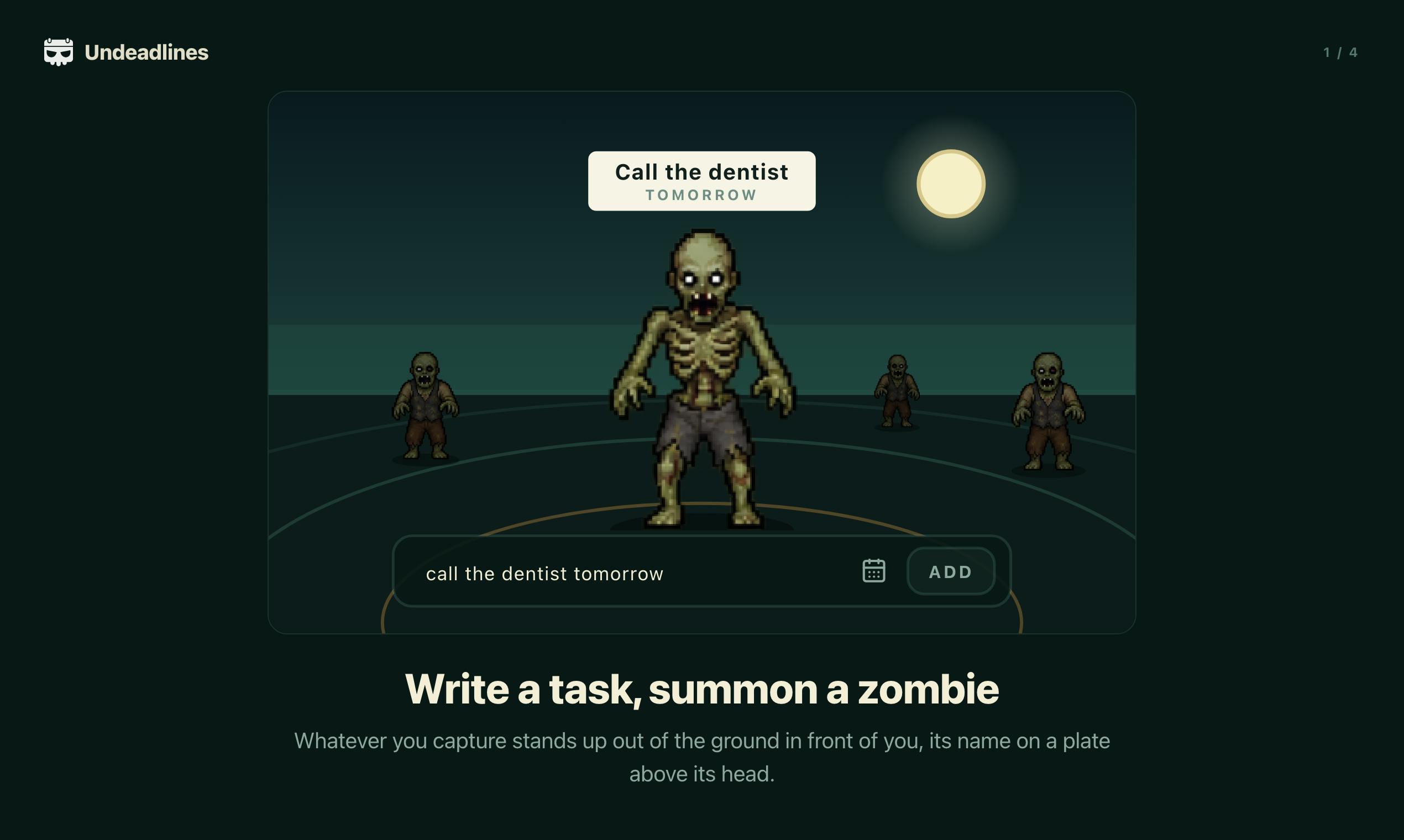
A gamified weekly planner that turns your tasks into zombies—the closer they get, the sooner they're due.
Undeadlines is a creative productivity tool by indie developer David García that tackles "date numbness" by visualizing deadlines as zombies surrounding you. The closer a zombie, the more urgent the task. By converting time into spatial distance, it leverages evolutionary psychology to make urgency intuitive rather than cognitive, focusing solely on weekly planning with extreme minimalism.
When Tasks Become Approaching Zombies: The End of Date Numbness
Traditional to-do lists and calendar tools often use abstract date numbers to express task urgency. A task marked "due Friday" looks almost identical to one "due next Wednesday" until you suddenly realize a deadline is right around the corner. This "date numbness" is a pain point many productivity tools struggle to solve.
This phenomenon isn't just user laziness—it has solid cognitive psychology foundations. The psychological theory of "Temporal Discounting" suggests humans naturally underestimate the value and urgency of future events. The further away a deadline, the more "unreal" it feels in our perception. This bias relates to how our brains process time information: the prefrontal cortex handles abstract time reasoning, a process requiring active cognitive effort, unlike the automatic and intuitive nature of visual-spatial perception. Dates on traditional to-do lists are essentially strings of symbols that need to be "calculated"—users must mentally convert "today is Tuesday, deadline is Friday, that's three days left" to generate urgency. When tasks pile up, this extra cognitive step is easily skipped, causing people to gradually become "desensitized" to date information.
A new tool on Product Hunt called Undeadlines attempts to solve this problem in a highly creative way. Its tagline is blunt with dark humor—"Kill your tasks before they kill you." This gamified weekly planner, built by indie developer David García, visualizes each of your tasks as a zombie surrounding you: the closer the zombie, the nearer the deadline.
Using Spatial Distance Instead of Date Numbers: Core Design Philosophy
Undeadlines' core design philosophy translates "time" into "space." In most task management apps, urgency is indirectly perceived through reading text and numbers; Undeadlines makes urgency a "visible approach."
Intuitive Expression of Urgency
When you open the app, you see yourself surrounded by a circle of zombies. Those standing on the outer ring are distant tasks you don't need to worry about yet; as a deadline approaches, the corresponding zombie steps closer toward you. This design cleverly leverages humans' instinctive response to "approaching physical threats"—we're naturally alert to things getting closer and closer.
This has deep evolutionary psychology foundations. The human brain contains a highly sensitive "predator detection system"—in ancient survival environments, quickly identifying approaching threats was a life-or-death capability. This system, primarily driven by the amygdala, can issue alarm signals before the visual cortex completes detailed processing, which is why we have an almost thoughtless alert response to "oncoming objects." Psychologists call this the "Looming Bias": compared to stationary or receding objects, approaching objects receive priority processing from the brain and are judged to be closer than their actual distance. Undeadlines' zombie approach mechanism simulates this primitive spatial threat signal in a digital interface, transforming rational deadline judgment into a lower-level, nearly automatic spatial alertness response.
By contrast, a string of date text struggles to activate this instinct. Undeadlines shifts cognitive burden from "calculating how many days remain" to "seeing at a glance who's closest to me," dramatically reducing the mental cost of judging task priority.
Restrained Design Focused on One Week
Undeadlines positions itself as a weekly planner, not a grand system trying to manage all your future tasks. This restrained design scope is interesting: it acknowledges that humans' effective urgency perception window is inherently limited. Rather than making you anxious facing a mountain of long-term to-dos, it focuses on "which zombies to eliminate this week."
The Psychology Behind Gamified Task Management
Undeadlines is categorized on Product Hunt under "Productivity," "Task Management," and "Games" simultaneously—this positioning itself indicates what it is: a tool that turns productivity into a game.
Gamification as a design methodology traces its core ideas to the "serious games" movement of the 1980s, but large-scale application in the tech industry began around 2010. Yu-kai Chou's "Octalysis Framework" is one of the field's most influential theories, categorizing core human behavioral drives into eight dimensions including "Epic Meaning & Calling," "Development & Accomplishment," and "Unpredictability & Curiosity." Undeadlines primarily activates the "Scarcity & Impatience" and "Loss & Avoidance" dimensions—zombie approach simultaneously creates urgency and psychological avoidance motivation toward being "devoured" (missing the deadline). Early gamified products like Habitica (formerly HabitRPG) used RPG role-playing to drive habit formation, Duolingo used streak counts and experience points to incentivize language learning—all proving that appropriate gamification mechanisms can significantly boost user action willingness and retention.
"Kill" Rather Than "Complete": A Psychological Framework Shift
From tagline to interaction, Undeadlines reinforces a sense of confrontation: tasks aren't "completed," they're "killed." This verbal shift seems like mere wordplay but actually changes users' psychological framework. Completing a task is passive obligation fulfillment, while killing a zombie is active, achievement-laden victory. Packaging boring to-do items as enemies that need "elimination" effectively sparks the desire to act.
Minimalism: Fighting Feature Bloat
The developer describes it as "dead-simple," contrasting sharply with many feature-bloated productivity tools today.
The productivity tool sector has long suffered from what's called "Feature Creep." Take Notion as an example—it evolved from a simple note-taking tool into an all-in-one workspace combining documents, databases, kanban boards, wikis, and calendars, with a correspondingly steep learning curve. Research from Gartner shows that over 60% of features in enterprise productivity software are never used. This bloat not only increases users' cognitive burden but creates a phenomenon called the "Configuration Paradox": users spend enormous time customizing and configuring the tool itself, actually reducing time spent completing tasks. The recent minimalist tool trend—like Todoist's "simple mode" and Things 3's restrained design—responds to this predicament.
Undeadlines pushes minimalism to a more extreme degree: it doesn't even offer a traditional list view, relying entirely on spatial metaphor to convey information. Many task management tools try to encompass project management, collaboration, tags, kanban, and massive features, ultimately making users spend more time configuring tools than completing tasks. Undeadlines chooses to do one thing—express deadlines through zombie distance—and makes it intuitive.
Undeadlines' Differentiated Value and Usage Limitations
Judging from Product Hunt data, Undeadlines currently has limited traction—a typical indie developer creative piece. Both its value and limitations are quite apparent.
Building Recognition in a Commoditized Space
In the heavily commoditized productivity space, Undeadlines uses a distinctive zombie metaphor to establish unique product recognition. For users tortured by traditional to-do lists and "numb" to date numbers, this novel visualization approach might truly deliver a different time management experience. It proves that innovative interaction metaphors still have room to survive in mature tool categories.
Challenges to Face
Highly gamified tools like this also face natural challenges. First is novelty decay: the zombie metaphor is attractive initially, but whether it maintains effectiveness over long-term use remains to be validated. Second is scenario fit: for serious work scenarios requiring precise dates, bulk management, or team collaboration, pure spatial visualization may be insufficient. It's better suited for personal, lightweight weekly task arrangements.
Creativity as Another Path for Productivity Tool Evolution
Undeadlines may not become the next Notion or Todoist, but it provides a sample worth considering: productivity tool evolution doesn't have to be feature stacking—it can also be perception reconstruction. When everyone competes on who has more complete features and more integrations, redefining "urgency" with a simple zombie metaphor becomes remarkably valuable.
For indie developers, Undeadlines is also a small-but-beautiful practice—using a minimal feature set paired with a memorable creative concept to solve a specific, real pain point. Since its 2013 launch, Product Hunt has become the preferred platform for indie developers and small startup teams to launch new products. The platform's community voting and commenting mechanisms allow products' early exposure to depend not entirely on marketing budgets but more on the appeal of the product idea itself. This ecosystem has spawned numerous "creative micro-products"—typically built by solo developers or tiny teams, not pursuing comprehensive feature coverage but focusing on using a unique creative entry point to solve a specific problem. These products' business models are often freemium or one-time payment, with low development costs and fast iteration, but they also face long-term challenges in user retention and monetization.
Undeadlines follows exactly this path—it may not bring explosive growth, but it preserves what's most precious in a product: clear philosophy and distinctive personality.
Key Takeaways
- Spatial metaphor over abstract dates: Undeadlines transforms deadline urgency from cognitive calculation to intuitive visual perception by representing tasks as approaching zombies
- Leveraging evolutionary psychology: The tool taps into humans' instinctive alertness to approaching threats, making urgency feel more real than traditional date-based reminders
- Restrained scope as a feature: By focusing exclusively on weekly planning rather than long-term task management, it acknowledges the natural limits of human urgency perception
- Gamification that shifts psychological framing: Reframing task completion as "killing" enemies rather than fulfilling obligations creates more intrinsic motivation
- Minimalism as differentiation: In a feature-bloated productivity tool landscape, doing one thing exceptionally well stands out
- Creative micro-products have a place: Indie developers can compete not through feature parity but through distinctive, memorable interaction concepts that solve specific pain points
Related articles
TiVo Charging for Ad-Skipping? DVR User Rights and the Digital Ownership Debate Explained
TiVo plans to charge DVR users for ad-skipping, sparking debate over digital ownership and consumer rights. A deep dive into subscription trends and their implications.
Batch Generating Ad Creatives from a Single Product Image: Real Bottlenecks and Solutions for Scaled Workflows
From one product photo to multi-platform ad assets—brand consistency, text rendering, and cross-platform adaptation collapse first. Deep dive into AIGC marketing workflow bottlenecks with template-driven and layered composition solutions.
Scriptly: AI Voice-Following iOS Teleprompter That Eliminates Pace-Chasing
Scriptly is an iOS voice teleprompter using AI real-time voice-following technology to auto-match speaking pace. Supports local storage for privacy, integrates writing, script management & video recording workflow for content creators.