Undergraduates Publishing Solo at A* Conferences: Myth or New Normal?

More undergraduates publishing solo at A* conferences triggers graduate anxiety; rational perspective needed on implicit mentorship and survivorship bias.
A recent Reddit thread sparked discussion: more undergraduates are publishing as first authors at A*-class conferences, causing anxiety among some graduate students. Analysis shows that "independent" publications often involve implicit support like course guidance or internship mentorship. Truly zero-guidance cases are concentrated in low-compute theoretical fields, and survivorship bias exists. Graduate anxiety stems from unreasonable cross-track comparisons. The trend is driven by academic evaluation pressures and open-source tools, but raises concerns about quick incremental research. The article calls for re-examining research paths and valuing problem-posing ability over publication speed.
Recently, a discussion thread on Reddit caused quite a stir in academic circles: a growing number of undergraduates are publishing papers as first authors at A*-class top conferences without supervisor guidance. The poster, a graduate student, admitted feeling both admiration and anxiety upon seeing this news, and even began to doubt their own research progress.
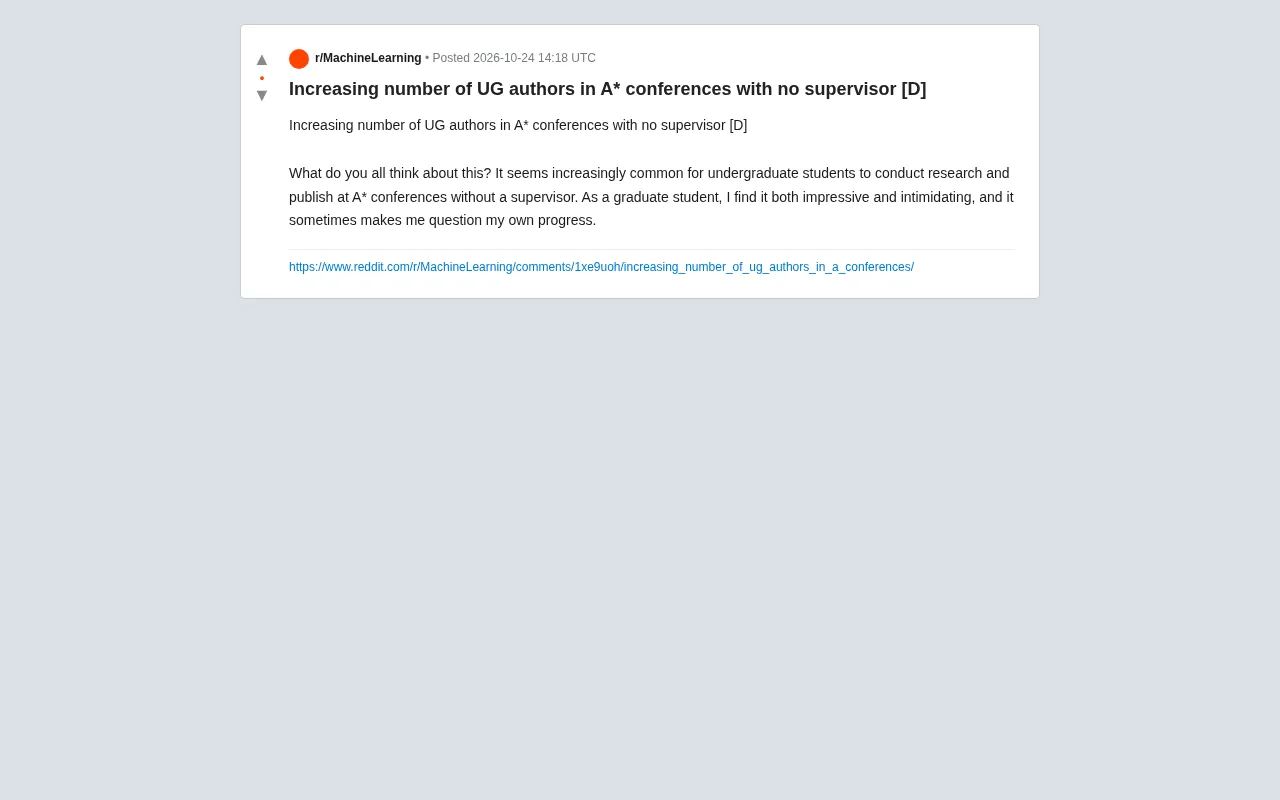
This phenomenon is not an isolated case. From top machine learning conferences like NeurIPS and ICML, to systems conferences like SOSP and OSDI, to CHI in human-computer interaction, the presence of undergraduate solo authors is indeed increasing. Behind this lies both the proliferation of open-source tools and online courses, as well as the downstream effects of the academic evaluation system. But what needs more sober analysis is: what do these "independent" publications actually mean? What impact will they have on graduate students and the academic ecosystem?
How "Independent" Is It Really for Undergraduates to Publish at Top Conferences?
First, the definition of "no supervisor" needs clarification. Discussions under the original Reddit post pointed out that while some undergraduates do complete research entirely through self-study and open-source community collaboration, a considerable proportion of cases involve students who received guidance from professors in course projects or implicit mentorship from industry researchers during internships—but did not list the mentors as authors in the final byline.
According to observations from multiple commenters in the thread, truly zero-guidance cases are concentrated in directions with low computational requirements and strong theoretical foundations, such as algorithm optimization, theoretical machine learning, or certain formal verification work. In fields requiring large-scale experiments or expensive equipment, it is extremely difficult for undergraduates to complete work independently. This means that what we see—"undergraduates publishing solo at A*"—involves survivorship bias: failed or unpublished projects do not enter public view.
A* conferences represent the highest tier in the most authoritative academic conference ranking system in computer science. This ranking is typically established by national computer societies (such as the China Computer Federation, CCF), with A* representing the recognized top conferences in the field, with acceptance rates often between 15% and 25%, and papers subject to rigorous peer review. For example, NeurIPS and ICML in machine learning, SOSP and OSDI in systems, and CHI in human-computer interaction are all A*-class. Publishing at A* conferences is an important indicator of a computer science researcher's academic level and a key advantage in applications to top doctoral programs. Understanding this ranking system helps grasp the actual weight of the "undergraduates publishing solo at A*" phenomenon in academic evaluation.
Why Do Graduate Students Feel "Offended"?
The original poster's emotions are very representative. Graduate students undergo systematic research training and typically need 2-3 years to produce their first top conference paper, while undergraduates complete work independently in a shorter time—this comparison easily triggers self-doubt. But there is an easily overlooked variable here: the research direction and nature of the topic.
Some undergraduates choose extensions of topics their supervisors have already built up, or improvements to mature codebases in open-source communities—such work has low startup costs. Graduate students, on the other hand, often face more complex, frontier open problems. The comparability between the two is not high. As one commenter put it: "Comparing progress across different tracks only creates unnecessary anxiety."
Survivorship bias refers to people observing only the "surviving" samples (such as successfully published cases) while ignoring failed samples that never enter view (such as unpublished or abandoned projects), thereby producing erroneous estimates of overall success rates. In discussions about undergraduates publishing solo at top conferences, the public sees only a few success stories; the vast number of failed or unproductive attempts are never reported. This bias easily leads people to overestimate the prevalence and feasibility of independent undergraduate research, further intensifying graduate students' anxiety. Recognizing the existence of survivorship bias helps one view individual cases more rationally and avoid self-negation based on incomplete evidence.
The Academic Evaluation System Is Changing
The increase in undergraduates publishing solo at top conferences is closely related to the evolution of the academic evaluation system. More and more undergraduates view top conference papers as "hard currency" for applying to top doctoral programs, which in turn stimulates early investment in undergraduate research. At the same time, open-source communities and preprint platforms have lowered the barriers to disseminating research results, enabling independent researchers to receive peer feedback as well.
But this trend also brings concerns. Some commenters noted that to pursue publication quantity, some undergraduates tend to choose "quick and easy" incremental work rather than genuinely in-depth research. This may not only harm paper quality but also lead students to form misguided research values.
Implications for Graduate Students and the Academic Ecosystem
Rather than sinking into anxiety, it is better to view this phenomenon as an opportunity to re-examine research paths. The core value of graduate study lies in cultivating the ability to pose and define problems, not merely in pursuing publication speed. Independent publication by undergraduates is certainly commendable, but it should not become the yardstick by which all researchers' progress is measured.
For supervisors and departments, this phenomenon also raises new questions: How can more standardized research training be provided for undergraduates while avoiding overemphasis on publication metrics? How can academic integrity and mentorship quality be ensured while encouraging independent exploration? The answers to these questions may be more worth discussing than "whether undergraduates should publish solo at top conferences" itself.
The essence of academic research is expanding the boundaries of human knowledge, not a race. Undergraduates publishing solo at A* top conferences can be an inspiring story, but it should not become a boulder weighing on graduate students' minds.
One-line Summary
More undergraduates publishing solo at A* conferences triggers graduate student anxiety; implicit mentorship and survivorship bias require rational perspective.
Paragraph Summary
A recent Reddit thread has drawn attention: a growing number of undergraduates are publishing as first authors at A*-class top conferences, causing anxiety among some graduate students. The article's analysis points out that so-called "independent" publications are not entirely without guidance—many cases involve implicit support such as course feedback or internship mentorship. Truly zero-guidance cases are concentrated in low-compute theoretical directions, and survivorship bias exists. Graduate student anxiety stems from unreasonable comparisons of progress across different tracks, with differences in research direction being an important variable. The downward pressure of academic evaluation systems and the proliferation of open-source tools have driven this phenomenon, but also brought concerns about pursuing quick, incremental research. The article calls for re-examining research paths and focusing on the ability to pose problems rather than publication speed.
Related articles

WebMCP Security Guide: Three Hints That Make AI Agents Safer
The Chrome team demonstrates three security hints for WebMCP tools: readOnlyHint eliminates invalid confirmation dialogs, consequentialHint forces human confirmation for high-risk operations, and untrustedContentHint defends against indirect prompt injection—improving AI agent security with one or two lines of code.

Why Turbulence Is the Hardest Problem in Fluid Mechanics — and How AI Could Crack It
Why is turbulence the hardest problem in fluid mechanics? This article, based on a Lex Fridman podcast conversation, explores turbulence's multi-scale nature, comparisons with classical thermodynamics, and how AI might simplify turbulence description by discovering coordinate transformations — examining the intersection of vortex formation with mathematics and physics.

R.L. Stine Google Talk: How the Master of Horror Ignites Kids' Passion for Reading
At a Google talk, R.L. Stine shares his accidental pivot from comedy to horror, his principles for children's horror, how phones impact storytelling, and how Goosebumps motivates kids to read.