Understanding AI Agents from Scratch: The Core Loop of Perception, Decision, and Action

A systematic introduction to AI Agents: core capabilities, three generations of evolution, and the key tech stack.
This article explains AI Agents from the ground up, starting with how they differ from traditional programs — fixed input/output vs. dynamic intent understanding. It breaks down the three core capabilities (perception, decision, action) and traces the evolution from rule-based systems to today's LLM + tool calling + memory architecture. Key technologies including RAG are explained with practical examples, laying the groundwork for frameworks like LangChain.
The Essential Difference Between Traditional Programs and Agents
AI technology has permeated nearly every aspect of modern life — intelligent chatbots, autonomous driving, and smart healthcare are all prime examples. Users tend to have polarizing experiences with these products: the ones that work well earn the label "artificial intelligence," while the frustrating ones get mocked as "artificial stupidity." What separates a good experience from a bad one often comes down to the underlying technology. AI Agents, which have surged in prominence over the past few years, are one of the core technologies that make products genuinely useful.
To understand agents, we first need to see how they differ from traditional programs. Traditional programs share a common trait: fixed input produces fixed output. Think of a vending machine — you select a Coke, insert your coins, and it dispenses exactly that product, every single time. Whether written in Java, Python, or any other language, the logic of a traditional program is hardcoded in advance.
An agent is more like a thinking assistant. Give it a vague request — say, "I want to travel somewhere for the May Day holiday" — and it will automatically analyze suitable destinations for that period, factor in your current location and transportation options, and offer recommendations. It doesn't need precise instructions; it can interpret intent and dynamically generate results.
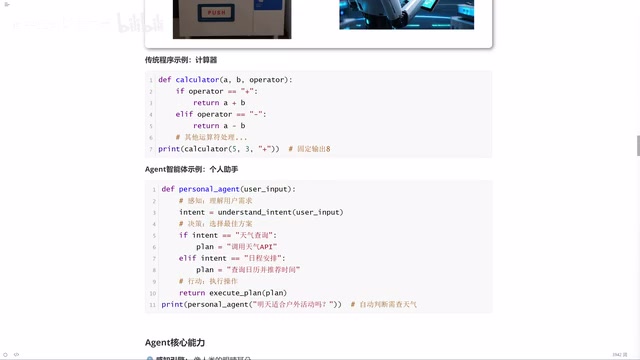
A code comparison makes this even clearer. A traditional calculator function takes two numbers and an operator and produces a fully predictable result. An agent function, by contrast, only needs a natural-language request as input — it first figures out what the user wants, then decides how to respond. The key is that the input can be ambiguous. Whether a user says "check today's weather for me" or "is the day after tomorrow good for going out?", the agent recognizes both as a "weather query" intent and calls the appropriate tool to return a result.
The Three Core Capabilities of an Agent
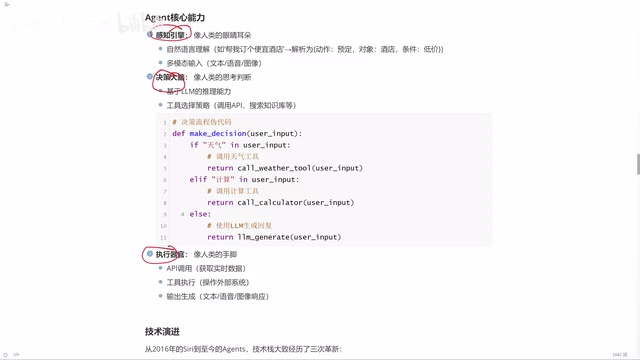
An agent's capabilities can be broken down into a closed loop: Perception → Decision → Action.
Perception Engine
The perception engine is the agent's eyes and ears — it receives and interprets external input. When you tell an agent "find me a cheap hotel," it uses natural language understanding to extract three elements: the action is "book," the object is "hotel," and the condition is "low price."
More importantly, the perception engine isn't limited to text. Voice, text, and images can all serve as input. This support for multiple input types is called multimodality, and it brings the agent's perceptual capabilities closer to how humans comprehend the world.
Decision Brain
Once input is perceived, the agent needs to make a logical judgment about what to do next — that's the job of the decision brain. It operates on the reasoning capabilities of a Large Language Model (LLM); common examples include GPT, DeepSeekAd, and Tongyi. After receiving user input, the model reasons through what response is appropriate and which functions need to be called.
At its core, an LLM is a probabilistic model trained on massive amounts of text data. Its fundamental mechanism is predicting the most likely next token given a context. Models like the GPT series use the Transformer architecture to capture long-range semantic relationships, enabling them to understand the true intent behind ambiguous expressions. In an agent context, LLMs don't just handle "understanding" — they also perform "planning," breaking a single user utterance into multiple executable sub-tasks and determining which tool each sub-task requires. This capability is known as Reasoning & Planning, and it represents the most critical leap that third-generation agents have made over their predecessors. Different models vary in reasoning depth, context window length, and tool-calling accuracy, which directly affects agent performance on complex tasks.
Action Executor
Once a decision is made, the executor carries it out — calling the relevant functions or interfacing with hardware to complete real-world operations, much like a person's hands and feet. This completes the full loop: perceive the user's need → decide what to do → execute and return the result.
Tool Calling (also known as Function Calling) is the key mechanism through which third-generation agents take action. The process works like this: developers declare a set of available functions to the model in advance (e.g., "check weather," "book hotel," "send email"), describing each function's purpose and required parameters. When the model determines that a tool is needed, it doesn't execute the code directly — instead, it outputs a structured JSON description specifying the function name and parameter values. An external program then actually calls that function, returns the result to the model, and the model uses it to generate a final answer. This division of labor — "model decides, code executes" — leverages the LLM's semantic understanding while preserving traditional software's precise control over real systems. It's the bridge connecting the "language world" to "real-world operations."
The Evolution of Agent Technology: Three Generations
From early Siri to Xiao Ai and DuerOS, intelligent assistants have gone through roughly three generations of technological evolution.
The first generation was built on rule engines and fixed templates. Ask "what time is it?" and it answers correctly. But rephrase the request as "adjust the time for me" and it fails, responding with "I don't understand your command." Anything outside the preset commands simply didn't work. Some smart speakers on the market today are still stuck at this stage.
The second generation introduced NLP models and intent recognition, enabling basic understanding of user needs regardless of phrasing. However, it lacked a memory system. Ask "what's the weather like today?" and then follow up with "is today good for going out?" and the agent can't connect the two exchanges — every question is treated as a brand-new session.
The third generation combines large language models + tool calling + memory systems. No matter how vague or tricky the request, the LLM can identify the real need, then call the appropriate tools — not just built-in functions, but also external resources like databases and cameras. A memory system lets the agent remember previous steps and handle multi-step, continuous tasks. This is where today's mainstream agents operate.
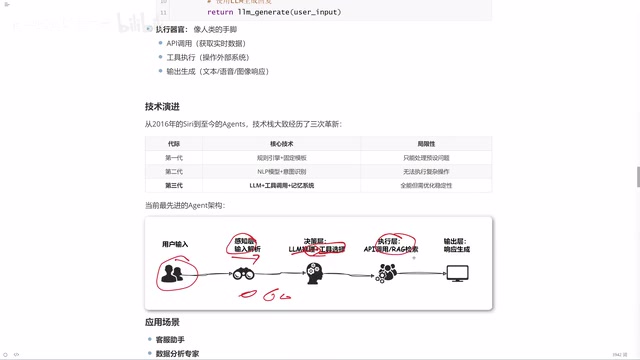
Looking at the overall architecture, a modern agent's workflow goes like this: user inputs a request → perception layer analyzes key elements → LLM reasons and selects tools → execution layer calls APIs or a RAG database → results are generated and returned.
Typical Application Scenarios
Agents are already deployed across a wide range of real-world use cases.
Customer service assistants are the most common. Early chatbots gave rigid, scripted replies. Platforms powered by agent technology feel far more natural and human-like in their interactions.
Data analysis experts can automatically perform common baseline analyses after receiving data, or conduct targeted analyses based on specific user requirements.
Personal productivity assistants handle everyday tasks. For example: "Remind me at 9 AM tomorrow to submit my report and suggest a commute route." The agent breaks this into two tasks — creating a calendar event and querying real-time traffic — executes both, and returns a unified response.
Tech Stack Breakdown: What You Need to Build an Agent
Actually building an agent requires mastering several key technologies:
- Large Language Model (LLM): The agent's "cerebral cortex," responsible for understanding, reasoning, and content generation. Examples: GPT-4, Claude, DeepSeek.
- Tool Calling: After the LLM decides what needs to be done, it executes tasks by calling tools — developers don't need to implement all the underlying functionality themselves.
- Memory System: The agent's "hippocampus," enabling it to remember previous operations and handle multi-step tasks. Memory is divided into short-term and long-term varieties.
- Retrieval-Augmented Generation (RAG): Optional but highly recommended. Since LLMs are trained on historical data, their knowledge can become outdated. RAG supplements the model with the latest information via external retrieval, addressing this gap.

A code comparison highlights the core difference well: a traditional program uses a fixed string template — whatever you pass in gets run through the same pipeline. An agent responds dynamically, evaluating the request and returning different content based on different outcomes. The fundamental distinction is dynamic versus fixed.
RAG (Retrieval-Augmented Generation) deserves a closer look. LLMs have a training data cutoff date, meaning they have no knowledge of events after training and cannot access private enterprise documents. RAG addresses this by retrieving the most relevant text passages from an external knowledge base (such as a vector database) before the model generates a response, then feeding those passages along with the user's question into the model so it can answer based on "real-time supplemented context." The core of a vector database is converting text into high-dimensional vectors and finding semantically similar content via similarity calculations — not traditional keyword matching. This allows agents to leverage the LLM's reasoning power while also accessing up-to-date or private information, effectively solving both the "stale knowledge" and "data silo" problems.
Summary
To understand agents, keep three threads in mind: first, the essential difference from traditional programs — fixed input/output versus dynamic perception-decision-action; second, the core closed loop of perceive, decide, and act; and third, the tech stack behind modern agents — LLMs, tool calling, memory systems, and RAG. Mastering these foundational concepts is what sets you up to dive into hands-on development with frameworks like LangChain and Ollama.
Related articles

Why Does the Tesla Roadster Need to Fly? A Deep Dive into Musk's Wild Demo
Tesla's Roadster launch showed wall-climbing, upside-down driving, and flying stunts—but The Vergecast notes the demo car may lack a battery, the Rocket version is invite-only and not street-legal, and the website terms don't guarantee delivery. After nine years of delays, why does this car still need to exist?

AI Is Not a Replacement: Human-AI Collaboration Through the Lens of Factory Root Cause Analysis
Starting from factory root cause analysis, this article explains how AI accelerates evidence chain construction rather than replacing human experts, exploring the pragmatic implementation logic and business value of 'AI supporting people rather than replacing them.'

AI Agent Decision Auditing: Building an Evidence Chain in Regulated Workflows
Starting from a Reddit discussion, this article analyzes three core issues in AI agent decision auditing within regulated workflows: what fields audit records should contain, how to handle feedback latency for erroneous decisions, and how to continuously calibrate LLM judge consistency with human judgment.