Understanding Buy Nothing Day: A New Echo of the Anti-Consumerism Movement Amid AI and the Consumer Wave

Buy Nothing Day falls on Black Friday, urging reflection on consumerism and algorithm-driven buying impulses.
The article introduces Buy Nothing Day, set for Black Friday, November 27, advocating no non-essential purchases that day. Its core is not saving money but questioning the line between "needs" and "manufactured wants." The topic drew 284 points and 85 comments on Hacker News, showing the tech community's concern with consumption mechanisms. E-commerce recommendations, one-click ordering, and seed-planting content front-load and automate purchases, making "not buying" require stronger self-awareness. Supporters see the day as a starting point for public discussion; critics call it merely symbolic. For tech workers, it is also a mirror for reflecting on growth mechanisms and product ethics.
When consumerism has permeated almost every corner of life, a movement called "Buy Nothing Day" has once again entered the public eye. According to a discussion on Hacker News, the movement is set for Friday, November 27 this year—the same day as the traditional shopping season's "Black Friday." The link garnered 284 points and 85 comments on Hacker News, showing that the debate over "whether to stop consuming" still carries considerable appeal.
What Is Buy Nothing Day
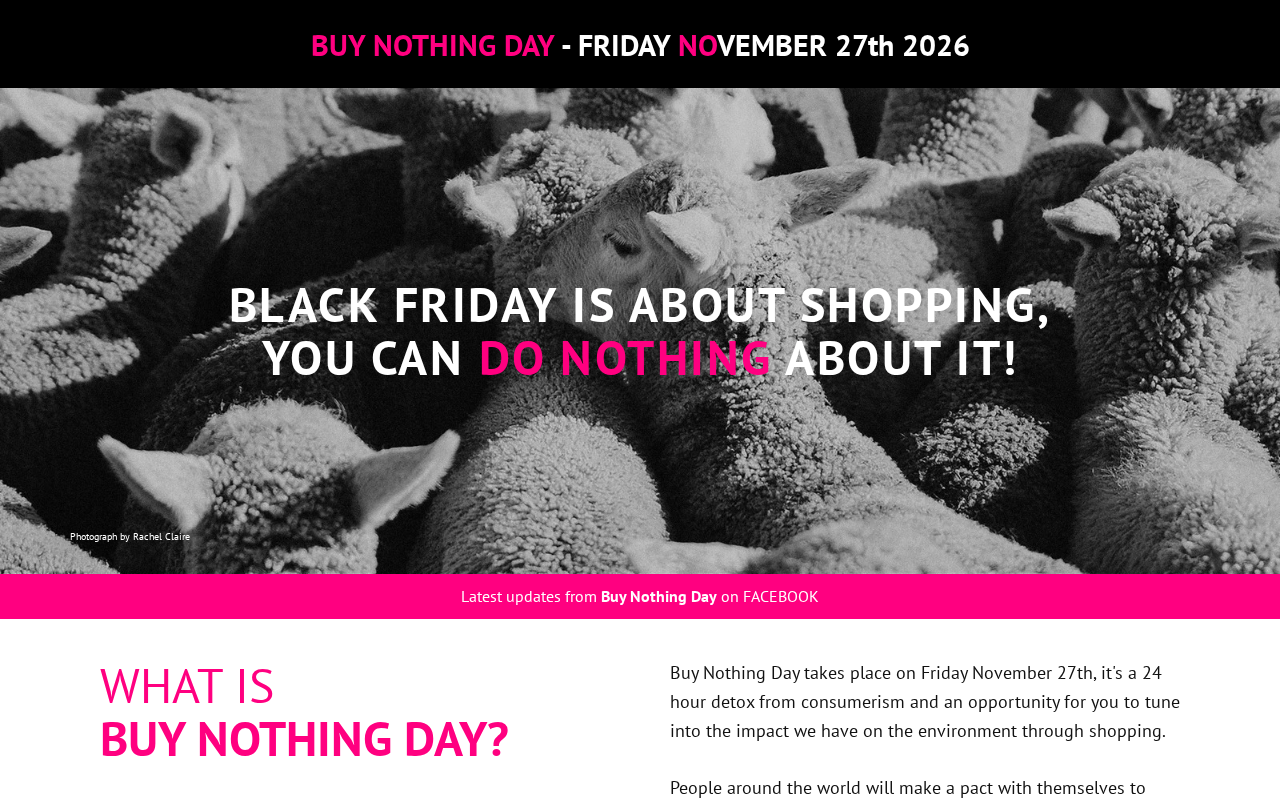
Buy Nothing Day is a grassroots movement rooted in anti-consumerist thought, with a simple and direct core proposition: on the one day of the year that most encourages consumption, actively choose not to buy any non-essential items. Its official website, buynothingday.co.uk, serves as a hub for information and spreading the philosophy, positioning the day as a public reflection on the culture of overconsumption.
It is not simply a "money-saving guide." The organizers want to convey a question: when shopping is packaged as a holiday and advertising is everywhere, are people still able to distinguish between "needs" and "manufactured wants"? This question feels especially sharp in an era of discounts, limited-time offers, and algorithm-driven recommendations.
"Black Friday" originates from the first Friday after Thanksgiving in the United States. Since the mid-20th century, the retail industry has shaped it into the start of the year's biggest discount season, and it has now spread into a global shopping event. In contrast, Buy Nothing Day was launched in 1992 by the Canadian art collective Adbusters, initially aimed at countering the commercialization of the Christmas shopping season. It later became fixed on Black Friday and spawned extensions such as "Buy Nothing Week" and "Buy Nothing Month." The movement is in line with the philosophy of "culture jamming"—using symbolic disruptions to expose how advertising and brands shape daily life. Understanding this background helps grasp why Buy Nothing Day deliberately chooses to speak out at the moment when consumerism is loudest, rather than picking another date.
Why the Movement Is Still Discussed Today
Consumption Infrastructure Is Unprecedentedly Powerful
Compared with the movement's early years, today's consumption decisions are pushed forward and automated to a far greater degree. E-commerce recommendation systems, one-click ordering, and social media "seed-planting" content make the act of "not buying" require stronger self-awareness than in the past. The heated discussion in the Hacker News comments (85 comments) itself shows that the tech community has firsthand experience with how this consumption machinery operates.
A recommendation system is a mechanism by which e-commerce platforms use user behavior data (browsing, clicks, dwell time, purchases) to train models that predict and surface products a user might be interested in. Common techniques include collaborative filtering, deep-learning ranking models, and real-time personalized retrieval, with the goal of maximizing click-through and conversion rates. One-click ordering reduces friction in the purchase decision to a minimum by storing payment and address information in advance, shortening the path from "wanting" to "buying." Seed-planting content usually refers to soft promotion appearing in the form of experience-sharing on social media, leveraging trust relationships to influence purchase decisions. Together, these three make consumption systematically front-loaded and automated, and also make "actively not buying" require resisting a whole set of finely optimized product designs.
From Personal Choice to Structural Critique
Among supporters of Buy Nothing Day, some treat it as a reminder for personal financial management, while others see it as a structural critique of consumerism. The disagreement lies in: what can one day of not consuming actually change? Critics argue it is more of a symbolic gesture that can hardly shake the commercial logic; supporters believe the symbol itself is the starting point of public discussion.
"Structural critique" refers to attributing problems to institutions, economic systems, and cultural mechanisms rather than to individual morality or willpower. On consumption issues, this means asking: how do the advertising industry, credit expansion, platform algorithms, and growth-oriented business models jointly manufacture demand, subjecting individual choices to systemic constraints? The opposite is individualized attribution, which treats how much one consumes as a matter of personal self-discipline. This distinction is key to understanding the Buy Nothing Day debate: if the problem is mainly structural, then the symbolic meaning of a single day of not consuming outweighs its actual effect on emissions or spending; if the structure is hard to change in the short term, symbolic action is seen as a starting point for building public discussion and pushing for reflection on policy and business ethics.
Why the Tech Community Cares
You may not have noticed that this discussion appeared on Hacker News rather than in fashion or lifestyle media. Tech workers are among the main builders of e-commerce recommendation systems, growth models, and ad technology, and they are all too familiar with the mechanisms of "how to make people buy more." Therefore, for the tech community, Buy Nothing Day is in some sense a mirror: while technology makes consumption easier, it also turns "actively not consuming" into a behavior that requires deliberate practice.
"Growth models" refer to a set of methods and practices tech companies use to drive user scale and revenue growth, including A/B testing, funnel analysis, retention curves, recommendation optimization, and growth hacking. Their core is to quantify user behavior into testable, iterable metrics and continuously optimize the conversion path. Tech workers often directly participate in designing and tuning these systems, and thus have firsthand knowledge of the mechanisms of "how to make people buy more." This also explains why Buy Nothing Day sparked discussion on Hacker News: for builders, reflection concerns not only personal consumption habits but also professional ethics—whether the metrics they optimize are amplifying consumption impulses that are not users' genuine needs.
What Participants Can Do
The movement itself has no complicated barrier to participation. Common practices include: not making non-essential online or offline purchases that day; replacing shopping with free activities such as walking, reading, or talking with friends; and using the day as an opportunity to re-examine one's own consumption habits. For tech workers, they can further consider whether the products and growth mechanisms they help build are inadvertently amplifying unnecessary consumption impulses.
The Value of Symbolic Action
The debate around Buy Nothing Day is essentially an old argument about "whether individual action can lever systemic problems." Its value may lie not in how much transaction volume is reduced that day, but in reminding the public once a year: consumption is a choice, not a default setting. In an era when recommendation algorithms understand you better and better, retaining the ability to "not buy" is itself a scarce form of autonomy.
One-line Summary
Buy Nothing Day falls on Black Friday, advocating reflection on consumerism and algorithm-driven buying impulses.
Paragraph Summary
The article introduces the Buy Nothing Day movement, set for Friday, November 27 this year (Black Friday), which advocates not buying non-essential items that day. Its core is not saving money but questioning the boundary between "needs" and "manufactured wants." The topic garnered 284 points and 85 comments on Hacker News, showing the tech community's firsthand concern with consumption mechanisms. The article notes that e-commerce recommendations, one-click ordering, and seed-planting content front-load and automate purchase decisions, making "not buying" require stronger self-awareness. On whether one day of not consuming can change the system, supporters see it as a starting point for public discussion, while critics view it as merely a symbolic gesture. For tech workers, the discussion is also a mirror for reflecting on growth mechanisms and product ethics.
Related articles

Prospero: A Lightweight Native AI Coding Tool Built with ImGui
Prospero is a bloat-free native AI coding tool built with ImGui, emphasizing lightweight design, high performance, and low dependencies. This article analyzes its design philosophy, technical choices, and the divergence between platformization and toolization in AI coding tools.

WebRTC Abused: New Variant of Credit Card Skimming Scripts on Shopping Sites
Security researchers found skimming scripts on popular shopping sites using WebRTC data channels to exfiltrate credit card data. This article analyzes the technical原理, differences from traditional Magecart attacks, and defense strategies for e-commerce platforms in third-party script governance and CSP policies.

Single GB10 Card Hits 101 tok/s: Inkling 2 Mini Performance Tested on vLLM
A developer shared on Hacker News running Inkling 2 Mini with vLLM on a single GB10 at 101 tok/s. This article analyzes the technical context, the significance of vLLM with small models on single cards, and caveats for interpreting tok/s metrics.