Understanding Ensemble Learning Through AdaBoost: How Weak Models Combine into a Strong One

AdaBoost reveals how combining error-prone weak models beats any single strong model — a key insight bridging ensemble learning and deep learning.
A student mastering AdaBoost realized he was "getting closer to deep learning" — a feeling that captures ensemble learning's core insight: instead of seeking one perfect model, we let many flawed weak models collaborate. AdaBoost dynamically reweights misclassified samples so each subsequent learner targets the mistakes its predecessors left behind, iteratively forging a high-accuracy classifier. This philosophy of collaboration, specialization, and iterative correction mirrors deep learning's layered neurons and backpropagation, making AdaBoost a powerful cognitive stepping stone. The recommended learning path: master the theory first, then implement from scratch and publish on GitHub for community feedback.
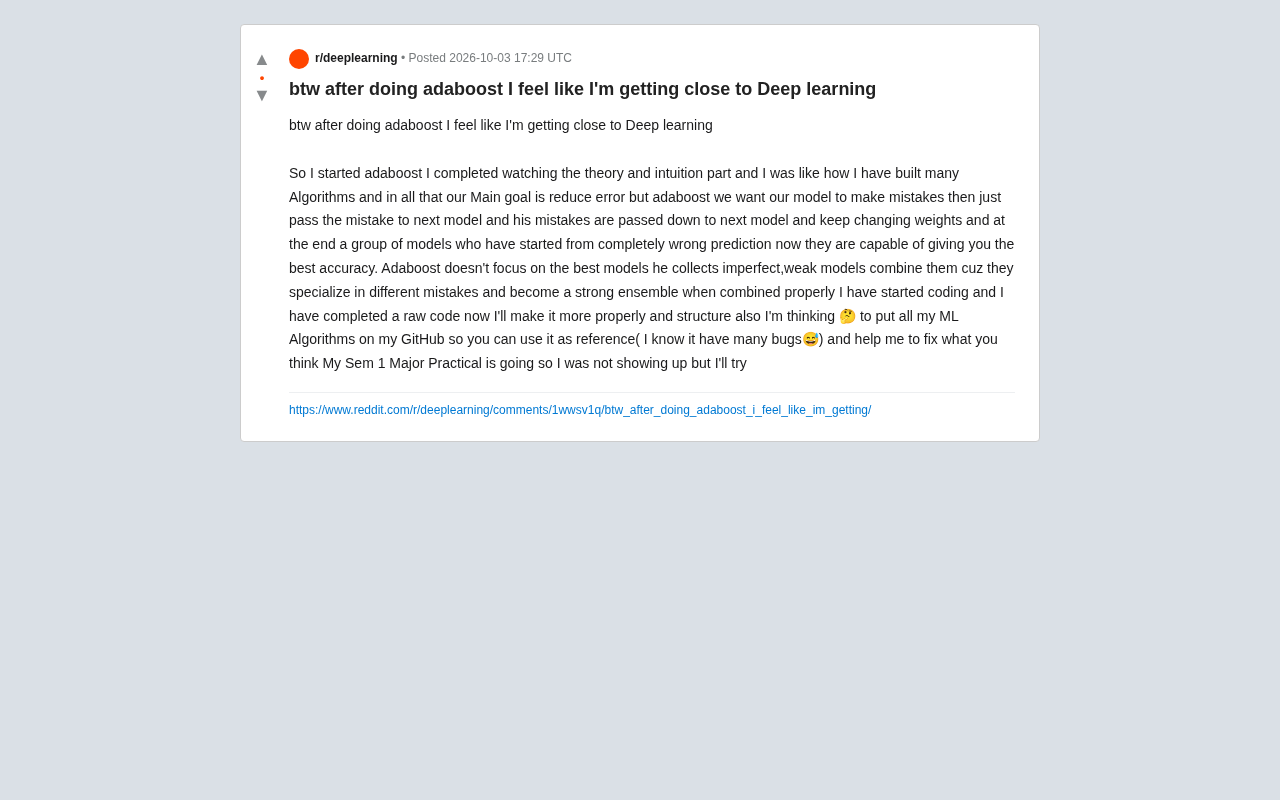
A student systematically learning machine learning shared a genuine insight in an online community: after completing the theory section on AdaBoost, he suddenly realized he was getting closer and closer to deep learning. This seemingly simple observation actually touches on a deeply counterintuitive core idea in ensemble learning — we're not chasing the perfect model; we're leveraging a crowd of "mistake-prone" weak models.
Why AdaBoost Sparks That "Aha" Moment
Most ML beginners start with algorithms like linear regression, logistic regression, or decision trees. They all share the same central goal: minimize error. The more accurate the model, the better. The fewer mistakes, the better. This logic is straightforward and aligns with common sense.
But AdaBoost takes an entirely different approach. As this student described it: "In AdaBoost, we actually want models to make mistakes, then pass those mistakes to the next model, which passes its mistakes to the one after that, continuously adjusting weights. In the end, a group of models that started from completely wrong predictions somehow gives you the best accuracy."
This cognitive dissonance is exactly why so many people consider AdaBoost a turning point in their thinking. It's the first time a learner realizes: a single model's performance does not equal the system's final performance.
AdaBoost's Core Mechanism: Error-Driven Relay Racing
AdaBoost (Adaptive Boosting) works like a strategic relay race.
The Role of Weak Learners
AdaBoost doesn't select the "strongest" model. Instead, it collects many imperfect weak learners — simple models that are only slightly better than random guessing (like single-level decision trees, also called decision stumps). Individually, each one is mediocre and frequently wrong.
The key insight is: different weak learners are good at handling different types of errors. When combined appropriately, their individual weaknesses cancel each other out, and together they form a powerful ensemble classifier.
A Decision Stump is the most common weak learner in AdaBoost — essentially a depth-1 decision tree that sets a single threshold on one feature to split samples into two groups. Its classification power is extremely limited; on complex datasets, its accuracy is often only marginally above 50%. Because it's so simple, a single decision stump has almost no practical value on its own. But within AdaBoost's framework, tens or even hundreds of decision stumps combined with learned weights can significantly outperform a single deep decision tree. This "weak-weak collaboration" effect is mathematically guaranteed by Schapire and Freund's Boosting Theory: as long as each weak learner's accuracy is slightly better than random guessing, the combined error rate decreases exponentially with each iteration.
Weight Adjustment Is the Soul
The essence of AdaBoost lies in dynamic weight adjustment:
- After each round of training, misclassified samples are assigned higher weights;
- The next weak learner focuses more attention on these "hard" samples;
- Meanwhile, better-performing weak learners get more voting power in the final prediction.
Iteration by iteration, the problems that earlier models couldn't solve are handed off to later models specifically "watching" those hard cases. Errors are passed forward and tackled level by level, ultimately merging into a high-accuracy whole.
The Intuitive Link Between AdaBoost and Deep Learning
This student's intuition that he was "getting closer to deep learning" is no accident. While AdaBoost and neural networks differ enormously in mathematical structure, they do resonate at certain conceptual levels:
Combining simple units to build complex capabilities. Deep learning also stacks large numbers of simple neurons and layers, with each layer learning feature representations at different levels of abstraction, ultimately composing powerful representational ability. AdaBoost uses "combinations of weak classifiers"; neural networks use "layered combinations of simple units." The underlying philosophy is the same.
Iterative error propagation and correction. AdaBoost passes error signals forward via weight adjustments; deep learning passes error gradients backward layer by layer via backpropagation, continuously refining parameters. Both treat "learning from mistakes" as the driving force.
Once you've internalized the ensemble learning idea of "multiple components working together," understanding the layer-to-layer collaboration in neural networks becomes much more intuitive. This is why ensemble methods are often seen as an important stepping stone toward deep learning.
It's worth noting that the connection between AdaBoost and deep learning goes beyond intuition. Gradient Boosting generalizes AdaBoost's ideas to any differentiable loss function, and its core operation — each new model fitting the residuals of the previous round — is mathematically similar to how backpropagation in neural networks corrects parameters along the gradient direction. Modern boosting frameworks like XGBoost and LightGBM evolved along this path and often outperform deep neural networks on structured data tasks. So AdaBoost is not just a "cognitive stepping stone" to deep learning — it's also the entry point to the entire gradient boosting family. Understanding its iterative correction logic builds a solid foundation for learning these powerful tools later on.
From Theory to Code: Practical Learning Advice
This student's approach is worth emulating: first study the theory and build intuition, fully understand the concepts, then write raw code from scratch, and gradually improve the structure from there. He has already completed a basic implementation and plans to refactor and clean up the code further.
He also mentioned a great learning habit — he plans to organize all the ML algorithms he implements and upload them to GitHub, both as a personal reference library and as an open resource for the community to help find and fix bugs.
This approach has several clear advantages:
- Writing algorithms from scratch builds far deeper understanding of the underlying principles than simply importing a library;
- Publishing code for public scrutiny quickly exposes blind spots in your own thinking;
- Building a personal portfolio creates lasting value for future job applications or academic pursuits.
He candidly admitted his code "definitely has many bugs," and that his learning pace has slowed due to major practical exams in his first semester. This actually reflects the reality most learners face: studying machine learning is rarely a smooth, full-time commitment — it's more often about finding a rhythm between coursework and hands-on practice.
Final Thoughts
AdaBoost is often treated as an "epiphany moment" in an ML learning journey because it breaks the naive intuition of "the stronger the single model, the better" and introduces a systems mindset built on collaboration, division of labor, and iterative correction. This very mindset is a crucial foundation for understanding more complex models — including deep neural networks.
For anyone currently learning ML, rather than rushing to master the latest large-scale models, it's worth following this student's example: thoroughly internalize the intuition behind classical algorithms, implement them by hand, share them publicly, and iterate on improvements. This path may look slow — but it leads closer and closer to deep learning.
Related articles

Chain of Thought Isn't Just for AI: How Humans Can Use CoT to Improve Thinking Quality
Chain of Thought isn't just a prompt trick for large models. Starting from a Hacker News discussion, this article analyzes why CoT works for human thinking too, breaks down actionable ways to transfer it, and highlights the key differences between human CoT and machine CoT.
Cloudflare Teams Up with OpenAI: Closi…
Cloudflare Teams Up with OpenAI: Closing the Loop from Vulnerability Discovery to Defense with AI
Cloudflare uses OpenAI Daybreak to investigate security vulnerabilities and generate reviewable remediation plans, while developers use Codex to boost coding efficiency and quality.

Orca Multi-Agent Orchestration in Practice: A Guide to Parallel Collaboration with Claude and Codex
Orca is Stable AI's free open-source agent workbench supporting 34 agents like Claude Code and Codex in parallel. Learn its Git worktree isolation, multi-model orchestration, and mobile management.