Understanding Large Language Models from Scratch: The Complete AI Evolution from Deep Blue to DeepSeek

A plain-language guide to AI concepts and the full evolution from Deep Blue to DeepSeek.
This article uses accessible language to map out the layered relationships between AI, generative AI, machine learning, deep learning, Transformer, and large language models. It traces the journey from Deep Blue's brute-force chess computing to AlphaGo's self-learning breakthroughs, through ChatGPT's mainstream impact and DeepSeek's open-source revolution — giving beginners a complete and clear foundation.
For anyone encountering AI for the first time, terms like artificial intelligence, generative AI, machine learning, deep learning, and large models can feel overwhelming. This article is based on a beginner-friendly large model development tutorial. It uses plain language to clarify the relationships between these core concepts and traces AI's complete evolution — from "brute-force computation" to "learning to think."
The Layered Relationship Between Five Key Concepts
Many people use AI, ChatGPT, and large models interchangeably — but they're not the same thing. To truly understand modern large models, you first need to build a clear, hierarchical mental map:
- Artificial Intelligence (AI): The broadest, top-level concept. It draws on computer science, mathematics, statistics, neuroscience, linguistics, and more. Its core goal is singular — enabling machines to learn, think, reason, and solve problems the way humans do. It represents a direction, not a specific product.
- Generative AI: One of AI's most important branches. Traditional AI mainly makes judgments (is this a cat or a dog? Is this spam?), while generative AI creates — writing articles, generating code, producing images, composing poetry.
- Machine Learning: The core methodology for achieving AI goals. Instead of programmers hard-coding every rule, machines automatically learn patterns from data.
- Deep Learning: An advanced form of machine learning that introduces the key concept of neural networks.
- Transformer: The dominant model architecture today.
- Large Language Models (LLMs): The end product of all these technologies coming together.
Put simply: AI is the goal, machine learning is the method, deep learning is the upgraded method, Transformer is the architecture, and large models are the product. Tools like Doubao, Qwen, and DeepSeek that we use every day are all, at their core, large language models.
From Deep Blue to AlphaGo: From "Computing" to "Learning"
AI's development didn't start just a few years ago. In 1997, IBM's supercomputer Deep Blue defeated world chess champion Garry Kasparov — giving the world its first real taste of machine "intelligence."
But Deep Blue wasn't actually "smart." It relied on brute-force search — computing every possible move tens or even thousands of steps ahead and selecting the one with the highest winning probability. Chess has fixed rules and a finite (though enormous) number of possible moves, making exhaustive search feasible. It wasn't thinking — it was just computing faster.
That's precisely why Deep Blue couldn't win at Go. The number of possible Go positions exceeds the total number of atoms in the observable universe — brute-force search is completely impractical. It wasn't until 2016, when AlphaGo defeated top professional player Lee Sedol 4–1 and went on to beat other champions like Ke Jie, that the world realized: machines had begun to genuinely learn.

The key difference between AlphaGo and Deep Blue lies in their underlying principles. AlphaGo first studied vast libraries of professional game records, then played against itself repeatedly — learning from losses and optimizing from wins — ultimately developing its own unique strategy. The core technology behind all of this was deep learning. Worth noting: the successor AlphaGo Zero went even further. With no human game data at all, it learned entirely through self-play from scratch and crushed the original AlphaGo 100–0. This marked a turning point — machines had moved beyond mere imitation of humans in specific domains.
The Rise of Generative AI: ChatGPT and DeepSeek
Despite AlphaGo's dramatic success, large models didn't immediately take off. Over the following years, deep learning hit a frustrating bottleneck — the network degradation problem. Think of a neural network as an assembly line: in theory, more layers mean greater learning capacity, but in practice, very deep networks would cause everything to blur together, making it impossible to distinguish between apples, bananas, and watermelons.
The breakthrough came from Residual Connections, proposed by Kaiming He and colleagues at Microsoft Research in 2015. The core idea was to add "skip connections" between layers, allowing input signals to bypass certain layers and flow directly to later ones — preserving original information instead of letting it get overwritten layer by layer. This made it possible to train extremely deep networks with over 100 or even 1,000 layers. The paper also won first place at the ImageNet image recognition competition that year, putting deep learning back on the fast track.
The release of ChatGPT marked a true industry turning point. For the first time, people discovered that AI could hold conversations, write articles, generate code, and translate text — and the concept of generative AI entered mainstream consciousness.

The real reason ChatGPT went viral was that it gave ordinary people their first direct experience of AI's productivity: open a webpage, type a sentence, and within seconds an article, a program, or a plan appears. It didn't change the underlying technology — it brought AI into everyday life.
DeepSeek pushed the industry into yet another new phase. Previously, training large models required enormous resources — massive compute budgets, huge teams, and specialized expertise. DeepSeek did something pivotal: it went open source. Not just the code, but the trained model weights (the core files containing hundreds of billions of parameters), training data recipes, and technical reports — all made publicly available. This meant developers and companies no longer needed to start from scratch. By using a small amount of domain-specific data for fine-tuning, they could train models tailored to their own use cases. Development costs dropped from tens of millions of dollars to tens of thousands — or even less. This dramatically lowered the barrier to AI development and accelerated adoption across the entire industry.
Three Approaches to Machine Learning
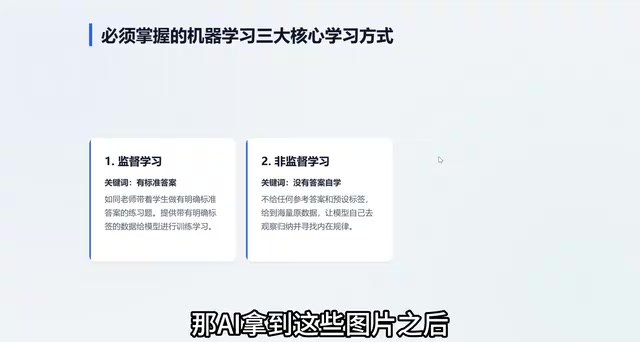
The core idea behind machine learning is: since it's impossible to write down every rule, let machines discover patterns from massive amounts of data. There are three main approaches:
Supervised Learning
Like a teacher guiding a student with both questions and answers. For example: provide ten thousand images already labeled as "cat / dog / car," and once trained, the machine can independently classify new images. Email spam filtering, bank fraud detection, and medical imaging diagnostics are all classic supervised learning applications — they share a common trait: large volumes of historical data with clear, correct labels.
Unsupervised Learning
"No correct answers given — let the machine find its own patterns." Imagine walking into a fruit store with no labels: your brain naturally groups the round red ones together and the long yellow ones together. Modern large models use a similar approach during pre-training — given "The weather is nice today, let's go ____," the AI predicts the missing word based on context. This "self-supervised learning" is essentially a variant of unsupervised learning: the massive volume of text on the internet serves as training material with no manual labeling required.
Reinforcement Learning
The most intuitive of the three: "reward good behavior, penalize bad behavior." Like a child who gets praised for tidying their toys and therefore does it more willingly.
In large model training, reinforcement learning typically appears as Reinforcement Learning from Human Feedback (RLHF): human annotators rank the quality of multiple model responses; a "reward model" is trained to simulate human preferences; and that reward model continuously scores the language model's outputs, using positive and negative feedback to iteratively improve behavior. RLHF is one of the key reasons ChatGPT produces fluent, natural, and safe conversations.
A simple way to remember all three: supervised has answers, unsupervised has none, reinforcement relies on feedback.
Deep Learning and Transformer: The Foundation of Modern Large Models
Deep learning is an advanced form of machine learning. Its defining feature is the introduction of neural networks — inspired by (not copied from) how the human brain works. Think of it as a multi-stage assembly line: data flows from the first layer through subsequent layers, extracting increasingly complex information at each stage. Take recognizing a cat in a photo: the first layer detects colors, edges, and lines; the second identifies ears, eyes, and tails; the third determines it's an animal; the fourth confirms it's a cat and not a dog.

"Deep" doesn't mean the AI is smarter — it refers to the fact that the model processes information through more layers, each learning features at a different level of abstraction.
But traditional neural networks have limitations: deeper networks train more slowly, and distant information tends to get lost. For example, in the sentence "Xiao Ming lent his book to Xiao Hong because he had an exam the next day" — early RNNs (Recurrent Neural Networks) processed text word by word, and the further along they went, the more they tended to forget earlier content. They struggled with long texts and couldn't parallelize computation, making training extremely slow.
In 2017, Google published the landmark paper Attention Is All You Need, introducing the Transformer architecture — fundamentally solving these problems. Its core innovation is the self-attention mechanism, which allows the model to consider the relationship between any given word and every other word in the sentence simultaneously, learning to "focus on what matters." Given the sentence "This morning, Xiao Li attended an AI conference in Beijing and announced a new large model," when asked "Who released the new model?" the model automatically focuses on "Xiao Li" rather than treating "this morning" or "Beijing" as equally relevant. Crucially, the attention mechanism supports highly parallel computation, making it feasible to train models with trillions of parameters.
Today, all major large models — ChatGPT, DeepSeek, Qwen, Doubao, ERNIE, Claude, Gemini — are built on the Transformer. It is the true foundation of modern large models.
You Don't Need to Build the Engine to Drive the Car
Many people worry that learning AI requires mastering advanced mathematics, neural network theory, or even training large models from scratch. In reality, the vast majority of people don't need to do any of that.
Knowing how to drive doesn't mean you need to know how to build an engine. Using a smartphone doesn't mean you need to know how to fabricate chips. Writing Python doesn't require you to have designed the language. The underlying technology has already been developed and refined by companies like OpenAI, Google, and DeepSeek.
For most learners and application developers, the real value lies in: using these models to solve real problems, improve productivity, and build applications that meet their own needs. In practice, the vast majority of AI applications are built by calling existing large model APIs, combined with techniques like Prompt Engineering and RAG (Retrieval-Augmented Generation) — not by training models from scratch. Standing on the shoulders of giants is far more valuable than reinventing the wheel.
AI is no longer a distant future — it's happening right now. Developers use it to write code, designers use it for design, marketers use it for copywriting, teachers use it to prepare lessons. The real question isn't whether AI will change the world. It's whether, when it does, we choose to embrace it — or get left behind.
Related articles

The Truth Behind Codex 'Build a Website in 5 Minutes': AI Isn't Creating Sites—It's Helping You Copy Them
Exposing the truth behind viral Codex 5-minute website videos: creators aren't building original sites with AI—they're copying shared prompts or scraping others' work. Learn AI coding tools' real limits.

Getting Started with AI Agent Development: A Complete Guide from Concept to Practice
A comprehensive guide to AI Agent architecture and development, covering automated marketing, intelligent customer service, and investment analysis scenarios with single and multi-agent collaboration.

The Truth Behind Codex 'Build a Website in 5 Minutes': AI Isn't Creating Sites — It's Helping You Copy Them
Exposing the truth behind viral Codex 5-minute website videos: creators aren't building original sites with AI — they're copying shared prompts or scraping others' work.