Understanding NVIDIA Dynamo Frontend in 5 Minutes: An OpenAI-Compatible Entry Point for Inference Architecture
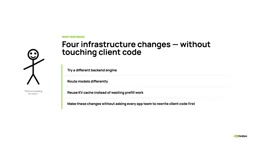
The Dynamo frontend decouples clients from backend infrastructure with a stable OpenAI-compatible API boundary.
The article explores the NVIDIA Dynamo frontend, whose core value is decoupling client compatibility from backend infrastructure. Application teams keep calling the familiar OpenAI-compatible Chat Completions interface, while the Dynamo frontend handles request forwarding, model routing, and backend selection behind a stable API boundary. This lets teams replace or compare inference engines like SGLang, TensorRT-LLM, and vLLM without rewriting client code. As the request entry point, the frontend also enables intelligent routing such as KV cache reuse to avoid costly repeated prefill. It can be adopted gradually as an independent module, starting with a stable entry point and then adding routing and scaling capabilities with lower risk.
Why Do You Need a Dynamo Frontend?
A common dilemma in the evolution of distributed inference: application teams have already written client code against an OpenAI-compatible Chat Completions API, but the infrastructure team wants to swap backend engines, adjust model routing strategies, or reuse KV cache to avoid redundant computation. If every backend change forces all application teams to rewrite their clients, the migration cost becomes prohibitively high.
The latest episode of NVIDIA Dynamo's "5 Minutes" series focuses on this problem. The video uses developer Ron's team as an example: their application calls an OpenAI-compatible Chat Completions endpoint, and the client code works fine, but the infrastructure behind the endpoint is starting to change—they want to try different backend engines, route models differently, and reuse KV cache instead of wasting time on repeated prefill. The key point is that they don't want every application team to have to rewrite client code first.
This is exactly the tension that the Dynamo frontend is designed to resolve. It is not just an API facade; it is where Dynamo decouples "client compatibility" from "backend infrastructure." In other words, the frontend preserves the familiar OpenAI-compatible interface (such as /v1/chat/completions) for clients, while Dynamo handles routing and backend selection behind the frontend.
A Stable API Boundary: Making Migration No Longer Break the Contract
The video illustrates the role of the frontend with a concrete migration scenario. Initially, Ron's team's endpoint was backed by a single engine and a single worker configuration. The application sends a request, the client calls the chat completion endpoint, the model returns a response—a simple, direct path.
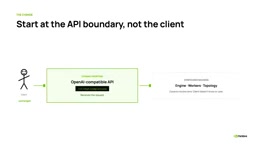
When the team wanted to introduce Dynamo, they did not start by changing every client; they started at the API boundary. Clients continue to call the same OpenAI-compatible route, and the Dynamo frontend receives the request and forwards it to the configured backend. This approach significantly reduces the disruption of migration: the frontend preserves the contract, application developers only need to confirm that the client can execute requests, and the infrastructure team gains room to evolve the serving architecture behind the scenes.
The core of this design philosophy is separation of responsibilities. Application developers care about whether requests are executed correctly; the infrastructure team cares about engines, topology, and performance. The frontend serves as the stable interface between the two, making backend changes transparent to clients.
OpenAI-compatible interface (/v1/chat/completions) refers to an HTTP interface that maintains consistency with the OpenAI Chat Completions API in request/response structure, field semantics, and error codes. A typical request body includes fields such as
model,messages, andstream, while the response includeschoices,usage, and so on. Since many client SDKs, orchestration frameworks, and evaluation tools implement to this contract by default, maintaining compatibility means applications can switch to a new backend with almost no changes. At the implementation level, protocol adaptation is usually required: translating the unified request into native calls for each inference engine, and then normalizing the output back into a unified format. Understanding this helps grasp the layered value of "stable contract, variable implementation."
Replaceable Backends: One Interface, Multiple Engines
The video then demonstrates backend replacement and comparison scenarios. Ron's team might want to run SGLang on one backend, TensorRT-LLM on another, and vLLM on yet another.

The key point here is not to make clients care about the details of each backend, but rather that Dynamo separates the external API contract from internal engine and topology choices. The frontend becomes the stable edge of the system, and behind that edge, Dynamo can route requests based on model, deployment, and service configuration. The same chat completions interface can point to backends that change over time.
The direct benefit of this separation is lower experimentation cost. Teams can compare the performance of different inference engines without touching clients, or direct traffic to different deployment forms by model. For scenarios that require multiple engines to coexist, this architecture is far more flexible than a tightly coupled client-server approach.
SGLang, TensorRT-LLM, and vLLM are three mainstream large-model inference engines today, with different positioning and optimization paths. vLLM is known for PagedAttention and high-throughput batching, with simple deployment and a mature ecosystem; TensorRT-LLM performs graph optimization and kernel fusion based on NVIDIA TensorRT, often achieving lower latency on NVIDIA GPUs but at higher compilation and tuning cost; SGLang focuses on structured generation and prefix/cache reuse, and stands out in prefix-sharing scenarios with RadixAttention. Their batching strategies, parallelism methods, and KV cache management mechanisms differ, so "one interface pointing to different engines" requires the frontend to take on protocol adaptation and routing responsibilities—which is precisely the precondition for low-cost replacement and comparison experiments.
KV Cache and Routing: The Frontend Is the Starting Point for Intelligent Backend Behavior
The video also mentions the significance of KV cache. Prefill work can be very expensive, and if the routing process is unaware of reusable KV cache, the system may repeat work that could have been reused. The frontend is the entry point for requests into Dynamo, so it sits on the path that enables smarter backend behavior.
It should be noted that the video does not exaggerate the frontend's role as the direct manager of the cache, but emphasizes that requests enter through the frontend, routing decisions are triggered on this side, and capabilities such as cache reuse gain room to operate from there. For long-running production workloads, reducing repeated prefill often means significant resource savings, and the frontend happens to be the first link in this optimization chain.
Prefill and KV cache are two key aspects of large-model inference. During generation, the model must first perform a forward pass over the input prompt, producing Key/Value tensors for each layer and caching them for reuse during subsequent token-by-token decoding—this step is prefill, and its compute cost grows significantly with prompt length. KV cache reuse means that when multiple requests share the same prefix (such as system prompts, long documents, or multi-turn conversation history), the already-computed KV blocks are reused directly, skipping repeated prefill. Since the cache is usually distributed in the GPU memory of specific workers, if routing can direct same-prefix requests to the instance holding the corresponding cache, it can significantly reduce first-token latency and compute overhead; otherwise, it causes redundant computation. This explains why routing decisions at the request entry point are crucial to cache benefits.
Architecture Overview: From Tight Coupling to Layered Decoupling
The video concludes with an architecture diagram. On the left are client applications; in the middle is the Dynamo frontend, the stable API boundary; on the right is the backend service layer, including model workers, engines, routing choices, and infrastructure topology.
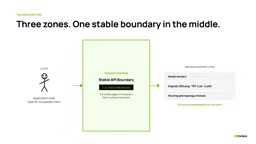
Before introducing Dynamo, clients may have been tightly coupled to a specific server or deployment form. After introducing Dynamo, clients maintain the OpenAI-compatible contract while the backend becomes more flexible. This before-and-after comparison is an intuitive way to understand the value of the frontend: the contract stays the same, the underlying implementation can change.
Layered decoupling in inference services is typically reflected as the separation of control plane and data plane: the control plane handles model registration, routing policies, replica scaling, and health checks, while the data plane handles actual request forwarding and token streaming output. The Dynamo frontend sits at the boundary between the two, serving as both the unified entry point of the data plane and the layer that removes routing and backend selection from clients. The accompanying concept is the "stable edge": the edge only promises that the protocol and semantics remain unchanged, while the internal topology (engine version, parallelism, replica distribution) can evolve independently. This layering makes canary releases, A/B comparisons, and multi-engine coexistence routine operations, without the cost of client modifications.
Independent Modularity: Gradual Adoption Starting from the API Boundary
Finally, the video emphasizes a practical point that is easy to overlook: the frontend can be adopted as an independent module. Ron's team can absolutely start only with the OpenAI-compatible API boundary without introducing all other Dynamo capabilities at once. The goal is to first establish a stable entry point, and then decide which backend, routing, or scaling features to add next.
For teams in production environments, this gradual adoption path reduces the risk of introducing new infrastructure. There is no need to overturn existing systems; instead, replace the entry layer first so clients remain unaware, and then gradually migrate backend capabilities to the new architecture. The video's conclusion is also straightforward: to modernize inference services without breaking existing clients, the Dynamo frontend is the right starting point. It preserves API familiarity while giving Dynamo the opportunity to optimize backend infrastructure.
One-line Summary
The Dynamo frontend decouples clients from backend infrastructure with a stable OpenAI-compatible API boundary.
Paragraph Summary
The article centers on the NVIDIA Dynamo frontend and explains that its core value lies in decoupling "client compatibility" from "backend infrastructure." Application teams continue to call the familiar OpenAI-compatible Chat Completions interface, while the Dynamo frontend handles request forwarding, model routing, and backend selection behind a stable API boundary. As a result, teams can replace or compare inference engines such as SGLang, TensorRT-LLM, and vLLM without rewriting client code, and route traffic by model and deployment form. As the request entry point, the frontend is also on the path that enables intelligent routing behaviors such as KV cache reuse, reducing expensive repeated prefill. The article concludes by emphasizing that the frontend can be adopted gradually as an independent module: establish a stable entry point first, then introduce routing, scaling, and other capabilities step by step, modernizing inference services with lower risk.
Related articles

5.3-Inch Phone Crowdfunding: Small-Screen Revival or a $599 Compromise?
Enough Phone crowdfunds on Kickstarter with a 5.3-inch screen, 8GB RAM, and 50MP sensor at $599. The Vergecast asks: can small phones find a middle ground?

Asahi Linux Ditches MIT for GPL: A Farce Aimed at Omarchy?
Asahi Linux switched its code license from MIT to GPL V2, accusing Omarchy of stealing code and commercializing it. Analysis suggests the move is poorly justified and violates the MIT license, exposing political divisions and AI controversies in the open source community.

Jensen Huang Affair Rumors Entangle Nvidia in China Spy Scandal as Its China Strategy Comes Under Pressure
Jensen Huang is alleged to have had an affair with a woman suspected of being a Chinese spy. The unverified rumor could weaken Nvidia's lobbying effectiveness in Washington, adding greater resistance to its push for relaxed chip export controls and its efforts to maintain access to China's AI market.