Understanding RAG from Scratch: Give a Large Model Context and It Can Answer Anything

A beginner-friendly explanation of RAG: how retrieval-augmented generation solves LLM hallucinations and enables enterprise AI.
This article explains RAG (Retrieval-Augmented Generation) from scratch, covering why large language models need external knowledge retrieval to combat hallucinations, outdated knowledge, and inability to answer private questions. It details how RAG works through vector search and semantic matching, explores application scenarios like customer service and policy queries, and discusses why vertical domain models powered by RAG represent the future of enterprise AI deployment.
What Is RAG? Breaking Down the Core Concept in One Sentence
Many tutorials on RAG (Retrieval-Augmented Generation) jump straight into jargon, leaving beginners more confused than before. This Bilibili tutorial series offers a more intuitive way to understand it: Give me a context, and I can answer your entire world — this is the soul of RAG. Simply put, RAG feeds knowledge that a large model doesn't originally possess through external retrieval, enabling it to answer based on that information.
RAG (Retrieval-Augmented Generation) was formally introduced by Meta AI (formerly Facebook AI Research) in a 2020 paper. Its core idea is to combine Information Retrieval and Text Generation — two traditional NLP tasks — in an end-to-end manner. In traditional generative models, all knowledge is compressed and stored in model parameters. This "parametric memory" approach has inherent capacity limitations and update difficulties. RAG introduces "non-parametric memory" (i.e., external knowledge bases), allowing the model to dynamically access external information sources when generating answers, thereby breaking through the limitations of purely parametric models.
To make the concept tangible, the creator uses an experience everyone has had: when shopping online, we often consult store chatbots. These robot assistants, pre-loaded with "Question 1 maps to Answer 1, Question 2 maps to Answer 2," are essentially a "prototype" of RAG. If you ask the right question, they respond; if not, they hand you off to a human agent.
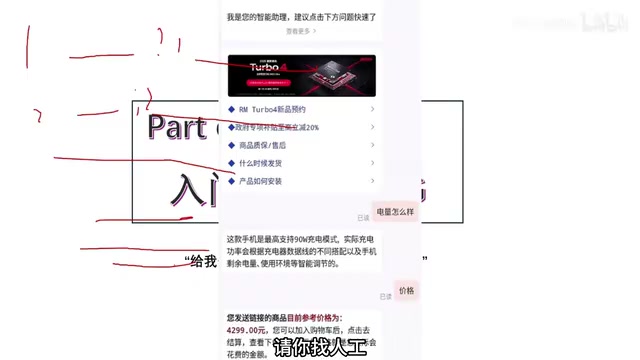
But this simple Q&A matching lacks RAG's "soul" — the large language model. It's rigid one-to-one matching that cannot flexibly understand and organize language. True RAG combines a knowledge base with a large model, enabling the machine to both "understand" questions and "articulate" answers clearly.
Why Do Large Models Need RAG? Three Core Pain Points
Hallucination: Confidently Spouting Nonsense
The most well-known problem with large models is "hallucination." When a model doesn't know the answer to a question, instead of honestly admitting it, it fabricates a seemingly correct response with great confidence. Just like that rigid chatbot — when it encounters a question without a preset answer, it either gets it wrong or gives up entirely. Large models are even more "dangerous" in this regard — they're wrong with absolute confidence. If you lack the domain knowledge to verify, you can easily be misled.
The root cause of LLM "hallucination" lies in the generation mechanism — the autoregressive decoding process of the Transformer architecture is fundamentally a probabilistic sampling process. When generating each token, the model calculates a probability distribution for the next token based on preceding context, then samples from it. When the model lacks sufficient training data on a topic, it still generates content that "looks reasonable" but is actually incorrect based on statistical patterns. The model isn't "deliberately lying" — its probabilistic generation nature dictates this behavior. Its optimization objective is "fluency" and "plausibility," not "factual accuracy." Academically, hallucinations are categorized into "factual hallucinations" (contradicting real-world facts) and "faithfulness hallucinations" (contradicting given context). RAG effectively transforms the model from "generating from nothing" to "generating with evidence" by providing real reference documents, dramatically reducing hallucination probability.
Outdated Knowledge
Large models have a "knowledge cutoff date." If a model's knowledge was updated to a certain point in time, it likely knows nothing about events that occurred afterward. While models with web search capabilities can compensate by querying the internet in real-time, purely offline models are helpless when facing new knowledge.
The "knowledge cutoff" is closely tied to the training pipeline. Taking GPT-4 as an example, the entire process — data collection, cleaning, pre-training, RLHF alignment — can take months or longer. During pre-training, the model learns language patterns and world knowledge from large-scale corpora, but this data collection has a clear time boundary. Once training is complete, model parameters are "frozen" — unless additional fine-tuning or incremental training is performed, it cannot acquire new knowledge. This is why even newly released models often have knowledge that lags by several months. Web search integration (like Bing search) is essentially a real-time RAG implementation — retrieving the latest information from the internet and injecting it into the model's generation context.
The Real Key: Inability to Answer Private Questions
The first two problems aren't actually the most fatal. The tutorial points out that the core reason large models can't truly be deployed in enterprises is that they cannot answer private questions.

The logic is simple: enterprise product documentation, internal knowledge, and trade secrets will never be publicly available on the internet, and certainly won't be used to train public large models — this involves information privacy and security. So if you ask a general-purpose LLM "What does Company X's Product A look like?" it will inevitably know nothing. RAG was born precisely to solve this core problem: retrieve reference answers from the enterprise's own knowledge base, then let the large model answer based on those.
Enterprises face serious data compliance challenges when using AI technology. Under various data protection regulations (such as the EU's GDPR, China's Data Security Law, and Personal Information Protection Law), core enterprise data must not be arbitrarily transmitted externally or used for third-party model training. Additionally, many industries (finance, healthcare, defense) have specialized data classification management requirements. RAG's technical advantage lies in the fact that knowledge bases can be deployed on enterprise intranets with data never leaving the domain; large models can use privately deployed open-source models (like LLaMA, Qwen, etc.), keeping the entire pipeline within enterprise control. This architecture ensures both AI capability acquisition and data security compliance, making it one of the most popular technical solutions for enterprise AI deployment today.
RAG's Working Mechanism: How to Make Large Models Understand and Articulate
Retrieving Answers from the Knowledge Base
RAG's working mechanism can be summarized as: retrieving appropriate reference answers from a knowledge base and letting the large model respond using those answers. While the model technically still "doesn't know," we've essentially handed it the real answer.
What's even more elegant is the efficiency aspect. Humans look up information on a one-time basis — every time we don't know something, we have to search again. Large models are different: once the knowledge base is established, every subsequent answer can leverage it without repeated feeding. This dramatically saves research time, making "having the LLM find answers for us" a reality.
RAG's retrieval component primarily relies on Vector Search technology. The workflow is: first, use an Embedding model (such as OpenAI's text-embedding-ada-002, BGE, etc.) to split knowledge base documents into chunks and convert them into high-dimensional vectors, which are stored in a vector database (such as Milvus, Pinecone, FAISS, etc.). When a user asks a question, the query is similarly converted into a vector, then the closest document fragments are found in vector space using metrics like cosine similarity or inner product. This semantic similarity-based retrieval approach understands user intent far better than traditional keyword matching. For example, a user asking "how to return items" and a knowledge base entry titled "return and exchange policy" may not match word-for-word, but their vectors are close in semantic space, enabling successful matching.
Solving the Twin Problems of "Can't Understand" and "Can't Articulate"
The tutorial uses a brilliant analogy to break down the essential difference between chatbots and RAG, distilling it into two core problems: can't understand and can't articulate.
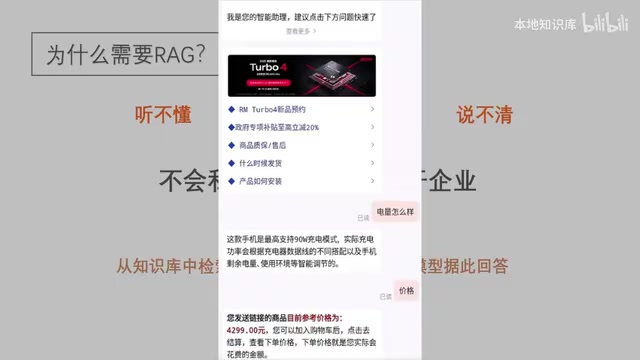
"Can't understand" means the model simply doesn't comprehend your question — like asking an elementary school student who only knows addition and subtraction to understand "what is a function." The concept simply doesn't exist in its knowledge base. "Can't articulate" means that even with fixed Q&A pairs, the chatbot's responses are stiff and rigid.
"Can't articulate" is actually easy to solve — give the knowledge to a large model, and it naturally organizes fluent, clear language. The real challenge is "can't understand," which is exactly what RAG tackles: through retrieval mechanisms, enabling the large model to understand and match the user's true intent. When the knowledge base is absent, the model can only give vague, generic answers; once the knowledge is in place, it can both "understand" and "articulate clearly," outputting accurate and precise answers.
From a technical perspective, "can't understand" is essentially a semantic understanding and intent matching problem. Traditional keyword matching cannot handle synonyms, near-synonyms, elliptical expressions, and other complexities of natural language. Modern RAG systems map text to semantic space through Embedding models, so that even when a user's phrasing differs significantly from the original text in the knowledge base, successful retrieval occurs as long as the semantics are similar. Going further, some advanced RAG systems employ techniques like Query Rewriting and HyDE (Hypothetical Document Embeddings), where the large model first understands and rewrites the user's question before retrieval, further improving the ability to "understand."
RAG Application Scenarios and the "Broad RAG" Concept
Three Most Readily Deployable Scenarios
The tutorial lists the three most readily deployable directions for RAG:
- Intelligent Customer Service: Feed product knowledge to a large model, and it can respond like a real human agent. Compared to traditional FAQ bots, RAG-based intelligent customer service handles more varied question phrasings and can combine multiple knowledge points for comprehensive answers, dramatically improving user experience.
- Policy Queries: Legal and policy knowledge updates on clear cycles, remaining stable between updates — making it ideal for knowledge base import. Conversely, constantly changing knowledge is less suitable for RAG. These scenarios demand extremely high accuracy, and RAG's "evidence-based" nature meets this need perfectly. It can also attach source citations in answers, facilitating user verification.
- AI Search: This point is controversial — some argue that real-time web search doesn't count as RAG.
Broad RAG: Don't Limit Yourself to Fixed Knowledge Bases

The tutorial raises a noteworthy perspective: under a broad definition of RAG, AI search also qualifies as a form of RAG. Returning to that initial statement — as long as you provide knowledge the large model doesn't have and let it answer based on that, it's RAG. AI search essentially retrieves from web pages when the model doesn't know an answer, then generates a response based on retrieved content — fitting RAG's core logic.
Whether AI search qualifies as RAG is indeed debated in both academia and industry. Narrow RAG typically refers to retrieval augmentation based on fixed knowledge bases — pre-built, relatively static document collections. AI search (like Perplexity AI, Google SGE) retrieves information from the internet in real-time and generates answers. The two are highly similar in technical architecture — both contain "retrieval-augmentation-generation" stages — differing only in whether the retrieval source is a static knowledge base or the dynamic internet. From a broader perspective, any technique that injects external information into the generation process can be viewed as a RAG variant, including Tool Use and Function Calling, which some researchers also categorize under broad RAG.
The creator also directly asked multiple large models "Do you use RAG technology?" Most responded with "includes but is not limited to" — indicating these models do contain RAG capabilities at their core (such as supporting file uploads), but aren't entirely equivalent to RAG. Regarding whether AI search counts as RAG, the models themselves acknowledged it "is also a form of RAG technology."
A Simple RAG Demo
The tutorial wraps up with a minimal example: if you ask a large model "How old is Xiaomi?" without providing any information, it can only give a vague, generic answer based on its own knowledge base (with a noticeable thinking pause). But as soon as you tell it "Xiaomi is 18 years old," it can immediately answer accurately. This is the most intuitive demonstration of RAG.
Though simple, this example fully illustrates RAG's three core steps: Indexing — storing the knowledge "Xiaomi is 18" in the system; Retrieval — finding this relevant knowledge when the user asks; Generation — the large model organizing language to answer based on retrieved knowledge. In actual engineering practice, each of these stages has extensive optimization opportunities — document chunking strategies, retrieval ranking algorithms, prompt engineering, etc. — all of which are advanced topics to master when diving deeper into RAG.
Data Is Running Out: Vertical Domain Large Models Are the Future
The tutorial also references a statement from an AI conference: the internet's data is almost used up. This is indeed worth pondering — humanity has only one internet, and the growth rate of internet knowledge is far outpaced by AI's development speed.
Scaling Law is the core theory driving large model development in recent years. Proposed by OpenAI in 2020, it states that model performance follows a power-law relationship with parameter count, data volume, and compute. However, the total amount of high-quality internet text data is finite — according to Epoch AI research estimates, high-quality text data may be exhausted by around 2026. This "Data Wall" problem has attracted widespread attention. To address this challenge, the industry is exploring multiple paths: synthetic data generation, multimodal data utilization, reinforcement learning (like DeepSeekAd's RL approach), and the vertical domain deepening mentioned in this article.
But does this mean AI development will stagnate? The answer is no. Because vast amounts of data have never entered the training pipeline of large models — data from industrial, financial, military, and other specialized domains. This data cannot be used to train general-purpose large models, but it's precisely the fuel for vertical domain large models.
The future development focus is shifting from "large and comprehensive" to "vertical depth" — building dedicated large models for industries, specific sectors, and individual companies. These models may appear "smaller" and "narrower," but they're actually more useful. True industrial deployment happens at this stage. And RAG is one of the key technologies enabling general-purpose large models to quickly acquire vertical domain capabilities. Compared to full fine-tuning a vertical domain model, RAG's advantages include: no need to retrain the model, instant knowledge updates, extremely low cost, and no impact on the model's existing general capabilities. For most enterprises, "general-purpose LLM + RAG" is the most cost-effective AI deployment solution.
Key Takeaways
Related articles

RAG Getting Started in Practice: From Principles to Building an Enterprise Knowledge Base
Bilibili RAG course highlights: from retrieval-augmented generation principles, document chunking and vectorization, to five accuracy factors and enterprise knowledge base boundaries, with fine-tuning vs RAG selection advice.

AI Model Selection Guide: DeepSeek vs. Qwen3 in Practice
How should AI developers choose models? Based on a Bilibili tutorial, this article breaks down the Function Calling differences between DeepSeek V3 and R1, Qwen3's programmatic thinking mode switching and agent capabilities, and outlines a multi-model learning path and practical selection logic.

Anchoring, Loss Aversion, and Nudges: 5 Psychological Tactics Retailers Use to Make You Spend
Behavioral economics reveals how retailers use anchoring, framing, loss aversion, and nudge theory to manipulate your spending decisions. This article breaks down 5 common psychological tactics and offers counterstrategies like slowing down decisions and setting your own anchors to see through the pricing design behind discounts.