Understory Notes: A Mac Note-Taking Tool Built for Writers

Understory Notes is a Mac app designed for people who "take notes to write," connecting the entire flow from collection to publishing.
Understory Notes is a Mac app created by independent developer Allen Ussher, positioned for people who "take notes in order to write something." It organizes snippets collected while reading into a hierarchical outline, displays the outline, material, and draft side by side while writing to reduce cognitive burden, and can export to PDF, rich text, Markdown, or publish directly as a website. Compared with general tools like Notion and Obsidian, Understory gives up cross-platform sync and plugin ecosystems to focus on the writing scenario. It received 71 votes and ranked 15th on Product Hunt, validating the "writing-first" vertical need. It's better suited to content creators, researchers, and heavy Mac users, and not suited to teams needing collaboration or project management.
In an era where note-taking apps are blooming everywhere, most products chase the goal of "capturing everything"—from to-dos to fleeting ideas, from meeting minutes to web clippings. But users whose ultimate goal is to "write an article" often find themselves constantly switching between multiple tools: one for collecting material, one for organizing outlines, and yet another for finishing the writing.
Understory Notes, a Mac app that recently appeared on Product Hunt, attempts to resolve this fragmentation with a single fluid workflow. Its positioning is crystal clear—designed for people who take notes in order to write something.
An Integrated Flow from Collection to Publishing
The core logic of Understory is to organize notes around the writing process itself.
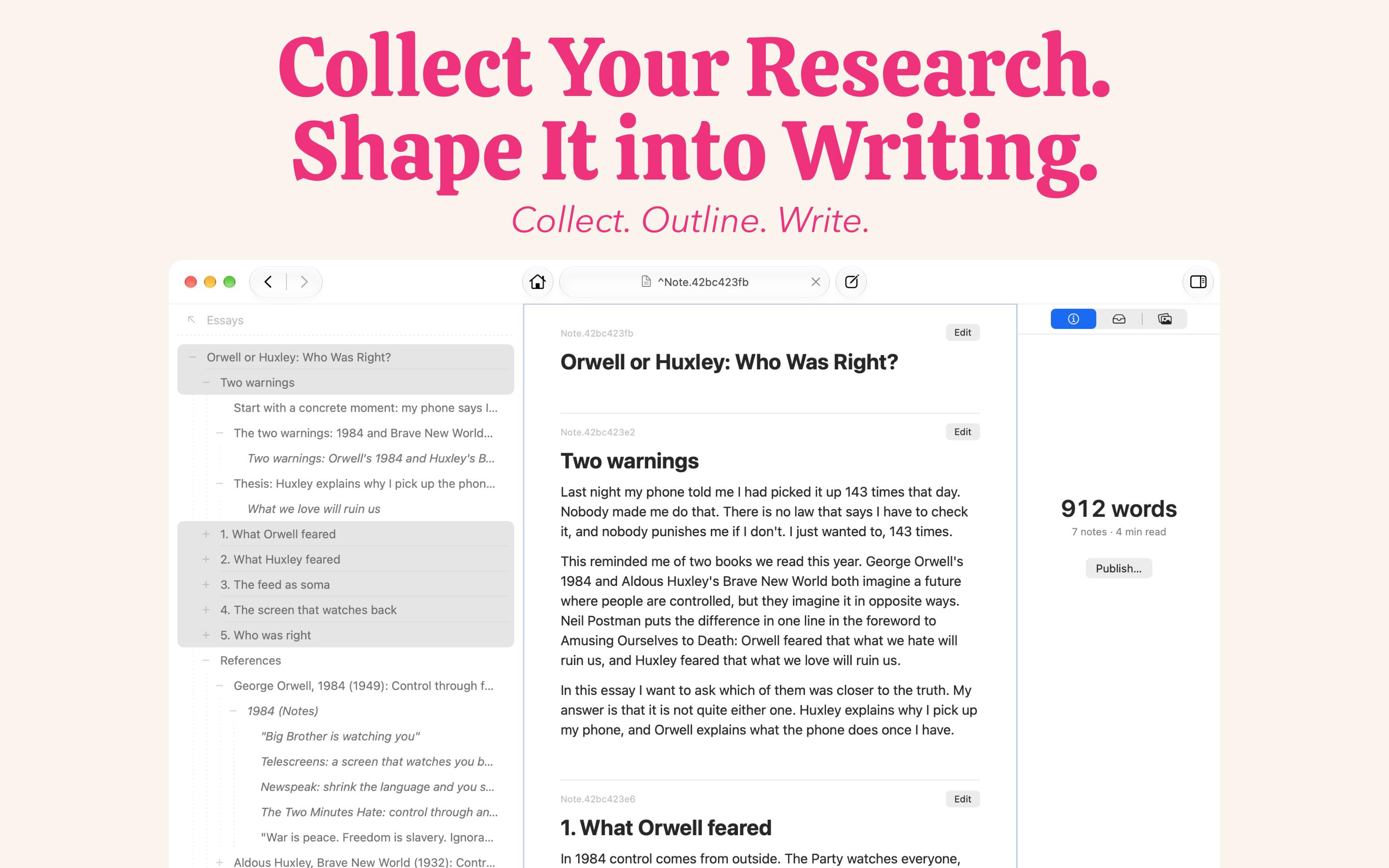
The snippets, quotes, and ideas you collect while reading enter the app as notes. These notes are not isolated cards—they can be dragged and arranged into a hierarchical outline. When you're ready to write, the app displays the outline and your research material side by side—structure on the left, material on the right, and your draft in the middle. This layout reduces the cognitive burden of switching back and forth between windows.
Finished content can be exported directly as PDF, rich text, Markdown, or published as a standalone website. This "collect → organize → write → publish" chain is the key differentiator between Understory and general-purpose tools like Apple Notes, Bear, or Obsidian.
Displaying research material side by side with the draft borrows from the academic writing tradition of "source comparison": writers need to look at citations while organizing their arguments, avoiding memory load and window switching. In digital tools, this layout first appeared in Scrivener's "split screen" mode, and later in writing apps like Ulysses and Craft. Its value lies in reducing working memory load—when the material is always visible, the author can focus on advancing the logic and polishing the language, rather than wondering "which note did that sentence come from?" Understory connects this mode with note collection and outline organization to form a complete writing loop.
How It Differs from General-Purpose Note Apps
The market is not short on note-taking tools. Notion can build databases, Obsidian excels at bidirectional links, and Bear is known for its Markdown editing experience. But Understory has chosen a narrower track: writing assistance.
This narrowing brings several concrete design trade-offs. It doesn't pursue cross-platform sync—currently it only supports Mac, which means the developer can polish the interaction to better fit desktop writing scenarios. It also doesn't emphasize a plugin ecosystem or API extensions, instead focusing its energy on the linkages between notes, outlines, and drafts.
Judging from Product Hunt data, this restraint has gained initial recognition—71 votes, ranking 15th among products that day. For a tool built by an independent developer, Allen Ussher, without backing from a major company, this result shows that the "writing-first" note-taking need genuinely exists, and that a group of users is willing to try new products for it.
Bidirectional links (Backlinks) are the core mechanism of tools like Obsidian and Roam Research: when note A mentions note B, the system automatically generates a backlink in B, allowing scattered notes to form a networked knowledge structure. This model suits long-term accumulation and cross-topic association, but it also requires users to actively maintain link relationships. Understory chooses a hierarchical outline rather than networked links, using a tree structure to express an article's skeleton—closer to the linear output scenario of "writing." What authors need is sequential logical order, not infinitely extending associations. The two are not a matter of better or worse, but serve different goals: bidirectional links excel at knowledge management, while outlines excel at article organization.
Who Should Use Understory
If you fit the following scenarios, Understory is worth a look:
- Content creators and researchers: For those who need to accumulate material first, then organize structure, and finally write, Understory's workflow fits better than general-purpose note apps.
- People who dislike jumping between multiple tools: Collection, organization, writing, and export are all done in one app, reducing context switching.
- Heavy Mac users: Currently Mac-only, so if you're a long-time macOS ecosystem user, the experience will feel more native.
Conversely, if you need team collaboration, cross-platform sync, or use notes to manage project tasks, Understory may not be the optimal solution—its design goal is personal writing, not a team knowledge base.
The Product Thinking of an Independent Developer
Understory is independently developed by Allen Ussher. In a context where the note-taking track is fiercely competitive and major companies offer free products, choosing the vertical niche of "writing" is a pragmatic strategy.
General-purpose tools struggle to be excellent in every scenario, and the writing scenario has its own particularities: it requires long periods of focus, clear reference to material, and a structured path from fragments to a finished piece. Understory doesn't try to compete head-on with Notion or Obsidian, but instead serves a more specific need—turning notes into articles for real.
For users troubled by "collecting a pile of notes but never writing anything," this focus itself is valuable.
Product Hunt ranking is an important indicator of exposure for new products, usually sorted in real time by daily votes, and 15th place means entering the top 1%–2% for that day. For an individual developer, 71 votes isn't a blockbuster, but it's enough to verify that the need exists: it shows that a group of users is willing to vote in support of the "writing-first" niche positioning. Compared with general-purpose note tools that often rack up tens of thousands of votes, Understory's numbers reflect a niche but clearly defined user profile—which is exactly the typical characteristic of vertical-track products: not a large total, but an extremely high match rate.
One-line Summary
Understory Notes is a Mac app designed for people who "take notes in order to write," connecting the entire flow from collection to publishing.
Paragraph Summary
Understory Notes is a Mac app created by independent developer Allen Ussher, positioned for people who "take notes in order to write something." It organizes snippets collected while reading into a hierarchical outline, displays the outline, material, and draft side by side while writing to reduce the cognitive burden of switching tools, and can export to PDF, rich text, Markdown, or publish directly as a website when finished. Compared with general-purpose tools like Notion and Obsidian, Understory gives up cross-platform sync and a plugin ecosystem, focusing on depth in the writing scenario. The product received 71 votes and ranked 15th on Product Hunt, verifying the existence of the vertical "writing-first" need. It's better suited to content creators, researchers, and heavy Mac users, and not suited to teams needing collaboration or project management.
Related articles

Software Factory in Practice: Building an Evaluable Self-Evolving Development Pipeline with Codex and Claude Code
Deconstructing a Codex and Claude Code software factory: control/data plane separation, foreman prompts for consistency, automatic triggers, and data-driven evaluation.

WorkBuddy Full Guide: How an AI Coworker Takes Over Workplace Automation
What is WorkBuddy? This article analyzes the core capabilities of this full-scenario AI agent: autonomous execution with deliverable results, local file processing, multi-agent parallelism, and workplace automation workflows, helping you judge its essential difference from ordinary AI chat tools.

The Truth About AI Agents: A Hundred Lines of Code + an LLM, Deconstructing the Agent's Underlying Logic
AI agents aren't a new AI species—just a language model plus tools, a loop, and a goal. Here's the underlying logic: how 100 lines of Python hit a 75% fix rate, why the harness beats the model, and Gartner's "agent washing."