UnEZ: A New Neural Network Architecture That Is Unsupervised and Directly Interpretable

UnEZ discussed on Reddit is a neural network trained unsupervised with a directly interpretable latent space that can output labels.
The Reddit community discussed an arXiv paper introducing a neural network called UnEZ. The architecture claims that while being fully trained without supervision, its latent space is directly interpretable and can directly output labels on unlabeled data, thereby blurring the boundary between unsupervised learning and classification tasks. The article compares the essential difference between UnEZ and traditional autoencoders: the latter's latent vectors are abstract and lack semantics, requiring post-hoc interpretation through t-SNE or attribution methods, whereas UnEZ claims latent dimensions directly correspond to interpretable concepts. The poster raised two core questions: whether similar architectures exist, and what the specific definition and validation method of "directly interpretable" are. The article notes that if the method can generalize, UnEZ has potential value in fields requiring high transparency such as healthcare and finance, but currently there is only discussion from a single community, and performance claims need to be treated with caution; its robustness, scalability, and performance on complex data still await independent verification.
The Reddit community recently discussed a paper from arXiv introducing a neural network called UnEZ. The core selling point of this architecture is that while being fully unsupervised in training, its latent space is directly interpretable, unlike the abstract, hard-to-understand representations of traditional autoencoders.
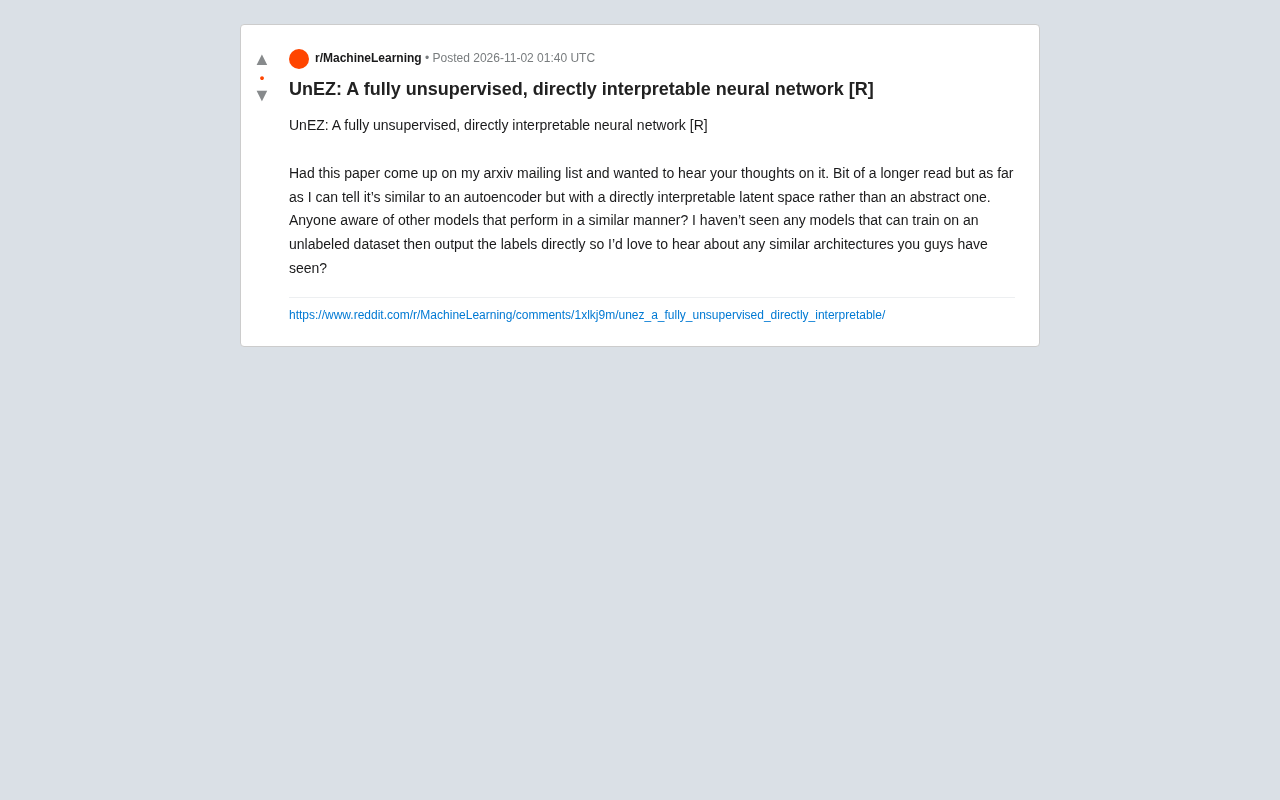
The Essential Difference from Autoencoders
The poster points out that UnEZ looks similar to an autoencoder, but the key difference lies in the design of the latent space. Traditional autoencoders compress the input into an abstract vector through an encoder and then reconstruct the input through a decoder; this latent vector usually lacks clear semantic meaning. UnEZ claims to obtain "directly interpretable" latent representations, which means the latent dimensions or variables may directly correspond to interpretable concepts or labels in the data, without the need for post-hoc analysis tools (such as t-SNE or attribution methods).
According to the post, UnEZ can be trained on unlabeled datasets and then directly output labels. If this holds true, it would blur the boundary between unsupervised learning and classification tasks, providing a more transparent modeling path for scenarios with unlabeled data.
Autoencoder is a class of neural networks aimed at reconstructing the input, consisting of an encoder and a decoder. The encoder compresses high-dimensional input into a low-dimensional latent vector, and the decoder then attempts to restore the original input from that vector. The training process does not require labels and belongs to unsupervised learning. However, the latent space of traditional autoencoders usually does not have direct semantic meaning: each dimension may correspond to hard-to-name mixed features in the data, so dimensionality reduction visualization tools such as t-SNE and UMAP or post-hoc attribution analysis are needed for interpretation. Variational autoencoders (VAEs) further introduce probabilistic distribution constraints, making the latent space more continuous and easier to sample, but they likewise do not guarantee a one-to-one correspondence between latent variables and human-understandable concepts. The "direct interpretability" claimed by UnEZ targets exactly this pain point: if the latent dimensions themselves can correspond to classification labels or interpretable factors in the data, then the model output no longer requires an additional post-hoc explanation step, thereby taking a key step forward in transparency.
Core Questions of Community Interest
The poster raised two questions worthy of deeper discussion:
- Are there other similar architectures? That is, models that also have unsupervised training, directly interpretable latent spaces, and can output labels. The poster said they had not yet seen similar work, suggesting that UnEZ may be novel in this niche direction.
- The specific definition and validation method of interpretability. "Directly interpretable" is a strong claim. The community usually cares about whether interpretability is validated through human evaluation, downstream task performance, or matching with ground-truth labels. Since the post does not elaborate on the paper's details, these aspects still require consulting the original text.
Interpretability does not have a single, universally accepted definition in the machine learning community. It can usually be evaluated from several levels: first, human understandability, that is, whether domain experts can make reasonable judgments based on the model's internal representations or output explanations, often validated through user studies or expert evaluation; second, faithfulness, that is, whether the explanation truly reflects the model's computation process rather than being a post-hoc fabricated story; third, downstream utility, that is, whether interpretable representations help improve performance on classification, retrieval, or decision-making tasks. For a model like UnEZ that claims "directly interpretable latent space," the key validation points are: whether the latent variables are highly aligned with ground-truth labels or known concepts, whether this alignment is stable on unseen data, and whether the "labels" output by the model have reliable confidence. Without these quantitative and qualitative validations, "directly interpretable" easily remains at the level of a claim.
Potential Impact and Points to Be Verified
If UnEZ's method can generalize, it may create value in fields requiring highly transparent decision-making (such as healthcare, finance, and scientific discovery). Unsupervised learning avoids annotation costs, while a directly interpretable latent space reduces the difficulty of post-deployment auditing.
However, based on community discussion alone, it is still impossible to judge the model's robustness, scalability, and performance on complex data (such as images and text). The poster also admitted that this is a "longer read," indicating that the paper may contain many technical details and is worth readers studying in depth themselves.
In high-risk fields such as healthcare, finance, and scientific discovery, model auditability is often as important as performance. Regulatory frameworks (such as the EU AI Act) impose transparency and interpretability requirements on high-risk AI systems, which makes "directly interpretable latent space" practically attractive. However, the practice of unsupervised models directly outputting labels also brings new validation challenges: without labeled data, how can the correctness of output labels be confirmed? Usually, trust must be established through a small amount of manual spot-checking, comparison with known knowledge bases, or semi-supervised evaluation. In addition, the model's scalability on complex high-dimensional data such as images and text, its robustness to noise and distribution shift, and whether the latent space can truly maintain semantic consistency are all important factors determining whether it can be deployed. These aspects are difficult to judge from community discussion alone and require waiting for reproduction experiments and independent evaluations.
Multi-Source Perspective
This discussion currently comes mainly from a single platform, Reddit, and no reproduction or commentary from other independent sources has yet been seen. Therefore, the performance claims about UnEZ should be regarded as one-sided statements by the paper's authors and treated with caution. No divergent views appeared in the community feedback either; it was more curiosity and a search for similar work.
For researchers interested in the intersection of interpretable machine learning and unsupervised learning, UnEZ offers a new direction worth tracking. In the future, citations and reproduction experiments on arXiv can be monitored to evaluate its actual effectiveness.
One-line Summary
UnEZ, discussed on Reddit, is a neural network that is trained unsupervised and has a directly interpretable latent space and can output labels.
Paragraph Summary
The Reddit community discussed an arXiv paper introducing a neural network called UnEZ. This architecture claims that while being fully trained without supervision, its latent space is directly interpretable and can directly output labels on unlabeled data, thereby blurring the boundary between unsupervised learning and classification tasks. The article compares the essential difference between UnEZ and traditional autoencoders: the latter's latent vectors are abstract and lack semantics, requiring post-hoc interpretation through t-SNE or attribution methods, whereas UnEZ claims that latent dimensions directly correspond to interpretable concepts. The poster raised two core questions: whether similar architectures exist, and what the specific definition and validation method of "directly interpretable" are. The article points out that if the method can generalize, UnEZ has potential value in fields requiring high transparency such as healthcare and finance, but currently there is only discussion from a single community, and performance claims need to be treated with caution; its robustness, scalability, and performance on complex data still await independent verification.
Related articles

AI Tools Quietly Altering Settings: Postman Silently Installs Plugin, Codex Sharing Option Auto-Resets
AI Daily reports: Postman silently installs a Mac plugin and self-approves startup hooks, logged as auto-existing upgrade; Hacker News developers say Codex data-sharing opt-out flips back. Plus Simon Willison's raw float weight experiment with QEN 3.8-27B.

AI Learns to Rewrite AI: MIT's "Weightspace Programming" Redraws the Path to Recursive Self-Improvement
MIT team proposes weightspace programming: GPT-6 Astra reads and edits AI model weights directly. Math scores jump several-fold, hand-written networks beat trained models. Eight experiments analyzed, plus Anthropic's same-day warning and the real boundaries of recursive self-improvement.

Running Qwen 3.8 on a Laptop to Read Raw Weights: 46 Minutes Per Answer
Simon Willison reproduced weight space programming with Qwen 3.8 27B on a laptop: a 17GB model file, 46 minutes per answer, 43,506 reasoning tokens, Pong over an hour, Freeway failed. Suited for interpretability researchers.