Unitree CEO: GPT-6 Already Makes Robots Work Well, Mass Production Only Awaits GPT-7

Unitree CEO says GPT-6 makes robots work well in factory pilots, with GPT-7 poised to break mass production bottlenecks.
Reddit is buzzing over Unitree CEO's statement: GPT-6 already works well across multiple robot platforms, factory pilots have begun, and GPT-7 is expected to clear remaining bottlenecks for mass production. The article distinguishes motion control from task understanding layers, noting LLMs intervene in the latter. Going from demo to production line requires overcoming engineering gaps in inference latency, edge deployment, and failure rates. Core remaining bottlenecks include generalization, long-horizon task reliability, and inference cost. Commenters diverge on whether LLMs are the right path to AGI, with LeCun's world model stance facing empirical testing. The article concludes that robotics competition is shifting from hardware locomotion to model integration and task generalization.
Starting from "The Bitter Lesson": When Large Models Collide with Robotics
A Reddit post about a statement from the CEO of Unitree Robotics sparked intense discussion. The core message is straightforward: GPT-6 already "works very well" across multiple robot platforms, factory pilots have begun; and GPT-7 is expected to clear the remaining bottlenecks, pushing robots into large-scale mass production deployment.
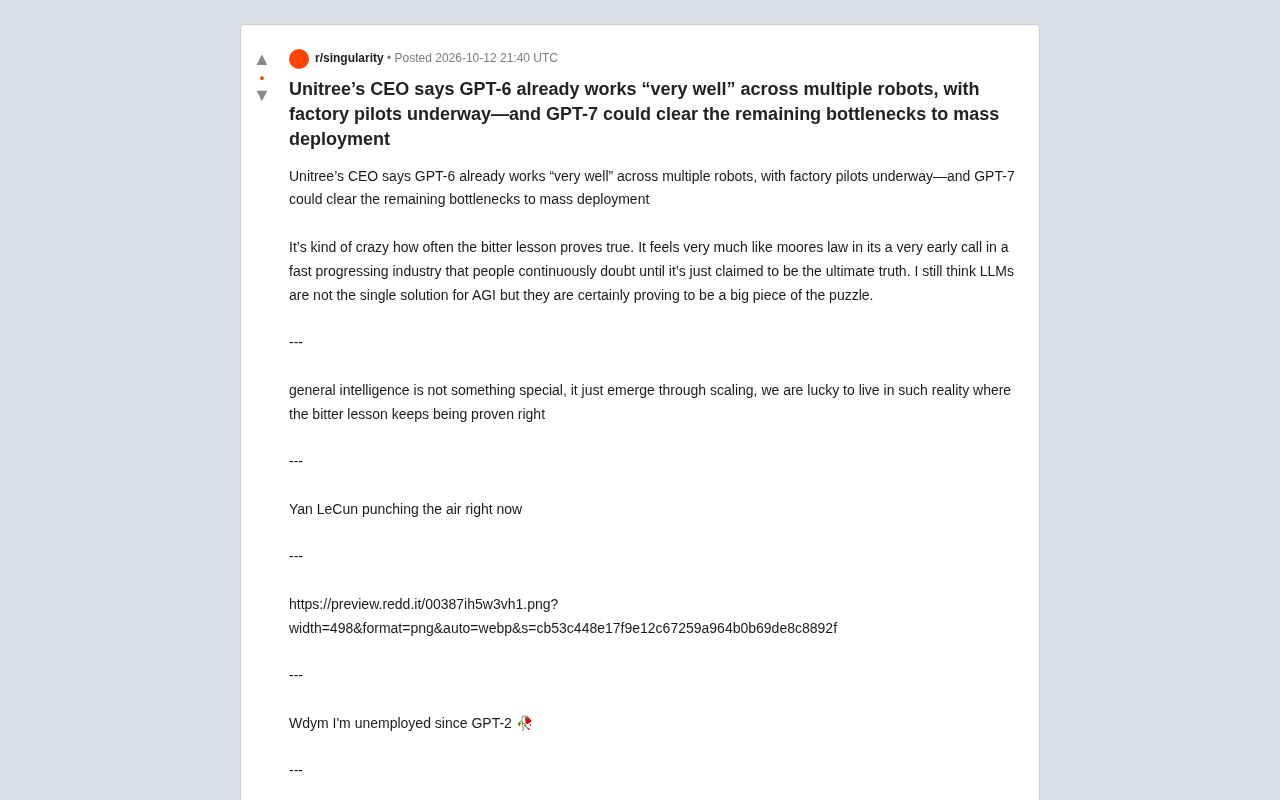
This isn't a demo video from some lab — it comes from the head of a company that has already delivered quadruped and humanoid robots to the market. In other words, the transition of large-model-driven robots from "can run and jump" to "can work on the factory floor" may be closer than most people expect.
The hottest comment in the thread frames it as yet another vindication of "The Bitter Lesson" — every time people think a certain approach won't work, scale eventually proves it does.
The Bitter Lesson was proposed by AI researcher Rich Sutton in 2019. Its core argument: throughout AI's history, methods that rely on human domain knowledge to hand-engineer features and rules have consistently been surpassed in the long run by general methods (such as search and learning) that scale with compute. Sutton cited chess, Go, speech recognition, and computer vision as examples where researchers repeatedly tried to inject human priors, only to be defeated by simple but scalable approaches. This thesis has been validated in near-textbook fashion by the GPT series — when parameter count, data scale, and compute expand in tandem, language understanding, reasoning, and generation capabilities exhibit emergent behaviors that cannot be obtained through clever architecture design. The Reddit comment placing Unitree's CEO statement in this lineage is essentially saying: problems in robotics previously thought to require specialized control algorithms may also be covered by the scaling of general-purpose large models.
What Does GPT-6 "Working Well" on Robots Actually Mean?
To grasp the weight of this statement, we need to distinguish two layers of capability.
Motion control layer: Unitree's previous strengths were concentrated in hardware and locomotion algorithms — quadruped balance, jumping, and terrain adaptation have long been industry-leading. This part relies on traditional control theory and reinforcement learning, with little connection to large models.
Task understanding and decision-making layer: This is where GPT-6 comes in. When a robot needs to understand natural language instructions like "move the box on the third shelf to the shipping dock" and decompose them into executable action sequences, the language understanding and task planning capabilities of general large models become critical.
When Unitree's CEO says "works well," it most likely refers to this latter layer: robots can receive instructions, plan paths, and complete operations in a factory environment, with stability reaching a level suitable for pilot testing.
Embodied Intelligence refers to an agent acquiring and demonstrating intelligence through perception and action interaction with the physical world, in contrast to conversational AI in purely software environments. Its core challenge: language models output token sequences, while robots need action sequences executed in continuous time and continuous space — there exists a "semantic–physical" gap between the two. The current mainstream approach to bridging this is a hierarchical architecture — the upper layer uses large models for understanding instructions, decomposing tasks, and planning steps; the lower layer uses motion control modules or specialized vision-language-action (VLA) models to translate subtasks into joint torques or trajectories. What Unitree's CEO means by GPT-6 "working well" essentially refers to the upper-layer planning component being stable enough to integrate into factory workflows, while the reliability of lower-level execution still depends on the robot's hardware and motion control expertise.
Factory Pilots: The Gap from Demo to Production Line
There's a massive gap between demo and mass production. Getting a single grasp to work in the lab versus maintaining a 99%+ success rate for 8 continuous hours on a production line are completely different engineering challenges.
The launch of factory pilots indicates several things:
- Model inference latency has been compressed to an acceptable range — robots don't "think" too long before acting
- Edge deployment solutions are working — no need to send data back to the cloud every time
- Failure rates have dropped to a level factories can tolerate
Someone in the comments joked, "I've been unemployed since the GPT-2 era." Though a joke, it reflects a real anxiety: when large model capabilities extend from screens into the physical world, it's not just white-collar jobs that are affected.
What Bottlenecks Is GPT-7 Supposed to Solve?
The most intriguing part of the post title is "GPT-7 could clear the remaining bottlenecks to mass deployment." What specifically are these remaining bottlenecks?
Generalization ability. Current models perform well in trained scenarios, but switching to a different factory, a different material, or a different workflow may require re-tuning. Mass deployment means robots need to quickly adapt to new environments, rather than having an engineering team stationed at every customer site.
Reliability of long-horizon tasks. A 95% single-step accuracy sounds good, but a task requiring 20 steps drops to 36% overall success rate. Factories need stable performance across long chains.
Cost and power consumption. Large model inference costs must drop to a level that the robot's total selling price can cover, which requires simultaneous advances in model efficiency and chip solutions.
Unitree's CEO pinning hopes on GPT-7 is essentially betting that the next leap in model capability can directly translate into a leap in engineering reliability. Whether this judgment holds is a question the entire industry is watching.
Long-horizon task reliability is the most underestimated mathematical problem in robot deployment. Assuming single-step success rate is p, and a task requires n consecutive steps with any single failure causing overall failure, the overall success rate is approximately pⁿ. The article's example of 95% single-step success rate and 20-step task corresponding to 36% overall success rate is a direct manifestation of this exponential decay. Factory production lines typically require 8 hours of continuous operation with sufficiently long intervals between failures, which means single-step success rates must approach 99.9% or higher, or the system needs the ability to autonomously detect failures and retry. This is why the industry increasingly values "recovery capability" — a 90% success rate robot that can self-correct after errors may have higher practical usability than a 99% success rate robot that cannot. If GPT-7 can introduce stronger self-monitoring and replanning at the planning layer, it would directly improve long-horizon reliability.
Divergence on LLMs and AGI
The comments section is not uniformly optimistic. A highly upvoted comment reads: "I still think LLMs aren't the only path to AGI, but they're definitely a big piece of the puzzle."
Another voice is more radical: "General intelligence isn't anything special — it just emerges from scale. We're lucky to live in a reality where the bitter lesson keeps being validated."
Someone also mentioned Yann LeCun — Meta's Chief AI Scientist who has long publicly questioned the path to AGI through LLMs alone, arguing that world models are the key. If Unitree's practice succeeds, it would somewhat serve as a real-world test of LeCun's position; if it fails, it might conversely confirm his judgment.
This divergence won't be resolved in the short term, but Unitree's factory pilot provides a rare empirical scenario: can large-model-driven robots actually make it from papers to the workshop floor?
Yann LeCun's World Model approach argues: true general intelligence requires a system that can build an internal predictive model of the physical world, capable of simulating "if I do this, how will the world change," and planning and reasoning on that basis. He believes current LLMs are essentially doing statistical prediction in token space, lacking intrinsic representations of causality and physical laws, and therefore cannot reach AGI by scaling alone. His proposed JEPA (Joint Embedding Predictive Architecture) attempts to predict in an abstract representation space rather than pixel or token space, to more efficiently learn world structure. Unitree's practice is seen as a test of LeCun's position because if a hierarchical system of a large model plus motion control can work stably in a factory, it suggests that representations learned by language models are sufficient to support some embodied tasks; conversely, if generalization bottlenecks remain unbreakable, it may confirm the fundamental limitations of the pure LLM approach in the physical world.
Several Practical Implications for the Industry
Regardless of whether GPT-7 delivers on its promises, Unitree's CEO statement has already sent a clear signal:
- The competitive dimension for robotics companies is shifting, from hardware specs and locomotion capabilities to model integration and task generalization ability
- Large model companies have another path for B2B scenarios — embodied intelligence could become a more profitable deployment direction than pure software
- The cost structure of factory automation may be rewritten — when general-purpose robots can acquire new skills through model updates, the marginal cost of deployment will drop dramatically
Whether the bitter lesson will be validated once again in robotics may be answered by factory pilot data in the next year or two.
One-line Summary
Unitree CEO says GPT-6 already makes robots work well in factory pilots, with GPT-7 expected to break through mass production bottlenecks.
Paragraph Summary
Reddit is buzzing over Unitree CEO's statement: GPT-6 already works well across multiple robot platforms, factory pilots have begun, and GPT-7 is expected to clear remaining bottlenecks to enable mass production. The article distinguishes the motion control layer from the task understanding and decision-making layer, noting that large models intervene in the latter. Crossing from demo to production line requires overcoming engineering gaps in inference latency, edge deployment, and failure rates. Remaining core bottlenecks include generalization ability, long-horizon task reliability, and inference cost. Commenters diverge on whether LLMs are the right path to AGI, with LeCun's world model stance facing empirical testing. The article concludes that the competitive dimension in robotics is shifting from hardware locomotion capability to model integration and task generalization ability.
Related articles

Workbuddy for Absolute Beginners: How a Desktop AI Agent Fits Into Real Workflows
A beginner's guide to the Workbuddy desktop AI agent: installation, claiming credits, file management, and building automated workflows—compared with CodeX for fit and cost, helping professionals shift from AI question-askers to AI managers.

OpenAI's New Agent Stack: Computer Use, Decisions API, and Ultra-Fast Workflows
OpenAI Dev Day unveiled a new agent stack: Computer Use outperforms humans, Decisions API delivers ultra-low-latency classification via Luna, Agents API opens the same Computer Use capabilities, and GPT-6.1 Sol costs only one-seventh of Astra. Core updates, benchmark data, and developer insights.

Liang Wenfeng Open-Sources DeepInfo Inference Framework, Takes On U.S. Ban
DeepSeek open-sources its DeepInfo inference framework after its models, featuring GPU/CPU cross-pipelining, small-model prediction with large-model verification, and full Huawei Ascend and NVIDIA chip support—facing the U.S. federal ban head-on. This article analyzes its significance for AI deployment and open-source strategy.