University GPU Queues Stretch to 3 Days — Is It OK for an Intern to Quietly Use Company Compute for Research?

University GPU queues hit 3-4 days, intern wants to use company compute for papers — community consensus is don't sneak it, but do negotiate.
A PhD student on Reddit complained that his university's GPU cluster has 3-4 business day queue times while his internship company's compute sits idle, so he asked whether he could use company GPUs for his own academic research. The article notes that this university compute crunch stems from the generative AI explosion raising overall GPU demand while university procurement moves slowly, leaving old cards to carry new workloads and stretching student iteration cycles tenfold. Company compute technically overlaps heavily with academic experiments, but most platforms have audit logs recording task purpose, duration, and data flow, making unauthorized use risky. The comments split into two camps: opponents emphasize the asymmetric risk of internship contract resource-use clauses, while supporters suggest going through formal communication to turn compute usage into a documented collaboration, possibly exchanging it for co-authorship or acknowledgment. The article also offers practical advice: fighting for on-campus priority, applying to external academic compute programs, and using quantization and gradient checkpointing to compress experiment demands — emphasizing that the core issue isn't whether company compute is untouchable, but whether explicit authorization was obtained in advance.
"Our university's GPU cluster has basically become a resort — submitting a job that only needs two GPUs means waiting 3 to 4 business days just to get to the front of the queue." That's a direct quote from a PhD student on Reddit. What made it even harder for him to sit still was the fact that his internship company's compute cluster was right there in front of him, sitting idle. So he threw out a question on the forum that almost sounded like a confession: Can I use my internship company's GPUs to run my own academic research?
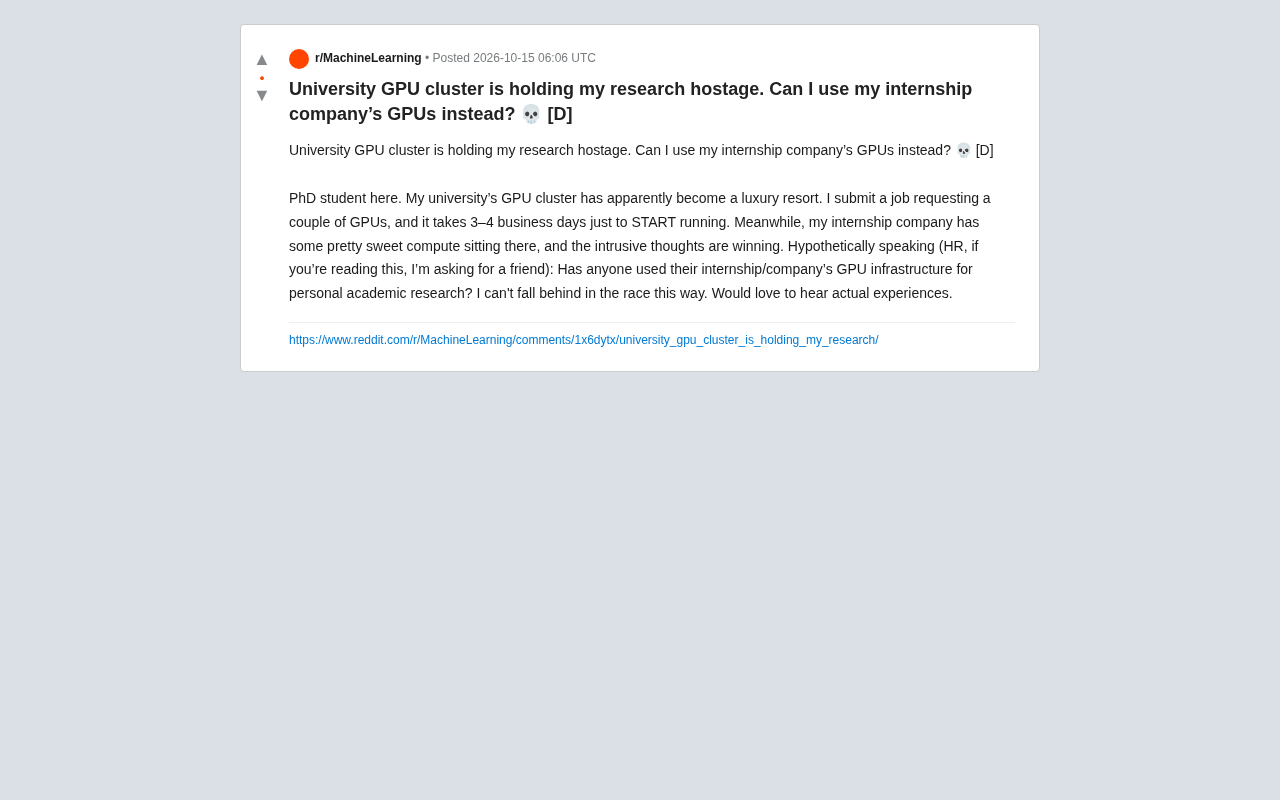
The post was tagged [D] (Discussion), and it drew a fair amount of attention. After reading through the comments and related discussions, I realized this wasn't an isolated complaint — it's a cross-section of the supply-demand imbalance in academic computing.
Why University GPU Clusters Suddenly Can't Keep Up
This wave of queueing is part of the same chain reaction as the compute crunch that followed the generative AI explosion in 2023. Large model training raised the baseline for GPU demand across the board: spot prices and rental prices for H100s and A100s kept climbing, and university procurement budgets simply couldn't keep pace.
One user in the comments who claimed to do system administration mentioned that utilization rates for V100s and A100s in their school's cluster stayed above 90% year-round, but procuring new cards involved a long process of budget approval, bidding, delivery, and installation — getting one batch deployed per year was already considered fast. The result is old cards carrying new workloads, with queue times sliding from "hours" to "days."
Against this backdrop, students' time costs get stretched directly. For an experiment that requires repeated hyperparameter tuning, if every run means waiting at least 3 days, the iteration cycle gets stretched tenfold. For PhD students racing to graduate or meet submission deadlines, that wait is more lethal than the shortage of compute itself.
What Are H100 and A100?
H100 and A100 are two generations of NVIDIA's flagship data center compute cards, and they're the two pieces of hardware most frequently mentioned in this university compute crunch. The A100 was released in 2020, uses the Ampere architecture, comes with 40GB or 80GB of HBM2e memory, and was the workhorse for large model training before ChatGPT. The H100 was released in 2022, uses the Hopper architecture, comes with 80GB of HBM3 memory, and adds FP8 computation and dedicated acceleration units for Transformer-like structures — throughput for training models of the same scale is generally several times that of the A100.
What matters for university clusters isn't just the performance gap — it's availability. The A100 used to be the "standard" that most universities could afford, but after the generative AI explosion, cloud providers and large enterprises snapped up supply in bulk, driving up both spot and rental prices across the board. The H100, due to factors like production capacity and export controls, has maintained a high per-unit price for a long time — a single procurement batch can consume an entire department's equipment budget for years. This directly explains the phenomenon mentioned in the comments: schools can only keep using old cards like V100s and A100s to carry new workloads, while the delivery cycle for new cards stretches to be measured in years.
The Gray Appeal of Company GPU Compute
Interns can access company compute usually because the team itself is doing model training or inference services, and has idle or elastic resources on hand. From a purely technical standpoint, running academic experiments and running business tasks have highly overlapping GPU requirements, with very low migration friction.
The problem lies in permissions and compliance. An engineer doing infrastructure at a big tech company added a key detail in the comments: most companies' compute platforms have audit logs, and tasks bound to employee accounts get their purpose, duration, and data flow recorded. If the experimental data involves unpublished results from a paper, or if the model being run is unrelated to the company's business, the logs will leave clear traces.
In other words, just because it can technically run doesn't mean it can safely be deployed.
Why Audit Logs Can "Pin Down" Usage
The audit logs mentioned in the comments refer to metadata automatically recorded by enterprise compute platforms for every task submission, typically including the submitting account, task start and end times, GPU model and count occupied, container image, command-line arguments, and when conditions allow, data mount paths and network egress. These logs were designed for cost allocation, troubleshooting, and security auditing, but they objectively form a traceable chain of evidence.
For interns, the risk point isn't the act of "running a task" itself, but the semantic signals left in the logs: paper-related keywords appearing in task names, datasets mounted from personal storage, run times concentrated in non-working hours, model architectures completely unrelated to the company's business. Any single anomaly could be pulled out separately during quarterly audits, exit reviews, or security incident post-mortems. More critically, these logs are usually held by the platform team rather than direct supervisors, and interns often don't realize who will view their traces and in what scenario — this is the root of "technically it runs, but safely it doesn't land."
The Unwritten Rules of Academia: Company Compute for Authorship?
Two main positions emerged in the comments, with fairly clear disagreement.
The first is "don't take it, the risk is asymmetric": once discovered by the company, at best you lose the internship opportunity, at worst you touch on academic integrity and company compliance issues. One user pointed out directly that internship contracts almost always have a clause stating "company resources are for company business only," and using company GPUs for personal academic projects falls into a typical clause coverage blind spot — if you weren't authorized, it's prohibited by default.
The second is "you can negotiate, but go through proper channels": the suggestion is for students to proactively communicate with both their company mentor and academic advisor, turning "using company compute for paper experiments" into a formally documented collaboration. If the paper's direction touches on the company's business, you could even consider having the company participate as a collaborator, exchanging compute investment for a co-authorship or acknowledgment.
This latter path actually has precedent in industry labs. According to several researchers who've done industry-academia collaborations, in joint research projects between companies and universities, the company provides compute and data while the university provides manpower and theory — authorship rules are negotiated clearly before the project starts, avoiding later disputes.
Basic Conventions for Joint Research and Authorship Rules
In formal industry-academia collaborations, the correspondence between compute, data, and authorship is generally fixed in a contract or memorandum of understanding before the project begins. Common practice: the company provides compute quotas and possibly data interfaces, the university team handles method design and experiment execution, the corresponding author of the paper is usually the university advisor, and the company-side contact person enters the author list or acknowledgments depending on their level of contribution. Some enterprises also require an internal compliance review before submission to confirm the paper doesn't contain sensitive data or business information.
The core logic of this process is "traceable contributions, provable authorization." If a student wants to use company compute for paper experiments, the safest path is to embed themselves into such an existing collaboration framework rather than relying on gray-area operations with a personal account. Even if the end result is just an acknowledgment rather than authorship, a compute usage statement confirmed by both advisors is enough to provide protection during a later audit or academic integrity check. By contrast, verbal permission or a default of "we won't pursue it" offers virtually no protection once the paper is public.
What Students Can Do Under the University Compute Crunch
Setting aside the gray areas, this PhD student's predicament has actually spurred some more prudent coping strategies in academia.
First, fight for on-campus priority. Many university clusters have expedited channels for tasks that are "about to be submitted" or "graduation sprint" — it's just that the information isn't transparent, and you need to proactively ask your department or cluster administrator. One user in the comments shared their experience of getting temporary quota through their advisor's intervention.
Second, borrow compute from academic collaborators. Supercomputing centers, national laboratories, and academic compute programs opened by some companies both domestically and abroad all offer free or low-cost quotas for university researchers. The application threshold isn't high, it just takes a long time.
Third, make experiments more compute-efficient. 4-bit quantization, gradient checkpointing, small-scale proxy model pre-experiments — these methods can compress the GPU requirements of experiments during the queue period, reducing trial-and-error runs once you actually get the cards.
A Question Without a Standard Answer
The most common reply this PhD student ultimately received can be summed up in one sentence: don't run it secretly, but you can go negotiate.
Company compute isn't untouchable — the key is whether you've obtained explicit authorization in advance, and whether the scope of that authorization covers your academic use. Running it secretly once might go unnoticed, but once the paper enters the public publication process, or the experimental data touches the company's sensitive boundaries, the nature of the matter changes immediately.
The structural pressure of university GPU queues won't disappear in the short term. Until compute actually gets cheaper, what students need may not just be faster queueing, but a set of communication skills for mobilizing external resources within a compliant framework.
Related articles

Workbuddy for Absolute Beginners: How a Desktop AI Agent Fits Into Real Workflows
A beginner's guide to the Workbuddy desktop AI agent: installation, claiming credits, file management, and building automated workflows—compared with CodeX for fit and cost, helping professionals shift from AI question-askers to AI managers.

OpenAI's New Agent Stack: Computer Use, Decisions API, and Ultra-Fast Workflows
OpenAI Dev Day unveiled a new agent stack: Computer Use outperforms humans, Decisions API delivers ultra-low-latency classification via Luna, Agents API opens the same Computer Use capabilities, and GPT-6.1 Sol costs only one-seventh of Astra. Core updates, benchmark data, and developer insights.

Liang Wenfeng Open-Sources DeepInfo Inference Framework, Takes On U.S. Ban
DeepSeek open-sources its DeepInfo inference framework after its models, featuring GPU/CPU cross-pipelining, small-model prediction with large-model verification, and full Huawei Ascend and NVIDIA chip support—facing the U.S. federal ban head-on. This article analyzes its significance for AI deployment and open-source strategy.