Unlock AWS HealthLake Clinical Data with Natural Language

AWS HealthLake plus OpenSharing and Genie One lets business users query clinical data in natural language.
The article examines the "last mile" bottleneck after healthcare organizations consolidate clinical data into AWS HealthLake: data is governed under FHIR, yet business teams cannot write FHIR queries, so exploratory analysis depends on data engineers. It proposes OpenSharing for controlled sharing without data copying and Genie One for natural language querying, while stressing explainability, traceability, compliance, FHIR model fit, and positioning Genie One as an accelerator rather than a replacement.
Clinical data has long been trapped in FHIR format and complex query languages, so when business users want a single metric, they often have to schedule time and wait for the data team. The combination of AWS HealthLake, OpenSharing, and Genie One attempts to make "talking to your clinical data" a reality.
The "last mile" problem in clinical data
More and more healthcare and life sciences organizations are consolidating clinical data in AWS HealthLake, using the FHIR standard for aggregation and governance. Once the data is centralized, a new bottleneck appears: the people who truly understand the business—clinical operations, pharmacovigilance, and real-world research teams—do not know how to write FHIR queries and are unfamiliar with the underlying data model.
As a result, although data assets exist, their use depends heavily on a small number of data engineers. Every ad hoc analysis must go through requirements discussions, scheduling, data extraction, and verification. Feedback cycles are stretched, and exploratory analysis is essentially impossible. This "last mile" is exactly what determines the return on investment of a data platform.
What is FHIR
FHIR (Fast Healthcare Interoperability Resources) is a healthcare data exchange standard developed by HL7, with R4 currently the mainstream version. It abstracts clinical data into a set of "resources," such as Patient, Observation (lab and test results), MedicationRequest (medication orders), and Encounter (visits). Each resource has a fixed field structure and coding bindings (such as LOINC, SNOMED CT, and ICD-10). Resources reference one another through Reference fields, forming a graph-like data network.
FHIR was designed for interoperability, not for analytics. Extracting a business metric from FHIR usually requires multi-hop joins across multiple resources, followed by coding mapping and time-window handling. This is the fundamental reason business users cannot easily get started directly, and it is also the key difficulty that a natural language query layer must overcome.
What OpenSharing and Genie One each solve
This solution divides the work between two components. OpenSharing handles the data sharing and access layer, allowing clinical datasets in HealthLake to be exposed to analytics scenarios in a controlled manner without copying data everywhere. For healthcare institutions, this is critical: clinical data involves privacy compliance, and every time data is moved, risk increases.
Genie One, on the other hand, is oriented toward natural language interaction, translating the business questions users ask into queries against the underlying data. Users describe their needs in everyday language, and the system generates and executes queries and returns results. The logic of combining the two is clear: OpenSharing addresses "can the data be accessed securely," and Genie One addresses "how can people who cannot write queries access it."
It should be noted that the original material discloses limited technical details about the two, so the specific data scope and query capability boundaries still need to be confirmed against official documentation.
Why "copying" is a risk point in data sharing
In clinical data scenarios, copying data to another storage or analytics environment means creating an additional copy that must be controlled separately: access permissions must be reconfigured, audit logs must be collected again, de-identification must be performed again, and any oversight could constitute a compliance incident. A common industry practice is "move the computation, not the data," meaning controlled sharing or federated query mechanisms let analysis be completed directly on the original storage, exposing only results or views to consumers. Such mechanisms usually require fine-grained row-level and column-level permissions, query auditing, and integration with identity systems, and these capabilities should be carefully confirmed during vendor selection.
What this means for healthcare data teams
The most direct change is that the analytics entry point moves forward. Explorations that previously only the data team could initiate can now be attempted by the business side, and data engineers shift from "data extraction workers" to "modeling and governance" roles.
Another value lies in the faster iteration enabled by a lower analytics barrier. Real-world research often requires repeatedly adjusting inclusion criteria, observation windows, and comparator definitions, and natural language interaction greatly reduces the cost of such trial and error. However, natural language querying in clinical scenarios must be handled carefully: ambiguous definitions, differences in coding systems, and subtle differences in time-window definitions can all cause results to deviate from expectations. Therefore, explainable results and traceable queries should be hard requirements during selection.
Typical ambiguities of natural language queries in clinical scenarios
Natural language-to-query conversion is relatively mature in general business scenarios, but clinical data presents several unique challenges: first, definitional ambiguity—for example, "diabetic patients" may mean those with a diagnosis code, those with medication records, or those with blood glucose indicators above threshold, and the populations obtained from these three definitions differ greatly; second, differences in coding systems—the same concept may use ICD-10, SNOMED CT, or local codes across institutions; third, time-window definitions—expressions such as "recent" and "first" need to be mapped to clear observation intervals. Therefore, when evaluating such tools, attention should be paid to whether they can display the generated query logic, whether they support user confirmation of definitions, and whether results can be traced back to specific resource records.
Several practical considerations for implementation
Compliance remains the primary prerequisite. Access control, audit trails, and de-identification strategies for clinical data need to be designed clearly at the sharing layer rather than remediated afterward.
Next is the degree of data model fit. HealthLake is centered on FHIR, and whether the natural language layer can accurately understand the relationships among FHIR resources directly determines answer quality.
Finally, there is the boundary of human-machine collaboration. Natural language interaction is suitable for exploration and preliminary insights, but analyses intended for regulatory submission or clinical decision-making still require manual verification and standardized processes as safeguards. Positioning Genie One as an "accelerator" rather than a "replacement" is a more prudent approach to implementation.
Frequently asked questions
Does this solution require data migration? From the design intent, the role of OpenSharing is precisely to avoid data copying and achieve controlled sharing on the existing HealthLake data.
Can non-technical users use it directly? Genie One is oriented toward natural language interaction, which lowers the barrier to use, but questions involving complex definitions are still best reviewed by the data team.
What scenarios is it suitable for? The benefits are most obvious in scenarios with frequent iteration, such as exploratory analysis, enrollment screening for real-world research, and rapid queries of operational metrics.
One-line Summary
AWS HealthLake combined with OpenSharing and Genie One enables business users to query clinical data in natural language.
Paragraph Summary
The article discusses the "last mile" bottleneck that healthcare and life sciences organizations encounter after consolidating clinical data into AWS HealthLake: although the data has been centrally governed according to the FHIR standard, the clinical operations, pharmacovigilance, and real-world research teams who truly understand the business cannot write FHIR queries, so data extraction depends heavily on data engineers and exploratory analysis becomes difficult to carry out. The author proposes using OpenSharing for controlled data sharing to avoid the compliance risks of data copying, and using Genie One to provide natural language query capabilities that translate business questions into underlying queries. The article also emphasizes that natural language queries in clinical scenarios carry risks such as definitional ambiguity, coding differences, and time-window definitions, and that explainable results and traceable queries should be hard requirements; compliance, FHIR model fit, and the boundary of human-machine collaboration are three practical considerations for implementation, and Genie One should be positioned as an accelerator rather than a replacement.
Related articles
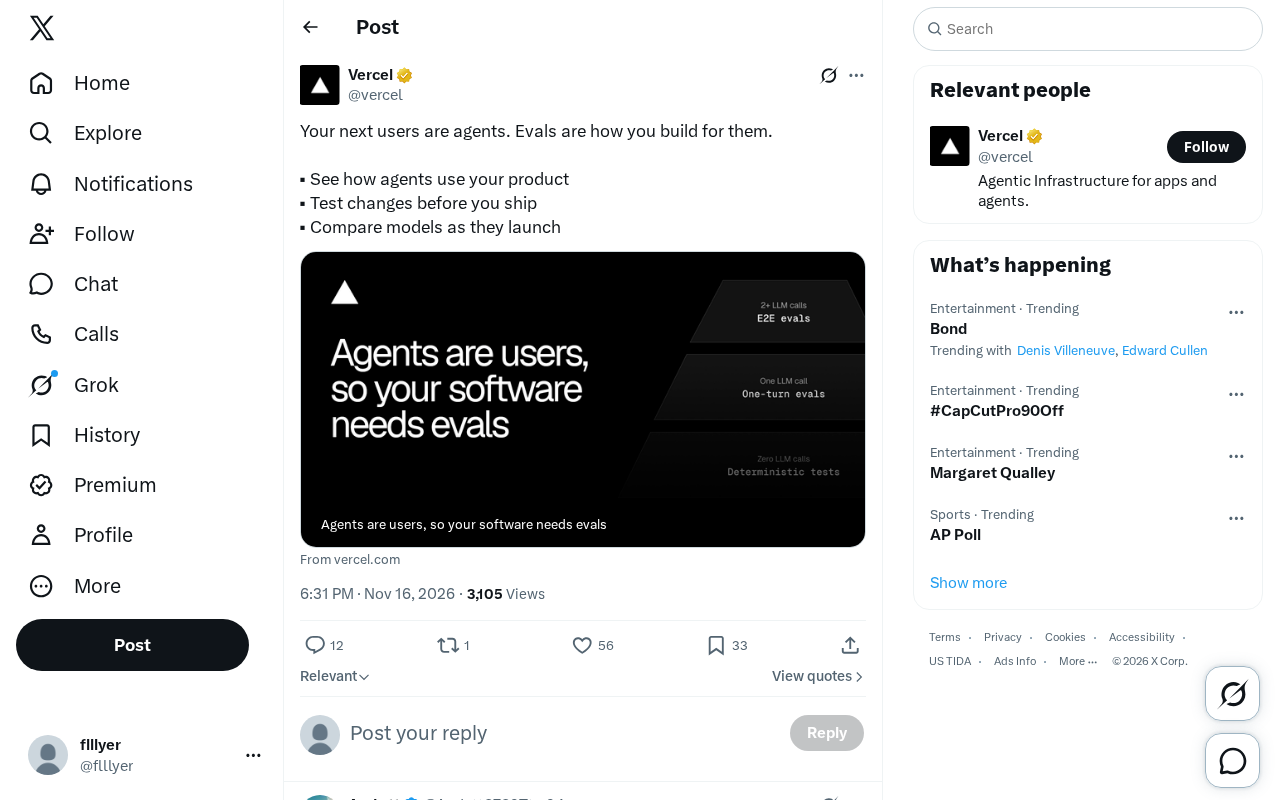
The AI Agent Era: Building a New Product Paradigm with Evals
AI Agents are becoming the next users of products. This article explains how to use Evals to observe Agent usage behavior, test changes before launch, and compare new model performance, helping product teams establish a development methodology for the Agent era.
Microsoft Global Email Outage Leads to Chlorine Leak at German Hotel, Injuring 15
A Microsoft 365 and Outlook global outage prevented a chlorine safety alert from reaching a German Phantasialand hotel, injuring 15 guests and exposing the fragility of cloud-dependent safety systems.
iPhone Duo to Support Face Unlock Using Only the Front Camera
Apple is developing front-camera-only face unlock for the iPhone Duo, now testing in the iOS 27.3 beta. We analyze the technical approach, user experience, and security trade-offs.