Unlocking Claude Code Cloud VMs: Context Engineering and Parallel Agent Orchestration

How to use Claude Code cloud VMs as a parallel AI engineering team through context engineering and least-privilege orchestration.
Most developers treat Claude Code cloud sessions as throwaway sandboxes. This article explores how to unlock their true potential: by building a unified context repository and assigning minimum-privilege credentials per task, each cloud VM boots ready to work. The result shifts AI-assisted development from one-on-one pair programming to parallel multi-agent orchestration — with the main bottleneck being upfront initialization cost.
Most People Are Using Cloud Sessions Wrong
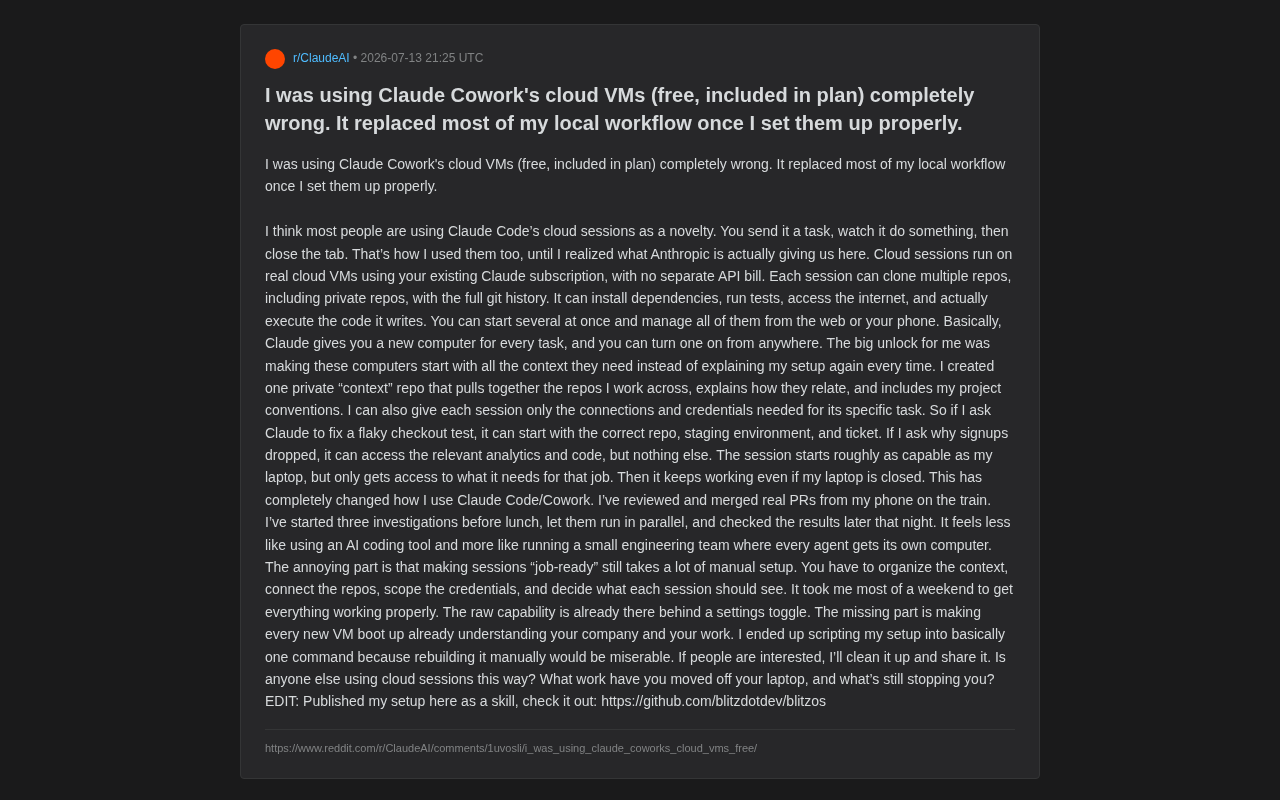
A Reddit developer shared his experience of rethinking Claude Cowork (Claude Code's cloud sessions). He admitted that, like most people, he initially treated cloud sessions as a novelty: toss it a task, watch it run, then close the tab. It wasn't until he truly understood the underlying capabilities Anthropic provides that his entire local development workflow was fundamentally transformed.
The core reality: Cloud sessions run on real cloud VMs using your existing Claude subscription, with no additional API charges. Each session is essentially a temporary, isolated Linux compute environment with a full filesystem, network access, and process execution capabilities — fundamentally different from traditional stateless API calls, where each request is independent with no ability to persist file operations or run long-running processes. This architecture is precisely what enables Claude to actually execute shell commands, run test suites, install dependencies, and even spin up local services for integration testing. Each session can clone multiple repositories (including private ones with full git history), install dependencies, run tests, access the internet, and genuinely execute the code it writes. You can launch multiple sessions simultaneously and manage them all from a browser or your phone.
As the author put it: "Claude gives you a new computer for each task, and you can boot it up from anywhere." That's a fundamentally different proposition from treating it as a one-off Q&A tool.
The Real Unlock: Cloud VMs That Boot With Full Context
The author points out that the biggest shift comes from making these cloud machines start up with all the context they need to complete a task — rather than re-explaining project setup every single time.
Building a Unified "context" Repository
He created a private "context" repository that aggregates multiple codebases involved in his daily work, documents the dependencies between them, and encodes project conventions. The essence of this approach is Context Engineering — systematically designing, organizing, and managing the input information provided to AI models to maximize their task execution effectiveness. Research suggests that at equivalent model capability, differences in context quality can produce order-of-magnitude differences in output quality. This practice spans repository structure design, writing convention documents (like CLAUDE.md or similar project specification files), retrieving and injecting relevant code snippets, and managing credentials and environment variables. Any new session can quickly understand the overall engineering structure without needing repeated background setup.
Assigning Minimum-Privilege Credentials Per Task
An even more refined practice: give each session only the connections and credentials needed for its current task.
- When asking Claude to fix a flaky checkout test, it starts with the right repository, staging environment, and corresponding ticket.
- When asking "why did signups drop?", it has access to the relevant analytics data and code — but nothing else.
This approach stems from the classic information security principle — the Principle of Least Privilege (PoLP) — where each program or user is granted only the minimum permissions necessary to do their job. In AI Agent scenarios, this principle becomes even more critical: when an agent has the ability to autonomously execute code, excessive permissions create not only security risks but also introduce irrelevant context noise, degrading output quality. Strictly aligning credential scope with task boundaries is both a security practice and an engineering technique for improving agent focus.
The author describes it as: each session boots up with roughly the capabilities of his laptop, but only gets access within the scope of the current task. This combination of "minimum privilege + full capability" is the core advantage cloud VMs have over local environments.
From "Using a Tool" to "Orchestrating an AI Engineering Team"
The most direct benefit of this pattern is parallelization and mobility. Since sessions run in the cloud, tasks continue progressing even when the laptop lid is closed.
The author shares a few real scenarios:
- Reviewing and merging actual PRs from his phone during a commute on the train.
- Launching three investigation tasks in parallel before lunch, then checking results together in the evening.
His summary cuts right to the point: "This no longer feels like using an AI coding tool — it feels more like running a small engineering team, where each agent has its own computer."
This reveals a key paradigm shift in AI-assisted programming — moving from pair programming to multi-agent parallel orchestration. Multi-agent orchestration represents a new architectural paradigm for AI-assisted development: in single-agent mode, the developer and AI have a one-to-one collaborative relationship, constrained by context window limits and serial execution bottlenecks. Orchestration mode allows large tasks to be decomposed into multiple parallelizable subtasks, assigned to different agent instances to pursue independently. This architecture closely mirrors concurrent programming concepts in software engineering, with the core challenges being task decomposition granularity, state synchronization between agents, and final result merging and conflict resolution. Anthropic's Claude Code, OpenAI's Codex Cloud, and GitHub Copilot Workspace are all exploring this direction. The developer's role shifts closer to that of a tech lead — assigning tasks, setting boundaries, and reviewing outputs — rather than being the person writing every line of code.
The Real Pain Point: Getting VMs "Job-Ready" Still Requires Heavy Manual Configuration
The author is equally candid about the barrier to entry. Getting sessions to a truly "job-ready" state currently requires significant manual investment:
- Organizing and structuring the context repository
- Connecting various business codebases
- Scoping credentials for each session
- Planning each agent's information boundaries
He admits it took him most of a weekend just to get everything working.
His assessment is worth noting: the raw capability is already there — it's just hidden behind tedious configuration overhead. What's truly missing is the ability for every new VM to boot up already understanding your company and how you work. To solve the pain of repeatedly rebuilding the setup, he eventually scripted the entire configuration into something deployable with nearly a single command and released it as an open-source project (blitzos, hosted on GitHub).
Three Takeaways for Developers
This hands-on writeup yields a few more broadly applicable insights:
First, the value of cloud agents isn't "can run code" — it's "persistent + parallel + isolated." Tasks keep running when the laptop shuts down, multiple tasks advance simultaneously, and each task's permissions are isolated from the others — these are things local environments struggle to deliver all at once.
Second, context engineering is becoming a core development skill for the AI era. What determines agent effectiveness usually isn't the model itself, but the repository structure, convention documents, and credential boundaries you've prepared for it. Context engineering is evolving from an ad hoc trick into one of the core skill stacks in AI-era software engineering — similar to how DevOps evolved during the cloud computing era. The "context repository" is a lightweight but highly leveraged engineering pattern.
Third, the biggest bottleneck in the current experience is initialization cost. Whoever can perfect "one-click new VM that understands your entire organization" will have captured the next real product opportunity. The author's scripting effort is, at its core, an attempt to fill exactly that gap.
It's worth noting that this content comes from a single Reddit developer's personal experience, and the conclusions (e.g., "replaced most of my local workflow") reflect a specific working context. Actual results will vary depending on team size, codebase complexity, and security/compliance requirements. But it offers a perspective worth paying attention to: the true potential of cloud agents may far exceed our current habit of treating them as temporary assistants.
Key Takeaways
Related articles

Kimi K3 Deep Dive: 2.8 Trillion Parameter Open-Source Model Closes the Gap with Closed-Source Frontier for the First Time
Moonshot AI releases Kimi K3 open-weight model with 2.8T parameters and 1M token context. Our deep dive covers coding, 3D dev, agent capabilities, and safety concerns.

How to Choose an AI Agent Platform for Your Team: 5 Evaluation Dimensions and a Decision Framework
Choose the right AI Agent platform by evaluating model flexibility, observability, tool integration, security compliance, and total cost. A complete decision framework to help technical leaders avoid vendor lock-in.

Legora's Legal AI Practice: How Vertical AI Empowers Law Firms and Corporate Legal Transformation
Explore Legora's legal vertical AI practice, covering AI model selection strategies, enterprise legal transformation challenges, and the path to deploying vertical AI in the legal industry.