Unpaired CCA (UCCA): Solving the Data Pairing Problem in Multi-View Learning

UCCA enables canonical correlation analysis on fully unpaired data by connecting it to the Quadratic Assignment Problem.
Canonical Correlation Analysis (CCA) is a cornerstone of multi-view learning but has always required paired data. The proposed Unpaired CCA (UCCA) bridges this gap by modeling unknown sample correspondences as a Quadratic Assignment Problem (QAP), deriving a method that learns maximally correlated linear projections without any paired supervision. UCCA significantly outperforms existing unpaired alignment baselines on real-world multimodal datasets and provides a rigorous statistical foundation for unpaired multi-view learning, though scalability under QAP's NP-hard complexity remains an open question.
The Old Problem in Multi-View Learning: Data Must Come in Pairs
Canonical Correlation Analysis (CCA) is a foundational method in statistics and machine learning for handling multi-view data. Its core idea is to find linear projections for two (or more) different views of data so that the projected representations are maximally correlated in a shared space — a technique widely used in multimodal representation learning, cross-lingual alignment, brain imaging analysis, and more.
But CCA has a critical prerequisite that has long been overlooked: it strictly requires paired data. That is, during training, you must know that the i-th sample in view A corresponds to the i-th sample in view B. In practice, this pairing information is often prohibitively expensive — or simply unavailable. If you have a collection of images and a collection of texts but don't know which image matches which text, traditional CCA breaks down entirely.
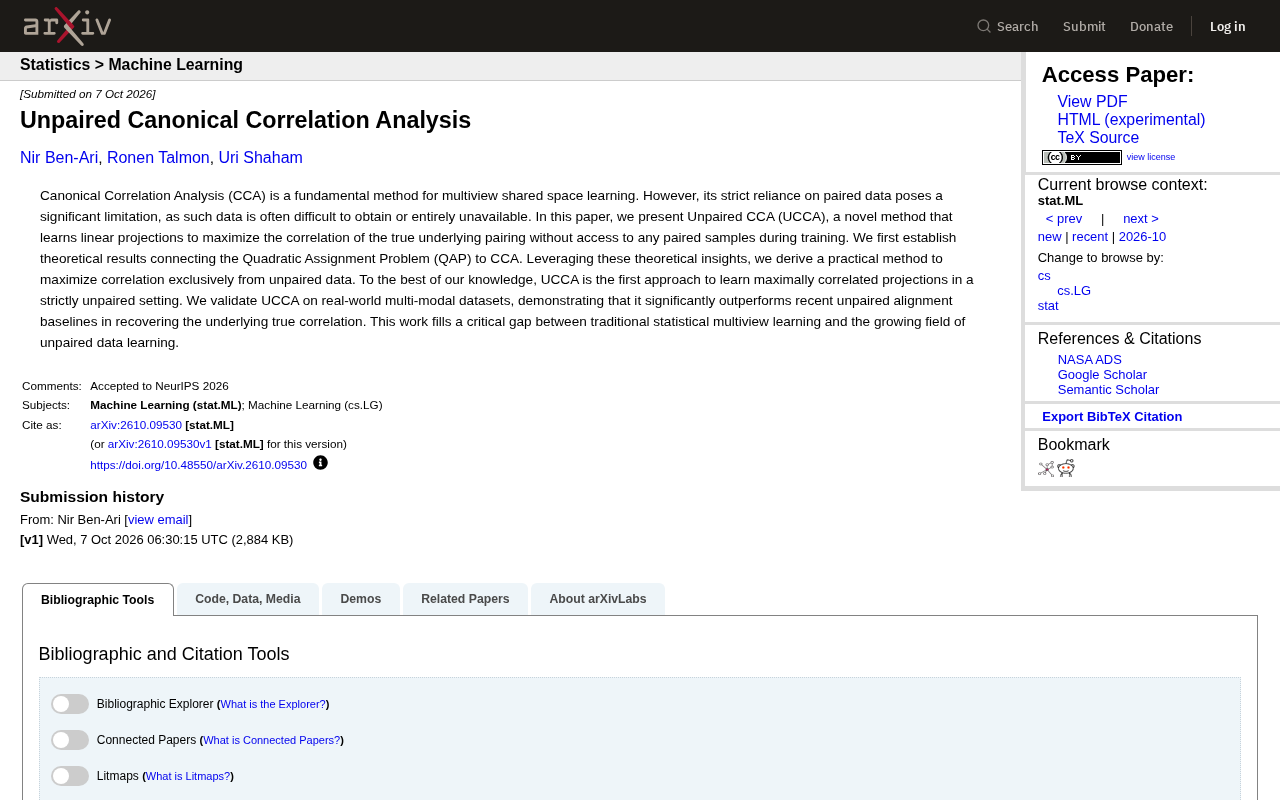
The paper Unpaired CCA (UCCA), published on arXiv (arXiv:2610.09530), targets exactly this pain point: learning linear projections that maximize the true underlying paired correlation, without ever accessing any paired samples during training.
The Core Idea of UCCA: Reformulating Pairing as Quadratic Assignment
UCCA's most valuable contribution is theoretical. The authors begin by establishing a theoretical connection between the Quadratic Assignment Problem (QAP) and CCA.
The key insight is this: when pairing relationships are unknown, finding the optimal pairing is itself a combinatorial optimization problem — you need to search over all possible sample correspondences to find the permutation that maximizes the correlation between the two projected sets. This is precisely the structure captured by the classical QAP, which seeks an optimal matching between two sets of objects to maximize (or minimize) some pairwise association cost.
By linking CCA's correlation maximization objective to the matching structure of QAP, the authors derive a clear solution path: since paired labels are unavailable, treat the "latent true pairing" as an optimization variable and solve for it jointly with the projection matrices. Building on this theoretical framework, they further derive a practical method for maximizing correlation from unpaired data alone.
This approach — revisiting a statistical method through the lens of combinatorial optimization — exemplifies the value of cross-disciplinary thinking. It's not a minor tweak to CCA; it redefines the solution space of the problem.
The Quadratic Assignment Problem (QAP) is a classic combinatorial optimization problem, first formulated by Koopmans and Beckmann in 1957 to model resource allocation scenarios such as facility location. Its standard form is: given two sets of $n$ elements each, along with two $n×n$ association matrices (describing flow or distance relationships within each set), find a permutation $\pi$ that maximizes (or minimizes) $\sum_{i,j} A_{ij} \cdot B_{\pi(i)\pi(j)}$. QAP is proven to be NP-hard — even instances with $n=30$ can defeat exact solvers — so practical approaches rely on heuristic or approximate algorithms (e.g., gradient relaxation, spectral methods). QAP has important applications in graph matching, chip layout, protein structure alignment, and more. By modeling the unknown view correspondences as the permutation variable in QAP, UCCA can inherit the rich toolkit of QAP solvers — a move that is arguably the most critical step for engineering feasibility in this paper.
Experimental Validation: Significantly Outperforming Unpaired Alignment Baselines
The authors validate UCCA on real-world multimodal datasets. Results show that UCCA significantly outperforms recent unpaired alignment baselines in recovering the true underlying correlations in the data.
According to the authors, UCCA is, to their knowledge, the first method to learn maximally correlated projections under a strictly unpaired setting. The "strictly unpaired" qualifier matters: it means no paired supervision signals are used at any point during training, unlike some weakly supervised methods that still rely on a small number of paired seed samples or auxiliary alignment information.
One caveat: the abstract does not disclose specific dataset names, quantitative improvement margins, or which baselines were used for comparison. The "significantly outperforms" claim should therefore be treated as the authors' concluding statement for now — the full experimental details require consulting the main body of the paper.
Why This Work Deserves Attention
This paper fills a genuine gap: the divide between classical statistical multi-view learning and the rapidly growing field of unpaired data learning.
Unpaired learning is well-established in computer vision — CycleGAN-style unpaired image translation is a prime example. But for classical statistical methods like CCA, a systematic theoretical foundation for escaping the pairing constraint has been lacking. UCCA's significance lies in providing that foundation: it uses QAP, a mature optimization framework, to give unpaired correlation learning a solid theoretical grounding.
From an application standpoint, the unpaired setting offers considerable practical value:
- High data collection cost scenarios: When paired annotation requires extensive manual effort or domain expertise (e.g., medical multimodal data), UCCA can directly leverage existing unpaired data.
- Repurposing historical data: Many organizations have accumulated large volumes of data from different sources that were never paired — UCCA provides a tool for mining their latent relationships.
- Cross-modal and cross-domain alignment: Establishing correspondences between heterogeneous modalities such as images, text, and signals.
That said, as a newly released theoretical paper, UCCA currently operates within a linear projection framework. How it handles highly nonlinear complex relationships, and how well it scales computationally on large datasets given that QAP is NP-hard, are important questions for future investigation.
The unpaired image translation paradigm pioneered by CycleGAN (Zhu et al., 2017) introduced cycle-consistency loss to constrain two generators to be mutual inverses, enabling cross-domain style transfer without paired training images. This idea spawned a wave of follow-on work and profoundly shaped how the computer vision community thinks about unpaired learning. However, deep generative model approaches inherently require large amounts of data and compute, and lack an explicit statistical characterization of "correlation structure" — they excel at generating realistic samples, but not at measuring the strength of linear or nonlinear associations between two sets of variables. UCCA takes a different path: preserving CCA's precise mathematical definition of correlation while solving the missing-pairing problem at the optimization framework level. This makes UCCA's results more interpretable and easier to integrate with downstream statistical analyses (such as variance explained or feature weight analysis), giving it a distinctive advantage in scientific research settings like neuroscience and genomics.
Summary
UCCA frees classical Canonical Correlation Analysis from the constraint of requiring paired data. By establishing a theoretical connection with the Quadratic Assignment Problem, it achieves the learning of maximally correlated projections from entirely unpaired data. It represents both an important extension of CCA as a foundational method and a new statistical perspective on unpaired data learning. For researchers and engineers who have large collections of unpaired multimodal data but struggle to establish meaningful associations between them, this is a new tool well worth studying in depth.
Related articles

Chain of Thought Isn't Just for AI: How Humans Can Use CoT to Improve Thinking Quality
Chain of Thought isn't just a prompt trick for large models. Starting from a Hacker News discussion, this article analyzes why CoT works for human thinking too, breaks down actionable ways to transfer it, and highlights the key differences between human CoT and machine CoT.
Cloudflare Teams Up with OpenAI: Closi…
Cloudflare Teams Up with OpenAI: Closing the Loop from Vulnerability Discovery to Defense with AI
Cloudflare uses OpenAI Daybreak to investigate security vulnerabilities and generate reviewable remediation plans, while developers use Codex to boost coding efficiency and quality.

Orca Multi-Agent Orchestration in Practice: A Guide to Parallel Collaboration with Claude and Codex
Orca is Stable AI's free open-source agent workbench supporting 34 agents like Claude Code and Codex in parallel. Learn its Git worktree isolation, multi-model orchestration, and mobile management.