UnrealGenAISupport: An In-Depth Analysis of the All-in-One AI Integration Plugin for UE5

UE5 open-source plugin UnrealGenAISupport provides all-in-one integration of dozens of AI models for game development.
UnrealGenAISupport is a rapidly rising open-source UE5 plugin that integrates dozens of mainstream LLMs including GPT-5, Claude, Gemini, and Deepseek, along with 3D generation models like Meshy and Tripo, and ElevenLabs TTS voice synthesis. Its built-in MCP server lets AI models directly control the UE5 editor, supporting intelligent NPC dialogue, procedural content generation, and AI Agent automated workflows — signaling AI's evolution from auxiliary tool to core game development infrastructure.
Overview
Generative AI is reshaping every aspect of game development. UnrealGenAISupport is a rapidly rising open-source plugin on GitHub that provides Unreal Engine 5 (UE5) with a comprehensive LLM and GenAI model integration solution, complete with a built-in MCP (Model Context Protocol) server that enables developers to seamlessly call dozens of mainstream AI models within their UE5 projects.
Unreal Engine 5 is a next-generation game engine developed by Epic Games, officially released in 2022. Its core technologies include Nanite (a virtualized micro-polygon geometry system capable of real-time rendering of billions of polygons from film-quality assets), Lumen (a global illumination and reflection system that achieves dynamic lighting without precomputation), and World Partition (a large-world streaming system). UE5 is not only widely used in AAA game development but is also rapidly penetrating industries such as virtual production for film and television, architectural visualization, and automotive design. Its Blueprint visual scripting system allows non-programmers to build complex logic, while the C++ API gives professional developers low-level control. It is precisely UE5's highly modular plugin architecture that enables UnrealGenAISupport to deeply embed itself in both the editor and runtime environments, achieving seamless integration with AI services.
The project has already earned 577 Stars and 87 Forks, developed in C++, reflecting the game development community's urgent demand for deep engine-AI integration.
Supported AI Model Ecosystem
Large Language Model (LLM) Integration
The plugin covers virtually all current mainstream large language models:
- OpenAI series: GPT-5 and other latest models
- Anthropic series: Claude Opus/Sonnet
- Google series: Gemini 3
- xAI series: Grok 4
- Chinese models: DeepseekAd R1, Alibaba Qwen, Kimi, GLM (Zhipu)
- Inference acceleration platforms: Groq, OpenRouter
- Local deployment: Ollama and other local models
This broad model support brings exceptional flexibility — use Claude or GPT-5 when you need high-quality reasoning, switch to Groq for low latency, and go with Ollama local models for offline scenarios.
Groq is a hardware and cloud services company focused on AI inference acceleration. Its core product is a proprietary LPU (Language Processing Unit) chip. Unlike GPUs that handle AI inference through parallel computing, the LPU uses a TSP (Tensor Streaming Processor) architecture that eliminates memory bandwidth bottlenecks found in traditional chips through deterministic computation. In practice, Groq can achieve output speeds of hundreds of tokens per second, far exceeding traditional GPU inference solutions. For gaming scenarios, this ultra-low latency characteristic is crucial — when NPCs need to respond to player dialogue in real-time, the difference between a few hundred milliseconds and several seconds of inference delay creates a fundamentally different experience.
Ollama is an open-source local large model runtime framework that allows developers to run open-source models like Llama, Mistral, Gemma, and Phi on their own hardware without relying on cloud APIs. Its core advantages include: fully local data (meeting privacy and security requirements), zero API call costs, and no network latency dependency. Ollama dramatically reduces hardware requirements through quantization techniques (such as 4-bit/8-bit quantization in GGUF format), enabling a consumer-grade GPU (like an RTX 4070) to smoothly run 7B-13B parameter models. In game development scenarios, Ollama is particularly suited for offline development environments, local AI features in single-player games, and projects with strict data privacy requirements. However, local models typically fall short of top closed-source models like GPT-5 or Claude in reasoning quality, so developers need to weigh quality against deployment flexibility.
3D Asset Generation Models
The plugin integrates several cutting-edge 3D generation services:
- Meshy: Text/image to 3D model conversion
- Tripo: High-quality 3D generation
- Hunyuan3D: Tencent's Hunyuan 3D generation
- Rodin: 3D character generation
- fal: Fast AI inference platform
- Dashscope/Seedream: Alibaba Cloud AI services
Voice and Multimodal Capabilities
- ElevenLabs TTS: High-quality text-to-speech
- Inworld: AI platform specialized for game NPCs
- Multimodal support: Image generation, image understanding, and more
ElevenLabs is one of the leading AI voice synthesis companies today. Its TTS (Text-to-Speech) technology is based on deep learning models capable of generating near-human-quality voice output, supporting emotion control, speech rate adjustment, and multilingual synthesis. Traditional AAA game voice production is an extremely expensive undertaking — Cyberpunk 2077 contains over 1 million words of voiced dialogue, involving hundreds of voice actors, with voice production costs reaching millions of dollars. And once the storyline changes, all related voice lines need to be re-recorded. AI TTS technology can reduce these costs by one to two orders of magnitude, and more critically, it supports real-time voicing of dynamic content — when NPC dialogue is generated in real-time by an LLM, traditional recording methods simply cannot apply, and only TTS can provide voice output for this dynamic content.
Core Application Scenarios in Detail
Intelligent NPC Dialogue Systems
By integrating LLMs, developers can free game NPCs from the constraints of traditional dialogue trees, enabling context-based natural language interaction. Combined with specialized platforms like Inworld, NPCs can possess memory, emotions, and unique personalities, giving players a different experience with every conversation.
To understand the significance of this transformation, it's important to understand how traditional NPC dialogue systems work. Traditional approaches are built on dialogue trees or finite state machines (FSMs), where developers must pre-write all possible dialogue branches and player options, with NPC responses being entirely predetermined. While this approach offers strong controllability, it has obvious limitations: content volume is limited by human writing capacity, players can quickly exhaust all dialogue options, and it cannot handle open-ended input. LLM-driven NPCs adopt a completely different paradigm — the NPC's background lore, personality traits, and current game state are used as the system prompt, while the player's natural language input is fed directly into the large model for inference, generating context-relevant dynamic responses. Combined with vector databases storing conversation history, NPCs can also achieve long-term memory. The challenges of this approach lie in latency control (responses need to be returned within 200ms to maintain immersion), content safety filtering, and maintaining character consistency.
AI Agent Automated Workflows
The plugin supports Agentic mode, where AI can not only answer questions but directly execute operations within Unreal Engine — automatically placing objects, adjusting scene parameters, generating level layouts, and more. The MCP server integration allows models like Claude to directly control the UE5 editor.
Procedural Content Generation (PCG)
Combined with 3D generation models, developers can dynamically create 3D assets at runtime or within the editor. This has high practical value for open-world games, user-generated content (UGC) platforms, and rapid prototyping.
Procedural content generation has a long history in the gaming industry. From the random dungeon generation of Rogue in the 1980s, to the infinite worlds of Minecraft, to the 18 billion procedurally generated planets of No Man's Sky, PCG technology has continuously evolved. Traditional PCG primarily relies on mathematical algorithms — Perlin Noise for terrain generation, L-Systems for vegetation, Wave Function Collapse for building layouts, and so on. While efficient, these methods often produce results lacking semantic understanding and artistic beauty. AI-driven PCG represents a new paradigm: through 3D generation models (like Meshy and Tripo), developers can describe requirements in natural language, and AI directly outputs 3D models with textures and topology. UE5 itself introduced a PCG framework in version 5.2, providing rule-based procedural generation tools, while the addition of AI generation models adds semantic-level creative capabilities to this framework, making it possible to "generate a forest with a single sentence."
Real-Time Voice Synthesis
Through ElevenLabs TTS integration, games can provide real-time voice acting for dynamically generated dialogue, dramatically reducing voice production costs while supporting multilingual output.
MCP Server: A Standardized Bridge Between AI and Unreal Engine
One of the plugin's biggest technical highlights is its built-in MCP UE5 server. The Model Context Protocol is an open protocol introduced by Anthropic that defines standardized interaction methods between AI models and external tools.
Understanding the design philosophy behind the MCP protocol helps grasp the technical value of this feature. Before MCP, every AI application needed custom integration code for different tools, creating a massive "M×N" connection problem — M AI models interfacing with N tools required M×N adapters. MCP solves this with a client-server architecture: AI applications act as MCP clients initiating requests, while external tools expose their capabilities through MCP servers (including tool invocation, resource access, and prompt templates). The protocol communicates via JSON-RPC 2.0, supporting both stdio and HTTP+SSE transport methods. The core value of MCP lies in standardizing tool integration — a single MCP server can be called by any AI client supporting the protocol, dramatically reducing integration costs. Currently, mainstream AI products including Claude Desktop, Cursor, and Windsurf natively support the MCP protocol.
Through the MCP server, AI models that support the protocol can:
- Query Actor information in the scene
- Execute Blueprint functions
- Modify materials and property parameters
- Automate editor operations
This effectively turns Unreal Engine into a development tool that AI can directly manipulate, opening up entirely new possibilities for AI-assisted game development. Developers can describe requirements in natural language within Claude Desktop, and the AI executes corresponding operations directly in the UE5 editor via the MCP protocol, achieving true "conversational game development."
Technical Architecture and Usage Considerations
As a native C++ plugin, UnrealGenAISupport runs directly at the Unreal Engine's low level, ensuring runtime performance and stability. Developers can invoke it through Blueprint visual scripting or use the C++ API for deep integration, keeping the barrier to entry relatively low.
It's worth noting that this plugin is essentially an API integration layer — actual AI inference is still performed on cloud or local model servers. Developers need to manage API keys, call costs, and network latency on their own.
Industry Trends and Future Outlook
The emergence of UnrealGenAISupport confirms a key trend in the game development industry: AI is evolving from an auxiliary tool into core development infrastructure. When a single plugin can interface with dozens of AI services simultaneously, it effectively builds a unified AI capability middleware for developers, making model switching and capability composition extremely convenient.
As AI model capabilities continue to grow and calling costs continue to decline, future games will increasingly rely on real-time AI-generated content. Infrastructure plugins like UnrealGenAISupport are likely to become standard components in the game development toolchain.
Key Takeaways
- UnrealGenAISupport is an open-source UE5 plugin integrating dozens of mainstream AI models, covering LLM, 3D generation, TTS, and multimodal capabilities
- Built-in MCP server support allows AI models like Claude to interact directly with the Unreal Engine editor, enabling AI-assisted development
- Supports intelligent NPC dialogue, procedural 3D content generation, AI Agent workflows, and other game development scenarios
- Covers domestic and international mainstream models including OpenAI, Claude, Gemini, Deepseek, and Qwen, providing a unified API integration layer
- The project has earned 577 Stars, reflecting the gaming industry's strong demand for deep AI integration
Related articles
 Product Reviews
The Programmer's Desk Setup Guide: Building a Workspace That Feels Like Home
Discover how programmers build productive, comfortable workspaces. From multi-monitor setups to ergonomic design, explore the desk philosophy that drives focus and flow.
 Product Reviews
Qoder vs Cursor Real-World Comparison: Which $20/Month AI IDE Is Better?
Hands-on comparison of Qoder vs Cursor AI IDEs: Agent autonomy, human interaction count, and architecture decisions. Qoder needed only 2 interactions vs Cursor's 8.
 Product Reviews
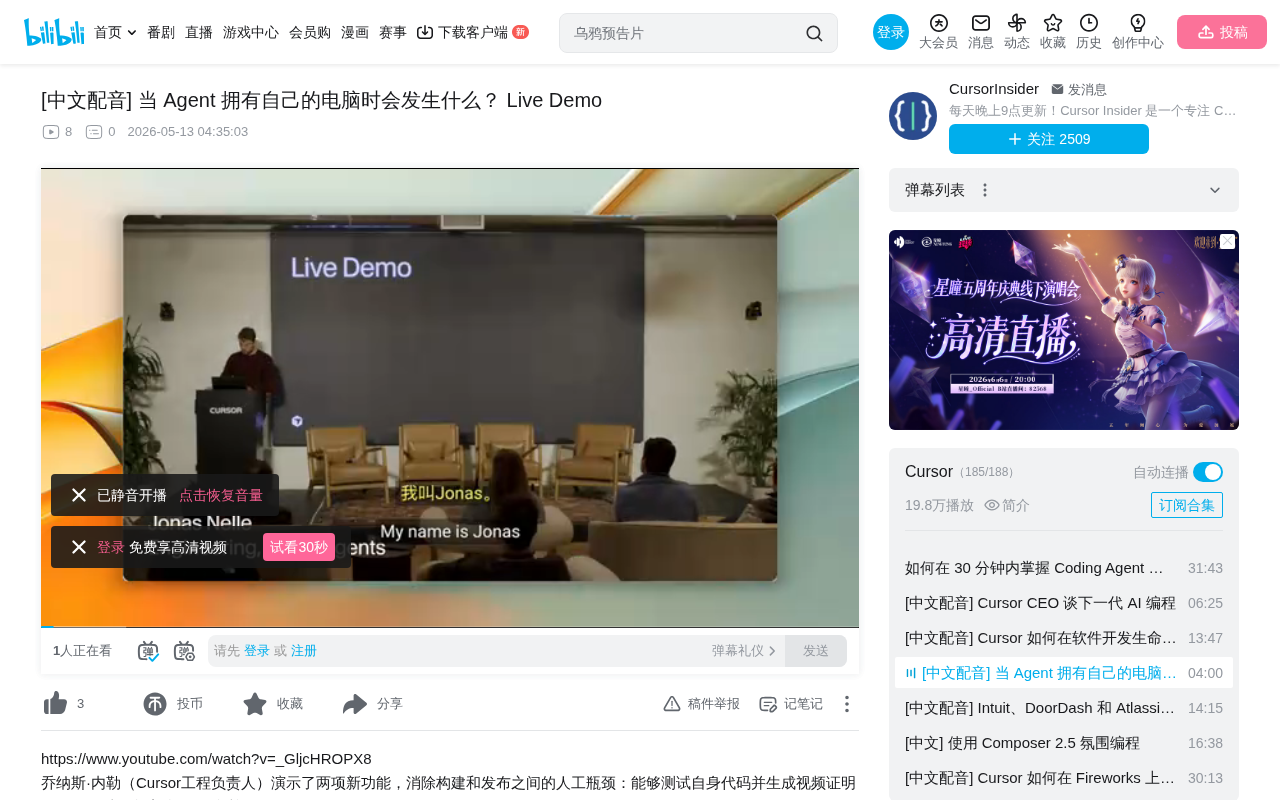
Cursor Cloud Agent Demo: Eliminating Bottlenecks Across the Entire Software Development Lifecycle
Deep analysis of Cursor's Cloud Agent demo showing how cloud VMs, automated test artifacts, and a full-chain control plane systematically eliminate human bottlenecks across the software development lifecycle.