Unsloth New Release: Decision Model Training Boosts Accuracy from 30% to 80%

Unsloth v0.1.904-beta adds Decision Model training that lifts LLM decision accuracy from 30% to 80%.
Unsloth v0.1.904-beta introduces Decision Model training, using QLoRA to fine-tune any text or vision LLM into a model that outputs confidence scores for each candidate option — boosting accuracy from 30% to 80%. The full pipeline from training to export and deployment is integrated into Unsloth Studio, with GGUF export and llama.cpp support for local deployment including multimodal models. The release also adds native ComfyUI model support, INT8 ConvRot image optimization, up to 4.1× faster training for Qwen3.5-35B, and native cross-platform sandboxing (Linux/macOS/Windows), marking Unsloth's evolution into a full-featured local AI workstation.
Unsloth has released v0.1.904-beta, introducing a highly practical new capability — converting any text or vision large language model (LLM) into a "Jev-style" Decision Model. According to official benchmarks, decision accuracy can jump from 30% to as high as 80% after training. This update also brings native ComfyUI model support, diffusion model optimizations, and a range of improvements to the desktop browser experience.
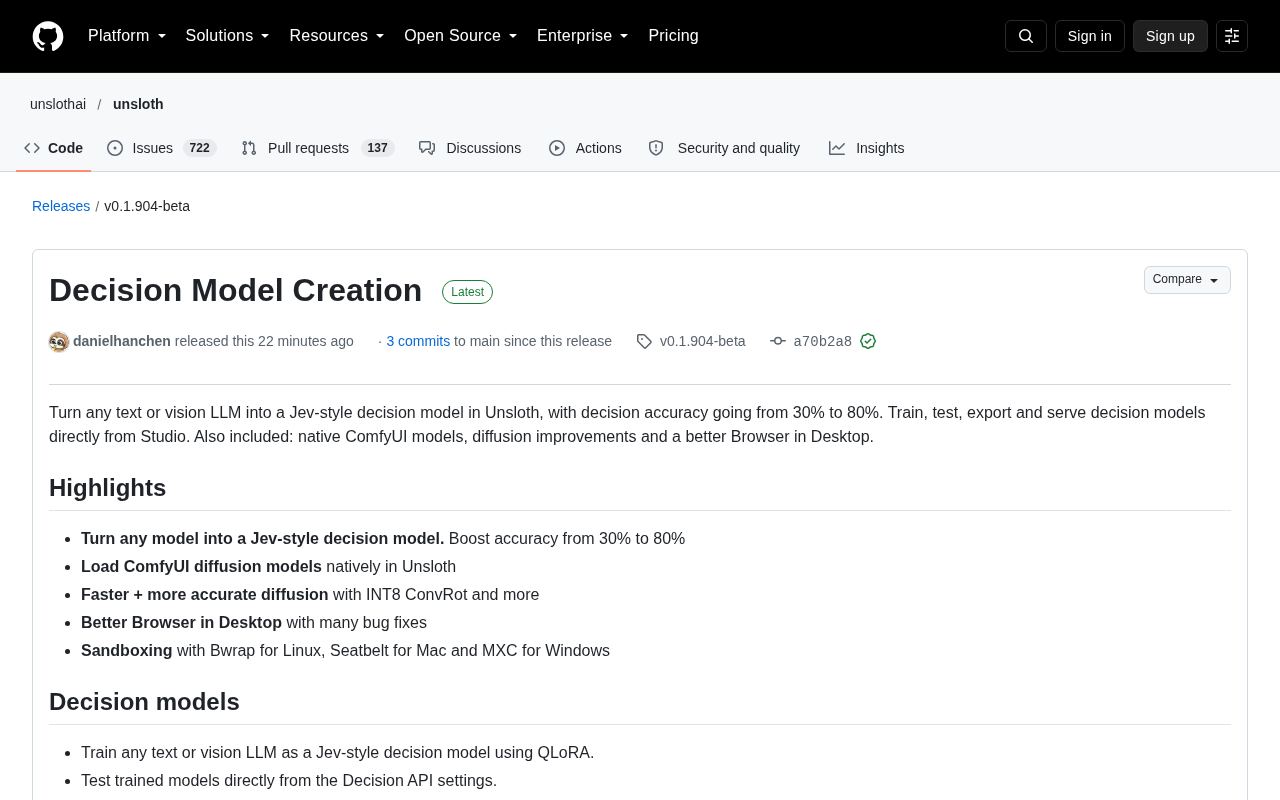
Decision Models: Turning Ordinary LLMs into Focused Decision-Making Tools
The headline feature of this release is the full integration of a Decision Model training pipeline into Unsloth Studio. Developers can train, test, export, and deploy entirely within Studio — no need to juggle multiple tools.
The technical approach uses QLoRA to fine-tune any text or vision LLM into a model specialized for decision-making tasks. Unlike standard generative responses, a Decision Model outputs confidence scores for each candidate option, making its reasoning more transparent, interpretable, and well-suited for embedding into automated workflows that require clear, discrete choices.
The jump from 30% to 80% accuracy is impressive on its own, but the more interesting story is the engineering philosophy behind it — abstracting "making a decision" into a standalone task that can be trained, evaluated, and served as a service, rather than relying on the ad-hoc outputs of a general-purpose conversational model.
A Complete Training and Deployment Pipeline
This release provides a well-rounded workflow with the following capabilities:
- Train any text or vision LLM into a Jev-style Decision Model using QLoRA;
- Test trained models directly within the Decision API settings;
- Generate decision outputs with confidence scores for each option;
- Export Clef models (based on the Qwen3.5 backbone) and Laya models to GGUF format;
- Deploy Decision Models via llama.cpp, including multimodal models capable of understanding images;
- Save and restore smaller adapter and decision-head checkpoints.
Official training documentation is available at unsloth.ai/docs/basics/train-your-own-decision-model-with-unsloth, lowering the barrier to entry. The ability to compress models into lightweight checkpoints containing only the adapter and decision head is especially valuable for developers with limited hardware resources.
QLoRA (Quantized Low-Rank Adaptation) is a parameter-efficient fine-tuning technique that combines quantization with LoRA. LoRA's core idea is to inject trainable low-rank decomposition matrices alongside the original weight matrices, updating only a tiny fraction of parameters. QLoRA takes this further by quantizing the base model to 4-bit NormalFloat format, dramatically reducing VRAM usage and making it possible to fine-tune billion-parameter models on a single consumer-grade GPU. For Decision Model training, QLoRA offers a dual benefit: it preserves the semantic understanding of the pre-trained model while allowing the "decision head" to be fine-tuned to output probability distributions over a finite set of options, rather than generating open-ended text. This is architecturally similar to traditional text classification or multiple-choice tasks, but integrated into a modern LLM inference framework — combining deep language understanding with controlled, structured output.
GGUF (GPT-Generated Unified Format) is a model serialization format defined by the llama.cpp project, designed to enable efficient inference of quantized large models on CPUs or consumer-grade GPUs. It packages model weights, hyperparameters, tokenizer vocabulary, and all other necessary information into a single file, eliminating the hassle of managing multiple files. llama.cpp is a lightweight inference engine written in pure C/C++ that supports multiple quantization levels (such as Q4_K_M and Q8_0) and can run large models on laptops or even smartphones. Exporting Decision Models to GGUF and deploying them via llama.cpp means these models can be embedded in local applications or edge devices with minimal latency, completely independent of GPU servers — particularly valuable for offline or privacy-sensitive decision-making scenarios.
Diffusion Models and Native ComfyUI Support
Beyond Decision Models, this release marks meaningful progress on image and video generation. Unsloth can now run supported ComfyUI image and video models directly from Hugging Face, with automatic detection of ComfyUI checkpoints and local model folders.
Users can reuse their existing ComfyUI text encoders and VAEs, and run Krea-2, HunyuanImage-2.1, and Wan2.2 expert pairs — as well as ComfyUI's NVFP4 and MXFP8 models — directly within Unsloth. Assets previously scattered across the ComfyUI ecosystem can now migrate over seamlessly, reducing redundant configuration work.
On the performance side, Qwen-Image-2.1 now defaults to INT8 ConvRot, preserving more full-precision image detail while achieving faster generation speeds on supported NVIDIA GPUs. Diffusion models are iterating in a clear direction: faster and more accurate.
ComfyUI is currently the most popular open-source diffusion model workflow orchestration tool, known for its node-based visual interface that allows users to freely combine components such as text encoders, VAEs (Variational Autoencoders), samplers, and ControlNet into inference pipelines. Its ecosystem has accumulated a vast collection of community-built custom nodes and pretrained checkpoints, making it the de facto "LEGO platform" for image and video generation. INT8 ConvRot is a precision optimization method that combines INT8 quantization with a rotation transform. By applying an orthogonal transformation to weights before quantization, it reduces quantization error while maintaining speed on NVIDIA GPUs with Tensor Core support (such as A100, H100, and RTX series). Unsloth enabling this by default for Qwen-Image-2.1 reflects a strategic shift from pure speed optimization toward a balance between speed and quality.
Significant Training Speed Improvements
Unsloth has always been known for training acceleration, and this release continues to build on that strength. Using QLoRA on A100 and RTX PRO 6000 GPUs, Qwen3.5-35B-A3B training speed improves by up to 4.1×, while Qwen3-30B-A3B sees up to a 3.3× improvement.
Sample packing has also been improved for hybrid architecture models including gated-delta, Mamba2, and short-convolution variants, fixing previous packing logic issues. Several data processing details have also been refined: prompt and completion message lists can now be trained as a single complete conversation; vision datasets now preserve each row's individual questions; and chat exports and training data now include system prompts. These changes may seem minor, but they directly impact training data quality and consistency.
Desktop Browser and Security Sandbox
The desktop Browser has received a large number of bug fixes and UX improvements. Users can now ask questions about the currently open webpage, confirm browser downloads and customize save locations, and reorder pinned pages in the sidebar just like managing chat history. Search is more robust — it continues searching when results are unavailable and can fall back to Wikipedia. Citation markers like [1] in responses are now clickable links, and RAG embedding models can be directly selected, pinned, or unloaded from the RAG menu.
Security is a significant focus of this release. Unsloth now provides sandboxed isolation for model-executed code on all three major platforms: Bwrap on Linux, Seatbelt on macOS, and MXC on Windows. Users can view sandbox status and choose protection levels in settings. As locally-run agents and code execution capabilities become increasingly common, this native sandboxing mechanism provides users with an essential security layer.
Bwrap (Bubblewrap) is a lightweight userspace sandboxing tool for Linux that uses Linux namespaces and seccomp filters to restrict a process's access to the filesystem, network, and system calls — it's also the underlying isolation mechanism used by Flatpak. Seatbelt is macOS's built-in sandbox framework, which constrains application permissions through declarative policy files. MXC is a container isolation mechanism on Windows. When a local large model can generate and execute code (i.e., Code Interpreter or Agent capabilities), sandbox isolation shifts from optional to necessary — a maliciously crafted prompt injection could induce the model to generate dangerous code, and the sandbox ensures that code cannot escape the controlled environment to access sensitive user files or network resources. Unsloth's native sandboxing across all three major platforms reflects a design philosophy that security infrastructure must evolve in step with growing local AI capabilities.
Summary
Unsloth Desktop is free and open source, supporting Windows, macOS, and Linux (including ARM64). This release makes clear that Unsloth is evolving from a pure "training acceleration library" into a comprehensive local AI workstation that integrates training, inference, diffusion generation, browser interaction, and security isolation. The introduction of Decision Models is particularly worth watching — it extends LLM capabilities from "generating text" to "making quantifiable choices," providing a new engineering foundation for building more reliable automated decision-making systems.
Related articles

ChatGPT Space Launches: Team Collaboration and New Pages Features Explained
ChatGPT Space is OpenAI's new team collaboration feature with Pages, real-time collaboration, and Slack/Google Drive sync. We break down its privacy design, multi-platform integration, and the full workflow from conversation to document.

Migrating Apache Spark UDFs to GPU Acceleration with AI Agents
NVIDIA developer blog explains how AI Agents rewrite Apache Spark UDFs for GPU acceleration, covering migration criteria, agent rewriting and verification workflows, plus pitfalls like result consistency and CPU-GPU transfer overhead.

Zed Editor v0.40.4-rc2 Released: Usage Credits Now Available Without Upgrading
Zed editor releases v0.40.4-rc2, allowing users to use usage credits for AI features without upgrading to a paid plan, lowering the trial barrier.