Unsloth New Release: Decision Model Training Boosts Accuracy from 30% to 80%

Unsloth adds decision model fine-tuning, native ComfyUI integration, and MoE training speedups in latest release.
Unsloth v0.1.905-beta delivers three core updates: decision model training via QLoRA that adds a decision head to any text or vision LLM for structured multi-option outputs with confidence scores (30%→80% accuracy, exportable to GGUF via llama.cpp); native ComfyUI ecosystem integration supporting Krea-2, HunyuanImage-2.1, and more with INT8 ConvRot optimization; and MoE training speedups up to 4.1× for Qwen3.5-35B-A3B on A100. The desktop app gains cross-platform code sandboxing and browser enhancements, expanding Unsloth's scope into structured decision-making and multimodal generation.
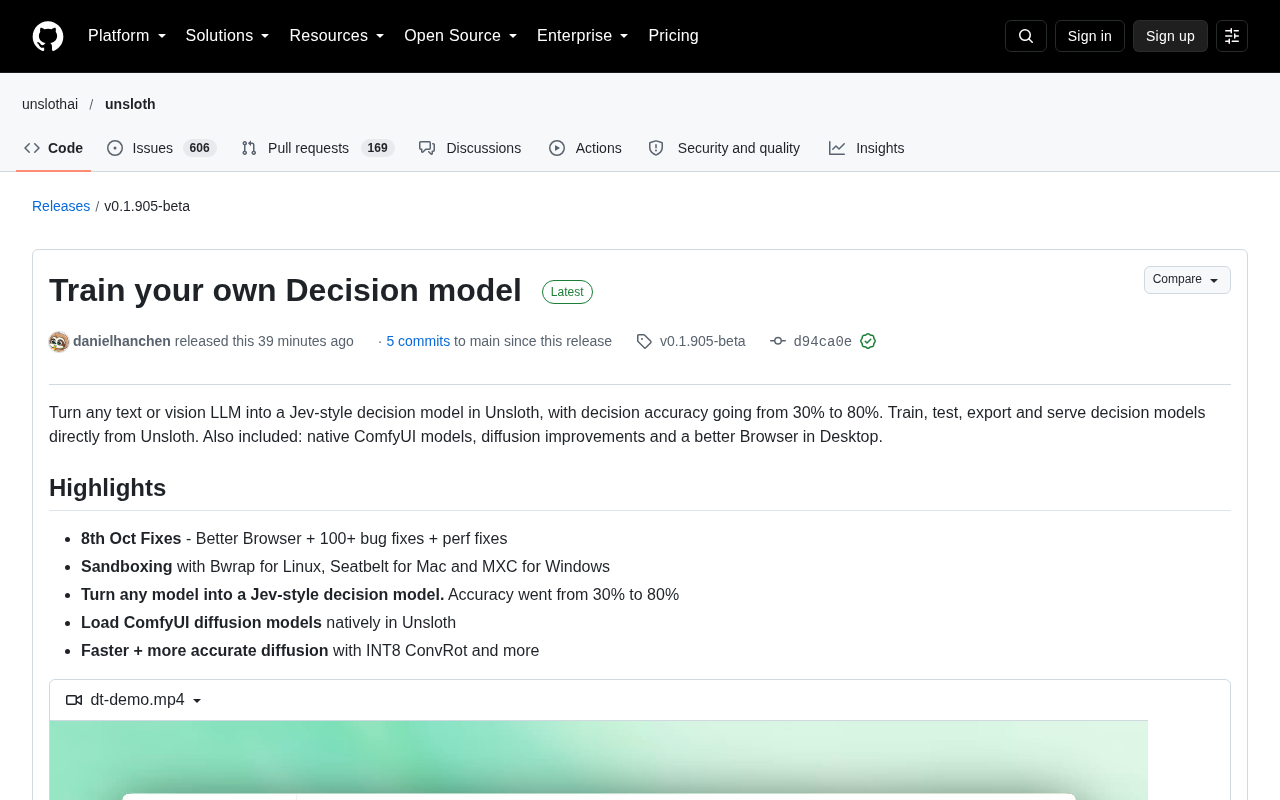
Open-source fine-tuning framework Unsloth has released v0.1.905-beta (internal version 2026.10.2), bringing a notably practical new capability — training any text or vision LLM into a "decision model." The official numbers are straightforward: decision accuracy jumps from 30% to 80%. The same release also integrates native ComfyUI model support, diffusion inference optimizations, and significant improvements to the desktop browser experience.
Decision Models: Teaching LLMs to "Make Choices"
The centerpiece of this update is the Jev-style decision model. Rather than having the model generate free-form text, it selects from a set of given options and assigns a confidence score to each. This capability has clear applications in routing, classification, tool-call arbitration, and agent decision-making — areas where traditional prompt engineering tends to produce unstable, hard-to-interpret results.
Unsloth's approach uses QLoRA to fine-tune any text or vision LLM, training a model with a dedicated "decision head." The entire workflow — training, testing, exporting, and deployment — can be completed entirely within Unsloth, without switching between multiple tools. You can test the trained model directly from the Decision API settings, making the end-to-end experience highly engineering-friendly.
The jump from 30% to 80% accuracy is the headline claim in the official release notes. To be fair, these numbers come from Unsloth's own release documentation without accompanying independent benchmarks or test condition details, so real-world results should be validated against your specific tasks.
Export and Deployment Flexibility
Trained outputs support multiple deployment paths: Clef and Laya models built on the Qwen3.5 backbone can both be exported to GGUF format and served via llama.cpp, including multimodal decision models capable of understanding images. The framework also supports saving and restoring smaller adapter and decision-head checkpoints, making incremental training and resume-from-checkpoint significantly cheaper. Official documentation is available at unsloth.ai/docs/basics/train-your-own-decision-model-with-unsloth.
QLoRA (Quantized Low-Rank Adaptation) is one of the leading parameter-efficient fine-tuning techniques today. The core idea is to first quantize a pretrained model to 4-bit precision to drastically reduce VRAM usage, then train only a small set of low-rank adapter matrices (LoRA layers) on top — without updating the original weights. This means large models that would otherwise require tens of gigabytes of VRAM can be fine-tuned on consumer-grade GPUs. A "decision head" is a lightweight classification layer appended to the top of the backbone model, responsible for mapping the hidden state from the model's final layer into logit scores for each option and converting them to probabilities — rather than generating a sequence of free-text tokens. This results in lower inference latency and more controllable outputs.
Diffusion Models and Native ComfyUI Integration
Another notable update track is the integration with the diffusion model ecosystem. Unsloth can now directly run ComfyUI image and video models from Hugging Face, with automatic detection of ComfyUI checkpoints and local model folders, along with reuse of your existing text encoders and VAEs.
The supported model lineup is extensive: Krea-2, HunyuanImage-2.1, Wan2.2 expert pairs, and ComfyUI's NVFP4 and MXFP8 quantized models are all included. For users accustomed to ComfyUI workflows, this lowers the barrier to migration and mixed-use significantly.
On the performance side, Qwen-Image-2.1 enables INT8 ConvRot by default, which Unsloth claims preserves more full-precision image detail while compressing, and delivers faster ConvRot generation speeds on supported NVIDIA GPUs. This kind of "quantize without sacrificing quality" engineering optimization is precisely where Unsloth has consistently excelled.
ComfyUI is currently the most popular node-based workflow interface for diffusion models. Users construct image/video generation pipelines by connecting functional nodes (samplers, text encoders, VAEs, etc.) and can save these as reusable workflow JSON files. Its checkpoint format (.safetensors or .ckpt) has become the de facto standard in the diffusion model ecosystem — the vast majority of models published on communities like Civitai use this format. INT8 ConvRot is a technique that quantizes convolutional or linear layer weights to 8-bit integers combined with rotation transforms to reduce quantization error. Compared to brute-force INT8 quantization, it better preserves perceptual quality — in image generation, this translates to higher detail fidelity and less color deviation.
Training Performance: Notable Speedups for MoE Models
Continued refinement of training efficiency remains a focus of this release. Using QLoRA on A100 and RTX PRO 6000 hardware, Qwen3.5-35B-A3B sees training speeds up to 4.1× faster, and Qwen3-30B-A3B up to 3.3× faster. Both are MoE (Mixture of Experts) architecture models, and the magnitude of these gains suggests Unsloth has made targeted optimizations to the training pipeline for sparsely activated models.
Additional improvements include:
- Improved sample packing for gated-delta, Mamba2, and short-convolution models
- Support for training prompt and completion message lists as part of the same conversation
- Vision datasets now retain each row's own question
- Chat exports and training data now include system prompts
These may seem like minor fixes, but they're the critical details that determine actual training data quality — especially correct handling of system prompts and multi-turn conversations.
MoE (Mixture of Experts) is a sparsely activated neural network architecture. Unlike dense models (where all parameters participate in every forward pass), MoE models contain a large number of expert sub-networks, with a lightweight "router" dynamically selecting a small subset of experts for each inference or training step while the remaining experts stay inactive. This allows the model's total parameter count to far exceed its activated parameter count — for example, Qwen3.5-35B-A3B has 35B total parameters but activates only ~3B per forward pass. MoE has been widely adopted in large-scale language models (e.g., Mixtral, DeepSeekAd-MoE). Its sparse computation pattern places different demands on a training framework's memory management and operator scheduling compared to dense models — which is the fundamental reason Unsloth's targeted optimizations here yield 3–4× speedups.
Desktop: Enhanced Browser and Security Sandbox
Unsloth Desktop, the free open-source desktop application, also received over 100 bug fixes and performance improvements in this release. Browser enhancements are the most concentrated area: you can now ask questions directly about open pages, confirm downloads and choose save locations, reorder pinned pages in the sidebar like managing chats, search that skips invalid results and falls back to Wikipedia, and [1]-style citations in responses that are now clickable links. Additionally, the RAG menu lets you directly select, pin, or unload embedding models.
On the security front, a cross-platform code sandbox mechanism has been introduced: Bwrap on Linux, Seatbelt on macOS, and MXC on Windows, isolating code executed by models. Users can check sandbox status and choose protection levels in settings. As models become increasingly capable of executing code, this kind of built-in sandbox is a necessary security backstop for local deployment scenarios.
The desktop app offers download packages for Windows, macOS, Linux x64/ARM64 (deb and AppImage), and Windows ARM64, covering all major platforms.
Overall Assessment
This is a feature-dense release with a clear through-line: decision models are the most novel addition, extending fine-tuning from "generating text" to "structured decision-making"; native ComfyUI integration broadens diffusion model coverage; and MoE training speedups alongside a slew of data processing fixes reinforce Unsloth's position as a high-efficiency fine-tuning framework. For developers looking to embed LLMs into judgment and routing tasks, decision models are worth exploring — though accuracy figures should be validated against your own task benchmarks.
Related articles

Felix Rieseberg Personal Homepage
Felix Rieseberg's personal homepage sparks attention on Hacker News. This article covers the Slack engineer's technical background, the rise and fall of nativefier, and the value of a developer homepage as a tech calling card.

@ai-sdk/vue 3.0.306 Patch Release Syncs with [email protected] Update
@ai-sdk/vue 3.0.306 released, synced with [email protected]. A routine patch release for the Vercel AI SDK ecosystem with no public API changes; the Vue adapter layer stays version-aligned with the core package.

Gemini 4 Argon API Launches: The Era of Million-Token Output Begins
Google launches Gemini 4 Argon with sparse MoE architecture, up to 1M output tokens, and a 68.90% Vals Index score, available across API, AI Studio, and the Gemini app.