Unsloth Quantization Benchmarks: NVFP4 Delivers 1.5x Speedup, Dynamic GGUF Compresses Model Size by 83.5%

Unsloth quantizes Qwen3.8-27B with NVFP4 for 1.5x speed and Dynamic GGUF for 83.5% size reduction.
Unsloth released two quantization schemes for Qwen3.8-27B using their improved Dynamic algorithm. NVFP4 achieves 1.5x inference speedup over BF16 while retaining 92-97% accuracy, targeting NVIDIA GPU deployments. Dynamic GGUF compresses the 54.7GB model to ~9GB (83.5% reduction) at 82.5% accuracy retention, enabling deployment on consumer hardware. Both leverage sensitivity-aware mixed-precision strategies that protect critical layers while aggressively compressing redundant ones.
Qwen3.8-27B Arrives with Quantization Solutions in Tow
With the release of the Qwen3.8-27B model, discussions around efficient large model deployment have heated up once again. The Unsloth team quickly followed up with two quantization approaches for this 27B-parameter model based on their improved Unsloth Dynamic algorithm: NVFP4 and Dynamic GGUF. Whether you're a production user chasing inference speed or a developer hoping to run large models on consumer-grade hardware with limited VRAM, there's a solution for you.
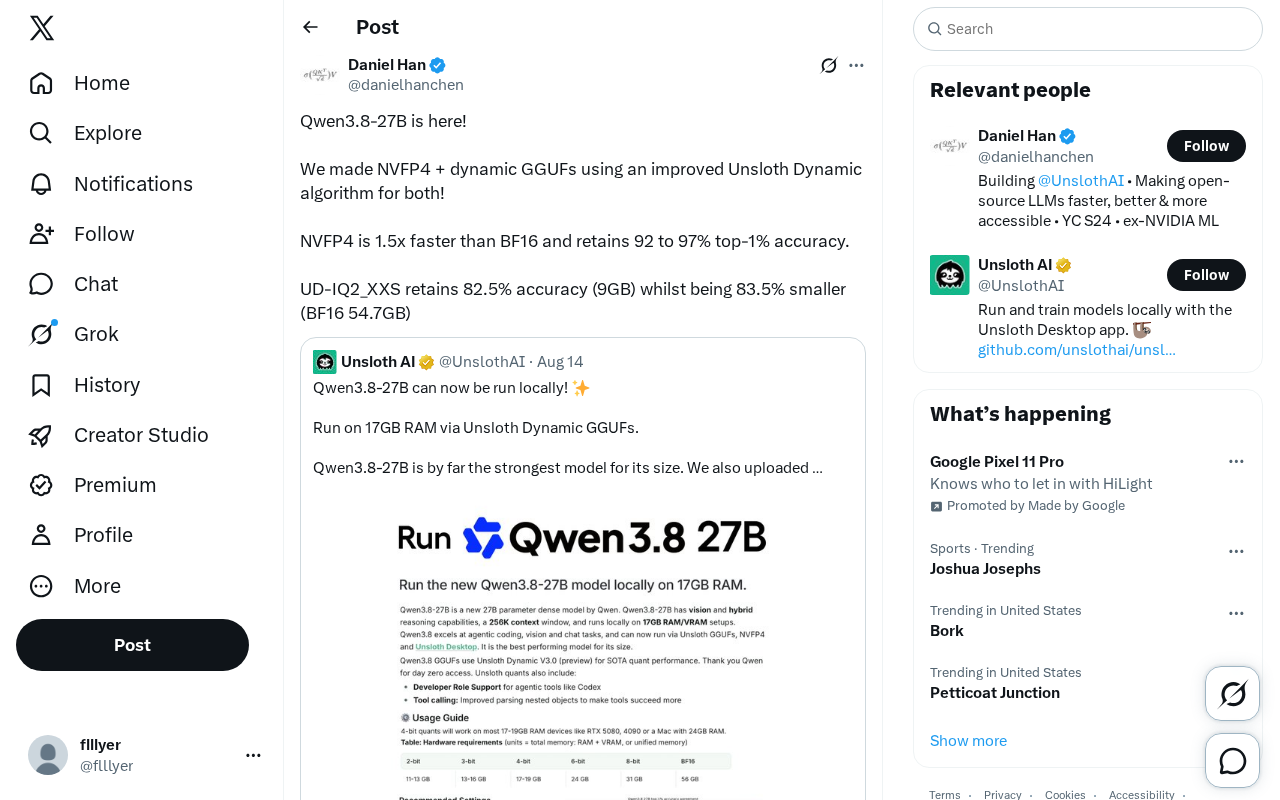
For those following the open-source LLM ecosystem, quantization is nothing new. But the real challenge has always been preserving a model's original capabilities while compressing size and boosting speed. This time, the numbers are worth a closer look.
NVFP4 Quantization: Balancing Speed and Accuracy
What 1.5x Inference Speedup Really Means
According to Unsloth's published data, the NVFP4 quantization scheme achieves 1.5x inference speedup over the BF16 baseline while retaining 92% to 97% top-1 accuracy.
NVFP4 is NVIDIA's 4-bit floating-point format (FP4), designed for next-generation hardware. Unlike traditional integer quantization (e.g., INT4), floating-point quantization tends to better preserve information when dealing with unevenly distributed weights. Specifically, INT4 uniformly divides the value range into 16 quantization levels, while FP4 uses a floating-point representation (with sign, exponent, and mantissa bits) to cover the numerical space non-uniformly—providing finer granularity near zero where weights are dense, and wider spacing in sparse tail regions. Since LLM weight distributions typically exhibit long-tail characteristics, FP4's non-uniform quantization aligns naturally with them. More importantly, NVFP4 has native hardware support in NVIDIA Blackwell architecture Tensor Cores, eliminating dequantization overhead and enabling true end-to-end acceleration.
A 1.5x speedup in real deployments translates to lower latency and higher throughput, directly reducing costs for large-scale serving scenarios. For a service handling a million daily requests, 1.5x faster inference means you can serve the same traffic with two-thirds the GPU resources, or cut response latency by roughly 33% on the same hardware.
Accuracy Loss Stays Within Acceptable Bounds
More critically, the accuracy numbers matter. A 92%–97% top-1 accuracy retention rate means the quantized model performs nearly identically to the full-precision version on most tasks. This retention rate is typically calculated by comparing the quantized model's scores against the BF16 baseline on standard benchmarks (such as MMLU, HellaSwag, ARC-Challenge, etc.). For example, if the BF16 model achieves 80% accuracy on a task, 97% retention means the quantized model still scores 77.6%—a gap of just 2.4 percentage points.
This matters because many aggressive quantization methods can dramatically compress models but at the cost of significant capability degradation—especially on precision-sensitive tasks like math reasoning, code generation, and long-chain logical reasoning, where poor quantization can cause output quality to fall off a cliff.
NVFP4's ability to maintain accuracy while accelerating inference reflects the refined quantization strategy of the improved Unsloth Dynamic algorithm—it doesn't compress all weights equally but dynamically allocates precision based on weight importance. The core of this mixed-precision strategy: during a calibration phase, sensitivity analysis identifies the critical layers and weight tensors that most impact model output, preserving higher precision for them while applying more aggressive compression to redundant layers.
Dynamic GGUF Quantization: Pushing the Limits of Compression
82.5% Accuracy Retention with 83.5% Size Reduction
If NVFP4 targets speed-first scenarios, dynamic GGUF demonstrates the boundaries of extreme compression. GGUF (GPT-Generated Unified Format) is the model file format used by the llama.cpp project, designed to run large models efficiently on CPU-only or CPU-GPU hybrid environments without relying on proprietary frameworks like CUDA. The GGUF ecosystem supports macOS Metal, Windows Vulkan, and other compute backends, making it one of the most popular inference solutions for individual developers and edge deployment.
Taking the aggressive UD-IQ2_XXS quantization tier as an example:
- Original BF16 model size: 54.7GB (BF16, or Brain Floating Point 16, is a 16-bit float format from Google Brain with the same 8-bit exponent range as FP32, widely used as the "full precision" baseline in deep learning)
- Quantized size: ~9GB
- Size reduction: 83.5%
- Accuracy retention: 82.5%
The impact here is clear: a 27B model that originally required a high-end GPU to fit in memory is compressed to roughly 9GB—within range of consumer GPUs and even some high-spec laptops. With mainstream cards like the RTX 4060 (8GB VRAM) or RTX 4070 (12GB VRAM), a 9GB quantized model can be fully loaded and run for inference. Trading less than one-sixth the storage for over 80% of model capability is extremely attractive for individual developers and researchers.
Where IQ2_XXS Fits
It's important to be realistic: IQ2_XXS is one of the more aggressive 2-bit quantization tiers in the GGUF system. The IQ series (Importance Quantization) uses a non-uniform quantization strategy based on importance matrices, evaluating each weight's sensitivity on calibration data to determine precision allocation. IQ2_XXS encodes weights at an average of ~2.06 bits per weight—compared to the more conservative IQ3_S (~3.44 bits) or Q4_K_M (~4.83 bits), compression is extreme but information loss is also greater.
82.5% accuracy retention means noticeable capability drops on some complex tasks. Specifically, math problems requiring precise numerical computation, complex multi-step reasoning, and fact-critical QA tasks may show significant degradation with IQ2_XXS. It's best suited for resource-constrained experimental scenarios that can tolerate some accuracy loss—rapid prototyping, text summarization, simple conversations, and other applications with relaxed precision requirements.
For higher quality needs, users can choose higher-precision tiers from Unsloth's dynamic GGUF lineup to find their own balance between size and capability. For instance, IQ3_S typically pushes accuracy retention above 90% with model sizes around 13–15GB; Q4_K_M retains over 95% accuracy at roughly 16–18GB. This is precisely the value of "dynamic" quantization—offering a full gradient of choices rather than a single option.
Core Technical Highlights of Unsloth Dynamic
Both quantization approaches are built on the "improved" Unsloth Dynamic algorithm, which is the key reason behind the strong results. The pain point of traditional quantization is that uniform bit allocation damages critical weights that heavily influence model output. Research shows that different components in Transformer architectures have significantly different tolerance to quantization error: Q (Query) and K (Key) projection matrices in attention mechanisms are typically most sensitive since they directly determine attention score precision; meanwhile, FFN intermediate layers, with higher dimensionality and more redundancy, can often withstand more aggressive compression without noticeably affecting output quality. Additionally, the first and last few layers are more critical due to their direct connection to input embeddings and output logits.
Unsloth Dynamic's approach is to identify and protect these sensitive layers while applying more aggressive compression elsewhere. During calibration, the algorithm runs a small batch of representative data through forward propagation, computing the Hessian matrix (or its approximation) for each layer's weights to assess quantization sensitivity. High-sensitivity layers receive more bit budget; low-sensitivity layers receive less—maximizing overall model performance under a fixed total bit budget.
This "protect the important, compress as needed" strategy turns quantization from a blunt instrument into a fine-grained resource optimization game. Its application across both NVFP4 and GGUF pipelines demonstrates the algorithm's strong generalizability across different hardware backends and deployment needs. NVFP4 targets high-throughput inference on NVIDIA data center GPUs, while GGUF covers everything from consumer GPUs to CPU-only inference in edge computing scenarios. Both share the same sensitivity analysis framework, differing only in the final quantization encoding format.
Implications for Developers and the Industry
From a broader perspective, this release reflects an important trend in the open-source LLM ecosystem: model capability and deployment efficiency are advancing in parallel. Model creators (like the Qwen team) push foundational capabilities forward, while tooling teams like Unsloth immediately close the last mile on the deployment side. This division of labor is accelerating the formation of a complete open-source AI toolchain—from training (DeepSpeed, Megatron) to fine-tuning (LoRA, QLoRA) to quantized deployment (Unsloth, llama.cpp, vLLM), with specialized teams at every stage.
For developers, this means:
- Users with ample VRAM can choose NVFP4, leveraging 1.5x speedup to cut serving costs;
- Hardware-constrained users can run 27B-class models locally via dynamic GGUF;
- Quantization is no longer a question of "can it work" but an engineering decision about "how to optimally trade off accuracy, speed, and size."
Notably, advances in quantization are also redefining model selection logic. Previously, developers might have been forced to choose between 7B and 13B models because larger ones couldn't run on available hardware. Now, with efficient quantization, developers can deploy 27B or even larger models directly, gaining capabilities far exceeding smaller models. This means "pick a large model + quantized deployment" may be a better strategy than "pick a small model + full precision" in many scenarios.
As quantization algorithms continue to evolve, the barrier to running large models will keep falling. Capabilities once confined to data centers are rapidly reaching every developer's desktop. When a 27B model can run smoothly on a single consumer GPU, we're one step closer to true "AI democratization."
Related articles

Felix Rieseberg Personal Homepage
Felix Rieseberg's personal homepage sparks attention on Hacker News. This article covers the Slack engineer's technical background, the rise and fall of nativefier, and the value of a developer homepage as a tech calling card.

@ai-sdk/vue 3.0.306 Patch Release Syncs with [email protected] Update
@ai-sdk/vue 3.0.306 released, synced with [email protected]. A routine patch release for the Vercel AI SDK ecosystem with no public API changes; the Vue adapter layer stays version-aligned with the core package.

Gemini 4 Argon API Launches: The Era of Million-Token Output Begins
Google launches Gemini 4 Argon with sparse MoE architecture, up to 1M output tokens, and a 68.90% Vals Index score, available across API, AI Studio, and the Gemini app.