Unsloth Releases Major Update: 5x Faster Inference, Browser Agent Evolves Comprehensively

Unsloth v0.1.907-beta brings up to 10x UI speedup and a comprehensive browser Agent upgrade.
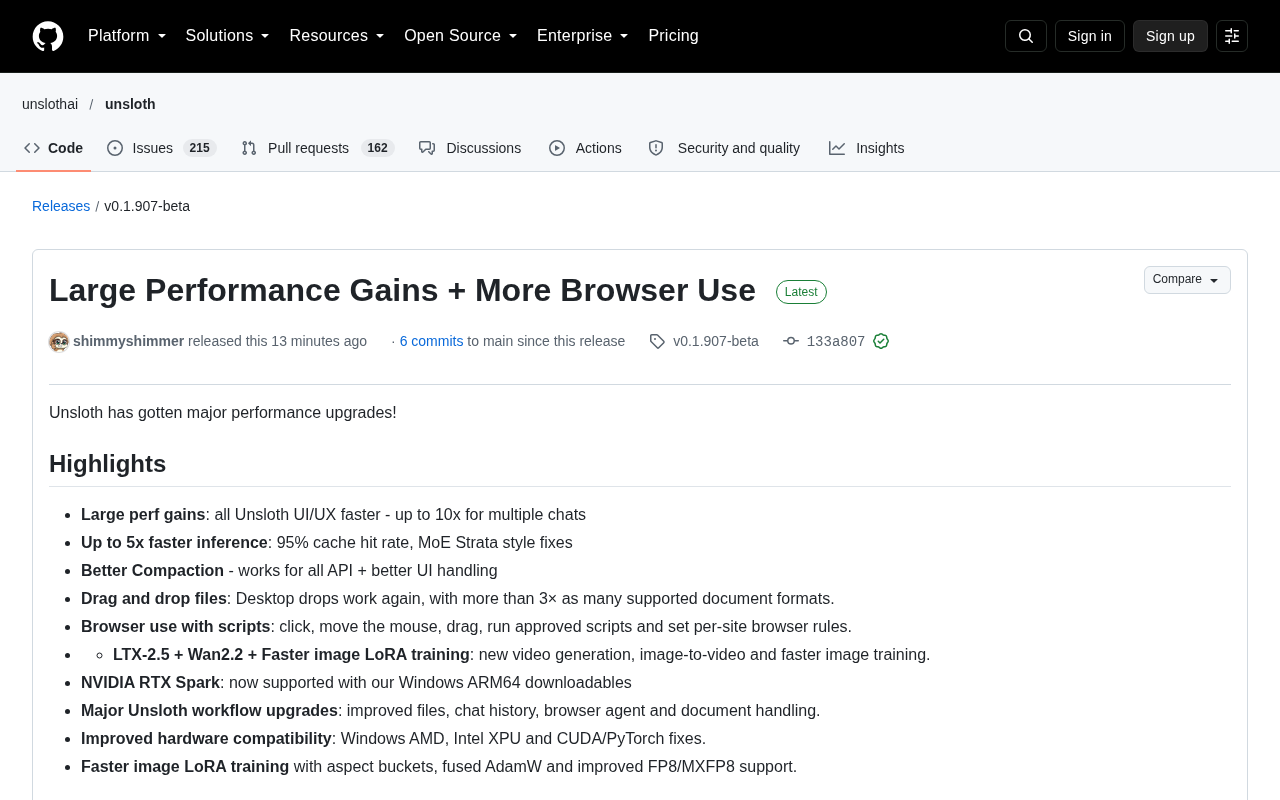
Unsloth released v0.1.907-beta, centered on performance and browser Agent. Leveraging a 95% cache hit rate and MoE optimizations, multi-chat UI/UX is up to 10x faster and inference about 5x faster, with large chats and training histories loading in smaller batches and reduced first-token latency in long GGUF and tool-heavy sessions; Qwen3.5/3.6/3.8 gain faster prefill and speculative decoding on MLX. Browser automation supports coordinate clicks, mouse movement, drags, and canvas operations, plus script approval, per-site trust rules, and unified form submission checks. Other additions include LTX-2.5 text-to-video with audio, Wan2.2 image animation, faster image LoRA training with FP8/MXFP8 memory optimizations, and /rewind, /compact, and VS Code Copilot Chat integration.
Unsloth has released the v0.1.907-beta update on GitHub. The core keywords of this update are "performance" and "browser Agent." The team claims overall UI/UX speed improvements of up to 10x, inference speed improvements of up to 5x, and a major expansion of browser automation capabilities.
Performance Improvements: From Cache Hit Rate to Long-Conversation Response
Unsloth has placed performance optimization at the most prominent position in this update. According to the release notes, UI/UX speed in multi-chat scenarios can be up to 10x faster, while inference speed has improved by roughly 5x. Behind this is a 95% cache hit rate and Strata-style fixes targeting MoE architectures.
In practical usage scenarios, large chats and training histories now load in smaller batches, consuming less data and memory at startup. In long GGUF conversations — especially sessions with heavy tool calling — subsequent replies begin noticeably sooner. Qwen3.5, Qwen3.6, and Qwen3.8 gain faster prefill and speculative decoding support on MLX.
The significance of these optimizations: when running large models locally, what most affects the experience is often not single-generation speed, but the cumulative latency and memory bloat after long conversations. Unsloth chose to focus on caching and batched loading, and that direction is the right one.
Cache hit rate in local large model inference refers to the reuse ratio of the KV Cache. When a Transformer model generates each token, it needs to recompute the attention key-value pairs for all previous tokens; if the already-computed KVs are retained, new tokens only need incremental computation, saving a large amount of redundant work. A 95% hit rate means the vast majority of requests hit existing cache, which is the main source of Unsloth's claimed 5x speedup. Hit rate drops typically occur during multi-turn conversations, when tool calling inserts new content, or when the context is truncated — because once the cache prefix changes, it must be recomputed from scratch.
MoE (Mixture-of-Experts) is an architecture that splits the feed-forward layer into multiple "expert" sub-networks, activating only a few at a time. It allows the model to have a very large total parameter count while keeping per-inference compute relatively small, but the trade-off is more complex memory usage, expert routing, and batch scheduling, requiring specialized adaptation of caching and batching strategies. The "Strata-style fixes" mentioned here target optimizations for layered loading and cache reuse in such architectures.
Speculative decoding is an acceleration technique that uses a "small model to draft quickly, large model to verify in one pass": the draft model guesses several tokens in succession, the target model verifies them in parallel in a single forward pass, accepted tokens are kept directly, and rejected ones are regenerated from the divergence point. Since verification is parallel, when draft quality is high it can significantly reduce the average latency per token. Prefill refers to the stage where the model processes the input prompt and builds the KV Cache; it has completely different computational characteristics from the token-by-token decode stage, typically being more compute-bound than bandwidth-bound. MLX is Apple's machine learning framework for Apple Silicon, and its support for prefill and speculative decoding directly determines the responsiveness of local inference on Mac.
Browser Agent: Complete Control from Clicks to Drags
Browser automation is the most interesting functional part of this update. The model can now click on specific coordinates on the page, move the mouse, drag page elements, and even operate on targets like canvas that have no labels.
Regarding script execution, users can require approval every time a script runs, or set Run scripts to Never in Settings > Browser. For clicks on unlabeled elements, per-site rules can be configured to add trusted sites to an Always allow list. Form submission also unifies approval logic — pressing Enter and clicking the submit button go through the same set of checks.
The Web UI also improves handling of compressed pages, client-side navigation, and lazy-loaded content, and the model can now fill in date and time fields. These seemingly minor improvements actually determine whether the browser Agent can work reliably on real websites.
Images and Video: LTX-2.5 and Wan2.2 Support
On the video generation side, the new version supports generating video from text or a starting image via LTX-2.5, with synchronized audio. Wan2.2-TI2V-5B, LTX-2, and LTX-2.3 can set a Start frame on the same loaded model to animate images.
The image page adds support for selecting SDXL samplers and schedules, and the loading issue for v-prediction checkpoints has been fixed. Image inputs can be cropped before generation, and large photos and regular video frame uploads are automatically resized.
Fused AdamW in image LoRA training refers to merging multiple element-wise operations in the optimizer update into a single GPU kernel, reducing memory read/write counts and kernel launch overhead, thereby improving throughput in small-batch training. Aspect-ratio buckets group training images by similar aspect ratios so that each batch has a uniform size, avoiding heavy cropping or padding just to make everything square — preserving composition while reducing wasted pixels. FP8 is an 8-bit floating-point format that halves memory footprint and bandwidth requirements compared to BF16; with native support on Ada, Hopper, and Blackwell architectures, it enables training larger LoRAs with almost no loss in precision. MXFP8 is the micro-scaling FP8 format defined by OCP, using finer-grained shared exponents to improve numerical stability at low precision, but it requires a compatible stack such as torchao.
Training: Faster Image LoRA and Lower Memory Usage
Image LoRA training now enables fused AdamW by default on NVIDIA GPUs and introduces aspect-ratio bucket support. FP8 LoRA training targets FLUX and Z-Image with lower memory usage on NVIDIA Ada, Hopper, and Blackwell GPUs. MXFP8 handles aspect buckets on Blackwell with a compatible torchao stack.
The Train tab adds a Sample every setting that lets you view preview images during supported image training and in run history. Caption dropout, LoRA dropout, and checkpoint retention are also configurable in the image Train tab, and random flip has become opt-in.
Chat and Desktop: File Drag-and-Drop Returns and /rewind Feature
Desktop chat reintroduces file drag-and-drop, covering more Office documents, templates, EPUB, README files, and media files. The Web UI supports uploading PDFs and Office documents up to 200 MB.
Linked folders now respect common .gitignore rules, folders can be uploaded from the browser to project Sources, and failed sources can be retried. The /rewind command and the Rewind option in the message More menu can restore conversations, files tracked in the chat folder, or both simultaneously, with support for previewing changes and undoing the restore.
/compact can compress context in GGUF or MLX chats that support tools, with inline separators marking the compression point. Notifications can also be enabled when background replies complete.
Context compression (/compact) addresses the problem of limited context windows in local models: when a conversation approaches the window limit, earlier multi-turn messages are summarized by the model into a shorter digest, replacing the original history with the summary to free up space for continued conversation. It changes the KV Cache prefix, so the first reply after the compression point requires re-prefill, but in exchange the conversation can continue without starting a new session. /rewind relies on tracking filesystem state: files modified by the Agent or user in the chat folder are versioned, and rolling back restores both conversation messages and file contents, with the ability to preview differences before confirming — especially critical for code or script editing scenarios that require repeated trial and error.
Model and Hardware Compatibility
Local models can now be used in VS Code Copilot Chat via unsloth start vscode. Coding agents can use Unsloth with account API keys via MCP to perform model loading, generation, training, and export.
On the hardware side, PyTorch/Triton startup errors on Windows AMD systems have been fixed; Intel XPU can recognize native BF16 on supported Arc and Data Center GPUs without relying on intel-ocloc. Triton launcher errors after switching Python versions on CUDA systems have also been addressed, and the loading experience for Gemma 4 E2B under low VRAM has improved.
This update carries a substantial amount of information, spanning performance, browser automation, video generation, training optimization, and hardware compatibility. For local large model users, the improved controllability of the browser Agent and the acceleration of image LoRA training may be the two most noteworthy changes.
One-line Summary
Unsloth v0.1.907-beta delivers up to 10x UI speedup and a comprehensive browser Agent upgrade.
Paragraph Summary
Unsloth has released the v0.1.907-beta update, centered on two main directions: performance and browser Agent. On performance, leveraging a 95% cache hit rate and MoE architecture optimizations, multi-chat UI/UX is up to 10x faster and inference is about 5x faster. Large chats and training histories now load in smaller batches, and first-token latency in long GGUF and tool-heavy sessions drops noticeably, with Qwen3.5/3.6/3.8 gaining faster prefill and speculative decoding on MLX. Browser automation now supports coordinate clicks, mouse movement, drag-and-drop, and canvas operations, plus script approval, per-site trust rules, and unified form submission checks. Additional updates include LTX-2.5 text-to-video with audio, Wan2.2 image animation, accelerated image LoRA training with FP8/MXFP8 memory optimizations, as well as /rewind, /compact, and VS Code Copilot Chat integration.
Related articles

How Big Can Stars Really Get? The Physical Limits of the Largest Stars
Red supergiants are the largest stars by volume, with radii up to 2,000 times the Sun, engulfing the inner solar system. But there is no precise upper limit on stellar size—models predict up to 15,000 solar radii. The most massive blue stars are far smaller than red supergiants—biggest and heaviest are two different things.

Apple HomeView Smart Display Full Feature Breakdown: Wall-Mount or Desktop, $299
Apple launches HomeView, a $299 smart display with wall-mount and desktop options, 12MP camera for facial recognition, smart home control, music playback, and recipe step-by-step cooking. Full breakdown of watch faces, apps, privacy, and cooking integration.

Where Did the Promised New Studio Go? Craft Computing Answers After Five Years
Craft Computing's host responds to viewer questions: the new studio promised five years ago was shelved as construction costs soared from $30,000 to $75,000, and was replaced by a 168-square-foot garage conversion.