Unsloth: The Free Local LLM Training Tool with 60K+ Stars on GitHub — A Complete Guide
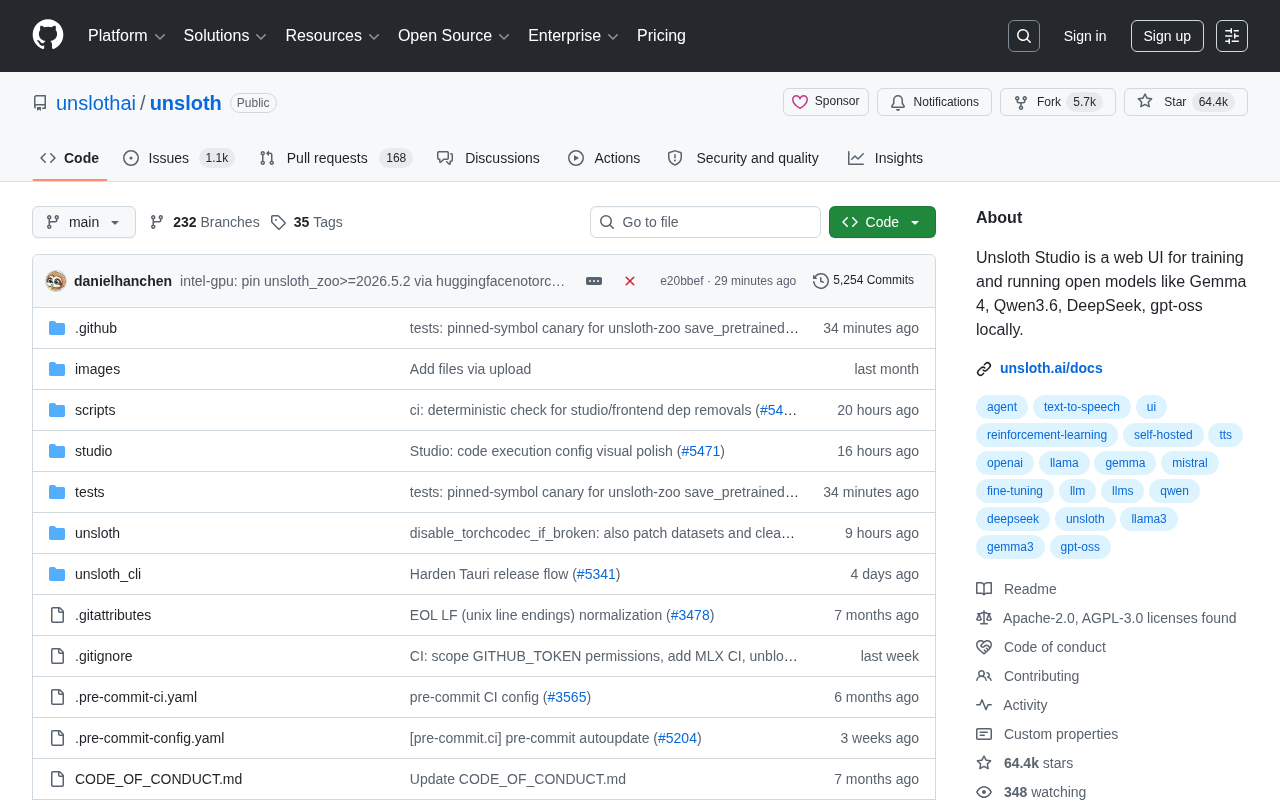
Unsloth is a 60K+ star open-source tool that lets you fine-tune LLMs locally via Web UI on consumer GPUs.
Unsloth is an open-source local LLM training tool with 63,500+ GitHub stars, supporting mainstream models like Gemma 4, Qwen 3.6, and DeepSeek. Built on LoRA/QLoRA techniques with custom CUDA kernels, it achieves 2-5x training acceleration and 70% VRAM savings, running on consumer-grade GPUs. Its Web UI significantly lowers the fine-tuning barrier, distinguishing it from tools like Ollama through its integrated training + inference positioning, making it ideal for researchers, enterprise teams, and AI enthusiasts.
What Is Unsloth? A One-Minute Overview of This 60K+ Star Open-Source Project
Unsloth is an open-source local large model training tool that provides a complete Web UI interface, allowing users to train and run mainstream open-source large language models on their own computers. The project has earned over 63,500 stars on GitHub with 5,500+ forks, making it one of the most popular local LLM training tools available today.
Written in Python, the project supports a wide range of popular open-source models including Gemma 4, Qwen 3.6, DeepSeekAd, gpt-oss, and more, providing developers and researchers with a low-barrier, high-efficiency platform for model fine-tuning and inference.
What Is Model Fine-Tuning?
Model fine-tuning refers to the process of further training a pre-trained large model using domain-specific or task-specific data to improve its performance in that area. Compared to training a model from scratch, fine-tuning requires only a small amount of data and computational resources to achieve significant performance improvements. Common fine-tuning methods include Full Fine-tuning, LoRA (Low-Rank Adaptation), and QLoRA (Quantized Low-Rank Adaptation). LoRA reduces the number of trainable parameters by injecting low-rank decomposition matrices into the model's weight matrices, making it possible to fine-tune models with billions of parameters on consumer-grade GPUs. Unsloth builds upon these efficient fine-tuning techniques, further optimizing memory usage and training speed through custom CUDA kernels, claiming 2-5x speed improvements over standard training pipelines.
Why Choose Unsloth for Local Model Fine-Tuning
One-Stop Support for Mainstream Open-Source Models
2024-2025 has been an era of flourishing open-source large models. Google's Gemma series is known for its efficient architecture design, suitable for resource-constrained deployment scenarios; Alibaba's Qwen series excels in bilingual Chinese-English capabilities and offers a complete scale gradient from 0.5B to tens of billions of parameters; DeepSeek has won widespread recognition from the developer community with its strong reasoning capabilities and open weight strategy. These models are typically released in Hugging Face's Transformers format under Apache 2.0 or similar open licenses that allow commercial use and derivative works.
Unsloth's core value lies in providing a unified training and inference entry point — users don't need to set up separate environments for each model. One tool handles fine-tuning for all mainstream models. The project already supports the latest Gemma 4 and Qwen 3.6 frontier models, and the maintenance team closely follows model release schedules, typically providing support shortly after new models are released.
Local Training vs. Cloud APIs: Why Run Locally
In an era where cloud API calls have become mainstream, local training still has several irreplaceable advantages:
- Data Privacy Protection: Sensitive data never needs to leave your servers, meeting enterprise compliance requirements (such as GDPR, data security regulations, etc.)
- Lower Long-Term Costs: For scenarios requiring repeated fine-tuning experiments, the long-term cost of local GPUs is far lower than pay-per-use cloud APIs. Taking OpenAI's fine-tuning API as an example, each training run is billed by token count, and the cumulative cost of frequent experiments may far exceed the price of a consumer-grade GPU
- Freedom for Deep Customization: Local training allows more granular parameter adjustments and architecture modifications without API limitations. Users can freely choose fine-tuning strategies, adjust model layers, modify attention mechanisms, etc.
- Works Offline: No network dependency, suitable for intranet deployments or special security environments
Web UI Graphical Interface: Fine-Tune Models Without Writing Code
Unsloth's Web UI interface is one of its biggest highlights. Traditional model fine-tuning requires writing extensive Python code and configuring complex training hyperparameters — including Learning Rate, Batch Size, Epochs, Weight Decay, Warmup Steps, and more. The selection of these parameters directly affects model convergence speed and final performance, and the traditional approach requires developers to manually set them in code and find the optimal combination through repeated experimentation.
Through Unsloth's graphical interface, these parameters are presented as visual forms with reasonable default values and parameter descriptions. Even users unfamiliar with the command line can complete the entire workflow from data preparation to model training to inference testing.
This design philosophy follows the same successful path as Stable Diffusion WebUI in the image generation domain. Stable Diffusion WebUI (developed by AUTOMATIC1111) wraps complex image generation models into a browser-accessible graphical interface and has earned over 140,000 stars on GitHub, proving the enormous market demand for the "lowering technical barriers" product strategy. Unsloth replicates this path in the large language model space, enabling more people to access model fine-tuning technology by reducing the barrier to entry.
Hardware Requirements: Consumer-Grade GPUs Are Enough
Many people assume training large models requires expensive data-center-grade hardware, but in reality, consumer-grade GPUs like the NVIDIA RTX 3090 (24GB VRAM) and RTX 4090 (24GB VRAM) can already support substantial model fine-tuning tasks. Taking a 7B parameter model as an example, VRAM usage can be kept to around 12-16GB when fine-tuning with QLoRA technology, well within the capabilities of consumer-grade graphics cards.
Unsloth achieves significant speed improvements over standard Hugging Face training pipelines through kernel-level optimizations (such as custom CUDA kernels and intelligent memory management), while reducing VRAM usage by approximately 70%. This means larger models (such as 13B or even 30B parameters) can also be trained on limited hardware, greatly expanding the capabilities of individual developers and small teams.
How Unsloth Differs from Ollama, LM Studio, and Other Tools
In the local LLM toolchain, Unsloth is positioned as a training + inference integrated platform. Compared to other common tools:
| Tool | Core Capability | Fine-Tuning Support | GUI |
|---|---|---|---|
| Unsloth | Training + Inference | ✅ Full support | ✅ Web UI |
| Ollama | Model inference deployment | ❌ Limited | ❌ CLI |
| LM Studio | Desktop inference | ❌ Not supported | ✅ Desktop app |
| Axolotl | Training pipeline orchestration | ✅ Supported | ❌ Config files only |
Ollama and LM Studio primarily solve the problem of "how to run existing models locally" and are suitable for quick experimentation and deployment; Axolotl supports training but requires defining training pipelines through YAML configuration files, with a steeper learning curve. Unsloth strikes a balance between training efficiency and usability — it provides professional-grade training capabilities while lowering the entry barrier through its Web UI. This is the key reason it has accumulated a large user base in a short time.
Who Should Use Unsloth
Unsloth is particularly well-suited for the following types of users:
- AI Researchers: Those who need to quickly compare different models' performance on specific tasks and run frequent experiments. Unsloth's unified interface makes switching between models and comparing experiments extremely convenient
- Enterprise Development Teams: Those who want to fine-tune models on private data while ensuring data stays within the intranet. This includes industries with strict data compliance requirements such as legal, healthcare, and finance
- Independent Developers and AI Enthusiasts: Those with consumer-grade GPUs (like RTX 3090/4090) who want to explore large models at minimal cost. With Unsloth, you can train a domain-specific expert model with just a few hundred high-quality data samples
- AI Educators and Students: Those who need an intuitive tool to learn and demonstrate the complete model training workflow, understanding every step from data preprocessing, model loading, and training loops to inference evaluation
Summary: Unsloth's Place in the AI Toolchain
Unsloth represents an important direction in open-source large model tool development: making local training and fine-tuning as simple as using ChatGPT. As open-source model capabilities continue to approach closed-source models (multiple benchmarks show that the latest open-source models have reached or even surpassed GPT-4 level performance on specific tasks), combined with the continuous improvement of consumer-grade GPU performance, tools like Unsloth will enable more individuals and small teams to customize their own AI models.
From a broader perspective, the trend Unsloth represents is the democratization of AI capabilities — distributing model customization abilities that were once only affordable by large companies to every developer through open-source tools and efficient algorithms. This aligns closely with the vision of the entire open-source AI community.
If you're looking for a tool to efficiently fine-tune open-source large models locally, Unsloth is one of the most community-recognized and actively maintained options available today.
Key Takeaways
- Unsloth is an open-source project with 63,000+ GitHub stars, providing a Web UI interface for locally training and running mainstream open-source LLMs
- Supports the latest open-source models including Gemma 4, Qwen 3.6, DeepSeek, covering the current mainstream model ecosystem
- Based on efficient fine-tuning techniques like LoRA/QLoRA, achieves 2-5x training acceleration and 70% VRAM savings through custom CUDA kernels
- Local training offers irreplaceable advantages over cloud APIs in data privacy, cost control, and deep customization
- Web UI design significantly lowers the technical barrier for model fine-tuning, replicating the successful path of Stable Diffusion WebUI
- Runs on consumer-grade GPUs (RTX 3090/4090), with 7B parameter model fine-tuning requiring only 12-16GB VRAM
- Distinguished from similar tools like Ollama and LM Studio through its training + inference integrated positioning
Related articles
 Product Reviews
The Programmer's Desk Setup Guide: Building a Workspace That Feels Like Home
Discover how programmers build productive, comfortable workspaces. From multi-monitor setups to ergonomic design, explore the desk philosophy that drives focus and flow.
 Product Reviews
Qoder vs Cursor Real-World Comparison: Which $20/Month AI IDE Is Better?
Hands-on comparison of Qoder vs Cursor AI IDEs: Agent autonomy, human interaction count, and architecture decisions. Qoder needed only 2 interactions vs Cursor's 8.
 Product Reviews
Cursor Cloud Agent Demo: Eliminating Bottlenecks Across the Entire Software Development Lifecycle
Deep analysis of Cursor's Cloud Agent demo showing how cloud VMs, automated test artifacts, and a full-chain control plane systematically eliminate human bottlenecks across the software development lifecycle.