Unsloth Tutorial: Fine-Tune LLMs Locally with 5x Speed and Massive VRAM Savings
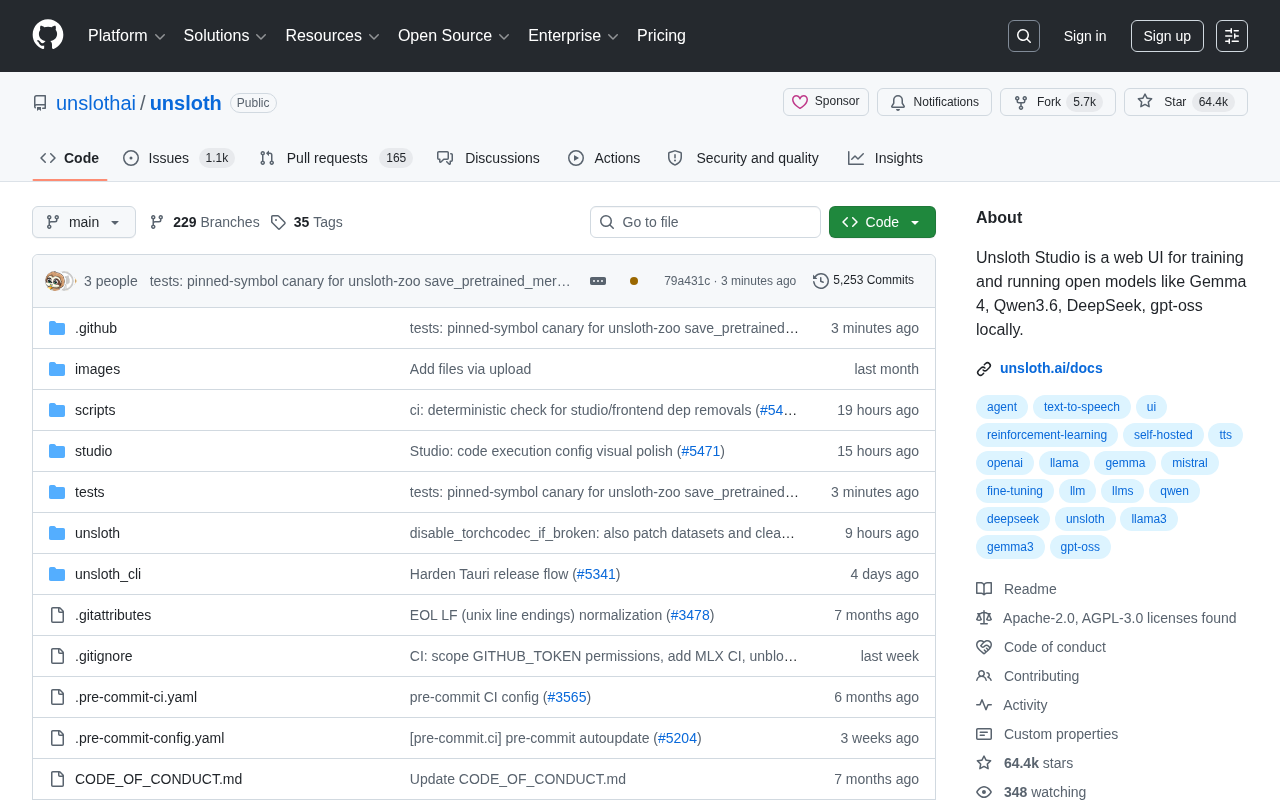
Unsloth is a 63K-star open-source tool for fine-tuning LLMs locally on consumer GPUs.
Unsloth is an open-source project with 63K GitHub stars that dramatically lowers the barrier to LLM fine-tuning through its Web UI interface. Supporting mainstream models like Gemma 4, Qwen3.6, and DeepSeek, it leverages efficient LoRA/QLoRA implementations, custom CUDA kernel optimizations, and intelligent gradient checkpointing to deliver 2-5x training speed improvements and 50-70% VRAM reduction, enabling consumer GPUs like the RTX 4090 to fine-tune 7B parameter models.
Unsloth Project Overview: A 63K-Star Local Training Powerhouse
Unsloth is an open-source project that provides a complete Web UI interface, enabling users to train and run mainstream open-source large language models in their local environment. The project supports popular models including Gemma 4, Qwen3.6, DeepSeekAd, and gpt-oss. With over 63,500 stars and more than 5,500 forks on GitHub, it's one of the most popular local model training tools available today.
Why Choose Unsloth for LLM Fine-Tuning
Dramatically Lowering the Fine-Tuning Barrier
LLM fine-tuning has always been a critical step in deploying AI applications, but the traditional fine-tuning workflow often requires writing extensive code and configuring complex training parameters—presenting a high barrier for average developers and researchers. Fine-tuning refers to further adjusting model parameters on top of a pre-trained model using domain-specific or task-specific datasets. Pre-trained models are typically trained on massive general-purpose corpora and possess broad language understanding capabilities, but may underperform in specific scenarios such as medical Q&A, legal document generation, or customer service conversations. Through fine-tuning, a model can significantly improve its performance on target tasks while retaining its general capabilities. Traditional full-parameter fine-tuning requires updating all model weights, demanding enormous computational resources—it was only with the emergence of Parameter-Efficient Fine-Tuning (PEFT) methods that this process became more feasible.
Unsloth dramatically simplifies this process by providing an intuitive Web UI interface. Users can complete the entire workflow—model loading, parameter configuration, training launch, and inference testing—without needing deep knowledge of the underlying training framework.
Comprehensive Coverage of the Open-Source Model Ecosystem
The project currently supports an impressive lineup of models:
- Gemma 4: Google's latest open-source multimodal model
- Qwen3.6: The latest version of Alibaba's Qwen series
- DeepSeek: High-performance reasoning models from DeepSeek
- gpt-oss: Open-source community GPT alternatives
This broad model compatibility means users can freely switch between and compare different models within the same tool, greatly improving experimentation efficiency.
Real-World Results: VRAM Optimization and Training Acceleration
Unsloth's core technical advantage lies in its VRAM optimization capabilities. The project employs multiple techniques to reduce memory consumption during training:
- Efficient LoRA/QLoRA Implementation: LoRA (Low-Rank Adaptation) is a parameter-efficient fine-tuning method proposed by Microsoft in 2021. Its core insight is that the weight change matrix during fine-tuning exhibits low-rank properties, allowing it to be decomposed into the product of two smaller matrices. By training only these two small matrices (typically representing just 0.1%-1% of the original parameters), results approaching full-parameter fine-tuning can be achieved. QLoRA further optimizes this by quantizing the base model to 4-bit precision for storage while applying LoRA adapters on top of the quantized model for training. This combination makes it possible to fine-tune models with billions of parameters on a single consumer GPU with 24GB of VRAM.
- Custom Kernel Optimizations: The Unsloth team has written custom CUDA kernels for critical computational operations in the Transformer architecture (such as attention mechanisms and matrix multiplications), reducing unnecessary memory allocations and data transfers to improve computational efficiency at the lowest level.
- Intelligent Gradient Checkpointing Strategy: Gradient checkpointing is a technique that trades computation time for memory space. In standard backpropagation, all intermediate activation values from the forward pass must be stored in memory for gradient computation—for deep networks, this consumes enormous amounts of VRAM. The gradient checkpointing strategy saves only activations at selected layers and recomputes from the nearest checkpoint when needed during backpropagation. This can reduce memory usage from O(n) to O(√n), at the cost of approximately 20%-30% additional computation time. Unsloth implements a smarter checkpoint selection strategy that achieves a better balance between memory savings and speed overhead.
Based on community feedback, fine-tuning with Unsloth delivers 2-5x faster training speeds compared to native Hugging Face Transformers, while reducing VRAM usage by approximately 50%-70%. This means even consumer-grade GPUs (such as the RTX 3090/4090) can handle fine-tuning of 7B or even larger parameter models.
It's worth noting the massive cost gap between consumer and professional training GPUs. Professional GPUs like the NVIDIA A100 (80GB VRAM) and H100 (80GB VRAM) cost tens of thousands to over a hundred thousand dollars per card and are typically deployed in data centers, while the RTX 4090 (24GB VRAM) costs only around $1,500-$2,000. A 7B parameter model loaded at FP16 precision requires approximately 14GB of VRAM, and with gradients and optimizer states during training, native full-parameter training might need over 50GB of VRAM. Through its combination of quantization, LoRA, and memory optimization techniques, Unsloth enables 24GB consumer GPUs to handle these tasks—truly bringing LLM fine-tuning to the individual developer's workstation.
Unsloth Technical Architecture and Usage
Deep Integration with the Python Ecosystem
Unsloth is built on Python and deeply integrates with mainstream AI frameworks including PyTorch, Hugging Face Transformers, and PEFT.
PyTorch is a deep learning framework developed by Meta (formerly Facebook), known for its dynamic computation graphs and Pythonic programming style—currently the most mainstream deep learning framework in both academia and industry. Hugging Face is an AI open-source ecosystem built around PyTorch, with core components including: the Transformers library (providing unified interfaces for thousands of pre-trained models), the Datasets library (standardized dataset loading tools), the PEFT library (a collection of parameter-efficient fine-tuning method implementations), and the Model Hub (a model hosting and sharing platform currently hosting over 500,000 models). Unsloth's deep integration with these components means users can directly use any compatible model from the Hugging Face Hub, and seamlessly upload fine-tuned models to share with the community.
This design choice ensures the project can quickly keep pace with upstream framework updates while also making it convenient for experienced developers to extend and customize.
Complete Web UI Workflow
The Web UI is one of the project's most distinctive features. Through the browser interface, users can:
- Select and Load Models: Pull models directly from local paths or the Hugging Face Hub
- Configure Training Parameters: Adjust learning rate, batch size, training epochs, and other parameters through the interface
- Monitor Training Progress: View loss curves and training metrics in real time
- Run Online Inference Tests: Chat with the model directly in the interface after training to verify fine-tuning results
Community Ecosystem and Development Trends
The 63,000+ GitHub stars reflect not just the project's popularity, but an active developer community. Unsloth's rapid growth is closely tied to the current flourishing of open-source LLMs—as more high-quality open-source models are released, the demand for efficient, user-friendly local training tools continues to grow.
From an industry perspective, Unsloth represents an important direction in AI toolchain "democratization": enabling more people to participate in LLM customization and deployment at lower costs. This democratization is driven by multiple factors: the continuous quality improvement of open-source models (with Llama, Qwen, DeepSeek, etc. approaching closed-source model performance), the maturation of parameter-efficient fine-tuning techniques, advances in quantization technology, and the emergence of user-friendly toolchains like Unsloth. Before this trend, LLM training and fine-tuning was almost exclusively the domain of large tech companies, requiring millions of dollars in hardware investment and specialized engineering teams. This shift is profoundly changing the industry landscape, enabling independent researchers, startups, and SMEs to build customized AI models for their specific business scenarios, gaining competitive advantages in vertical domains.
Whether you're an individual developer running research experiments or an SME building domain-specific models, Unsloth provides a practical and efficient starting point.
Summary: Who Should Use Unsloth
With its excellent VRAM optimization, intuitive Web UI interface, and broad support for mainstream open-source models, Unsloth has established itself as the benchmark project in the local LLM fine-tuning space. For developers looking to explore and fine-tune large language models in their local environment—whether you want to quickly adapt models to vertical scenarios using LoRA, or run a complete training pipeline on a consumer-grade GPU—Unsloth is a tool well worth trying first.
Related articles
 Tutorials
ChatGPT Plus Subscription Guide: Are GPT-5.5, image-2, and Codex Worth the Upgrade?
A detailed look at ChatGPT Plus features — GPT-5.5, image-2, and Codex — with a Plus vs Pro comparison and a complete step-by-step subscription guide for users outside the US.
 Tutorials
Harness AI Engineering in Practice: Using Claude Code to Master Enterprise-Level E-Commerce Development
Deep dive into Harness AI Engineering: master enterprise e-commerce development with Claude Code using the Rules, Skills, Wiki, and Changes framework.
 Tutorials
Cursor + Codex Dual-IDE Collaboration: A Practical Methodology for Open-Source Project Customization
A complete methodology for open-source project customization based on real-world experience, detailing the Cursor+Codex dual-IDE workflow, seven-stage process, MVP validation, and AI source code reading techniques.