Unsloth v0.1.463-beta: Fixes Studio Crash and llama-server Permission Issue

Unsloth v0.1.463-beta fixes a Studio crash triggered by access-denied errors in llama-server service discovery.
Unsloth has released v0.1.463-beta, a targeted stability fix for its open-source LLM fine-tuning framework. The update prevents Unsloth Studio from crashing when it encounters access-denied errors during llama-server service discovery — a common issue on multi-user servers, restricted production environments, and Windows systems. The fix implements graceful degradation so Studio skips inaccessible paths instead of terminating.
Unsloth Releases v0.1.463-beta
Popular open-source LLM fine-tuning framework Unsloth has released v0.1.463-beta. The project has accumulated over 67,000 stars and 6,100 forks on GitHub, attracting a large and growing community of developers and researchers for its high-performance LLM fine-tuning capabilities.
Unsloth was born in late 2023, during a pivotal period in the rapid maturation of open-source LLM fine-tuning toolchains. At the time, mainstream fine-tuning solutions largely relied on HuggingFace's PEFT library with the Transformers framework, which suffered from low hardware utilization due to the overhead of general-purpose abstraction layers. Unsloth filled this gap with deep hardware-level optimizations, differentiating itself from tools like Axolotl (known for configuration flexibility) and LLaMA-Factory (known for comprehensive features), and quickly establishing itself among developers who demand maximum performance.
Unsloth's core advantage lies in its low-level technical implementation: unlike general-purpose frameworks such as HuggingFace Transformers, the Unsloth team hand-wrote custom CUDA/Triton compute kernels targeting mainstream GPU architectures and deeply rewrote the backpropagation algorithm.
What are CUDA and Triton kernels? CUDA is NVIDIA's parallel computing platform that allows developers to write programs that run directly on the GPU. Triton is an open-source language developed by OpenAI specifically for writing efficient GPU kernels, with a lower barrier to entry than native CUDA. Writing custom kernels means bypassing the generic abstraction layers of frameworks like PyTorch to directly control memory access patterns, thread scheduling, and the fusion of mathematical operations — squeezing out peak hardware performance. This is the fundamental source of Unsloth's speed gains. GPU architectures themselves continue to evolve: NVIDIA Ampere (the A100's generation) introduced asynchronous memory copies and sparse matrix acceleration units, while Hopper (the H100's generation) further introduced dedicated Transformer Engine hardware. Hand-written kernels can specifically exploit the characteristics of different architectural generations in ways that general-purpose frameworks cannot automatically achieve.
Combined with attention optimizations like Flash Attention 2, Unsloth typically achieves 2–5x training speed improvements on the same hardware while reducing VRAM usage to 40–60% of native implementations.
How Flash Attention 2 works: Flash Attention was proposed by a Stanford University research team. The core idea is to reorganize the computation order of the attention mechanism — using a GPU tiling strategy to keep intermediate results in the fast on-chip cache (SRAM) as much as possible, reducing reads and writes to high-latency video memory (HBM). Flash Attention 2 further optimizes the parallelism strategy, reducing attention computation VRAM usage from O(n²) to O(n) while increasing actual throughput. It is now a standard infrastructure component in large model training and inference. Flash Attention 3 was released in 2024 targeting the Hopper architecture of the H100, parallelizing Tensor Core computation and HBM data loading using asynchronous execution pipelines to push throughput above 75% of the theoretical hardware limit — representing the current frontier of attention computation optimization.
This means fine-tuning tasks for 70B parameter models that previously required an A100 80GB can now run on a consumer-grade RTX 4090 (24GB) with Unsloth's optimizations, dramatically lowering the hardware barrier for individual developers.
This update was released by core maintainer danielhanchen as a beta version. While a small incremental update, it resolves a critical stability issue that could cause crashes for users relying on Unsloth Studio for model deployment and inference.
Core Changes in This Update
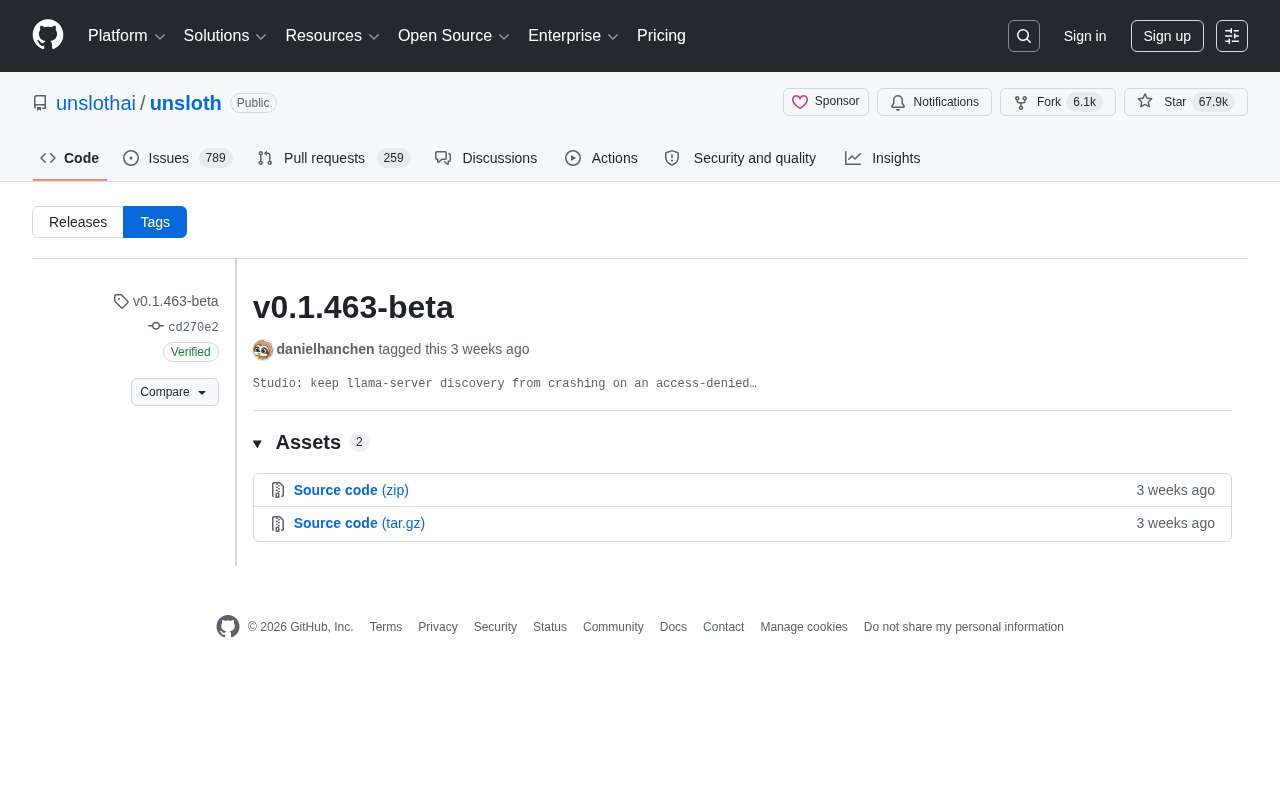
According to the official release notes, the main change in v0.1.463-beta is focused on the Unsloth Studio module:
Studio: keep llama-server discovery from crashing on an access-denied
In other words: fixes a crash in Studio that occurred during llama-server service discovery when an "access-denied" error was encountered.
Background
Unsloth Studio needs to probe the local environment for llama-server service instances at runtime to handle model loading and inference scheduling. This involves the coordination of two key components:
llama-server is a lightweight HTTP inference server provided by the llama.cpp project. It supports GGUF format models and provides an OpenAI API-compatible inference interface with minimal resource consumption. Unsloth Studio uses it as a local inference backend, communicating via REST API to quickly put fine-tuned models into use.
Background on llama.cpp and the GGUF format: llama.cpp was implemented in pure C/C++ by Georgi Gerganov, with minimal dependencies and high portability, enabling efficient inference of large models on CPU-only environments or low-VRAM devices. It has become the de facto lightweight standard for local deployment of open-source models. Its companion GGUF (GPT-Generated Unified Format) packages model architecture metadata, vocabulary, and quantized weights into a single file, supporting multiple quantization levels such as Q4_K_M and Q8_0. Q4_K_M is the community's most widely used balanced option — the K-quants grouped quantization algorithm assigns different precisions to weights of different importance, and the M (Medium) tier strikes a good balance between size and quality. Q8_0 approaches full precision but at 50% the size of FP16. Q2_K offers the smallest size but noticeable quality loss, suitable for extremely memory-constrained scenarios. Notably, embedding and output layers are more sensitive to quantization error, so llama.cpp typically retains higher precision for these layers, forming a mixed-precision strategy to protect the model's language understanding and generation capabilities. GGUF also has built-in support for Metal (macOS GPU acceleration), ROCm (AMD GPU), and Vulkan backends, allowing the same model file to run seamlessly on heterogeneous hardware — a key reason it has become the community's mainstream distribution format.
Service discovery is the mechanism by which Studio automatically locates running llama-server instances at startup.
How service discovery works: Service discovery is a core pattern in microservice architectures that solves the problem of "how does one service find the network address of another." In large distributed systems, this is typically handled by registries like Consul or etcd; Kubernetes has built-in support via kube-dns and Endpoints resources. In local tools like Unsloth Studio, service discovery simplifies to active probing of the local machine — checking if a process is listening on a known port (e.g., llama.cpp's default port 8080), sending test HTTP requests to verify service availability, reading
/proc/[pid]/cmdline(Linux) or Windows process snapshots (WMI) to locate the target process, and reading PID files or Unix socket files from known paths. The challenge with local probing is the variance in OS permission models: Linux's procfs has varying access permissions across distributions and security policies, Windows UAC strictly controls cross-user process access, and macOS SIP (System Integrity Protection) adds extra restrictions on reading system directories. These are all system-level calls that inherently depend on OS permission grants, making them prone to access-denied errors in restricted environments. Additionally, SELinux or AppArmor mandatory access control policies in enterprise Linux environments can layer additional restrictions on top of standard POSIX permission checks, further complicating the sources of permission issues.
The implementation typically involves: scanning local port ranges (e.g., 8080, 11434) for responses, enumerating system process lists to find llama-server processes, and reading service registration files from specific config directories. This works smoothly in normal environments, but in permission-restricted environments, reading certain process information or accessing specific directories triggers the OS's access-denied error.
The previous implementation did not handle this exception gracefully, causing the error to bubble up and terminate the entire Studio process.
This type of permission issue is especially prominent in the following scenarios:
- Multi-user shared server environments: access isolation between different users' processes
- Production servers with restricted permissions: system security policies limiting access to ports or directories
- Windows systems: relatively strict file and process access controls
For ordinary users, unexpected crashes with no warning severely disrupt normal workflows.
Significance of the Fix
This fix enhances the error tolerance of the llama-server service discovery process, enabling Studio to gracefully degrade when encountering access-denied errors — skipping inaccessible paths or ports and continuing to try other available discovery methods, rather than terminating the process.
Graceful degradation as a fault-tolerance design pattern is widely discussed in distributed systems, but it is equally critical in local tooling. The diversity of local tool runtime environments far exceeds that of server-side software — spanning everything from personal development machines to shared HPC clusters, with varying OS versions, security policies, and user permission configurations. This fix embodies exactly that design philosophy: downgrading "service discovery failure" from a fatal error to a loggable, skippable non-fatal exception, ensuring continuity of the core workflow. This is especially important for production users who prioritize stability.
From a software engineering perspective, this is a classic robustness improvement. Robustness measures a software's ability to maintain normal operation under abnormal inputs or environmental conditions. Good robustness typically follows "defensive programming" principles: catching exceptions from all external system calls (file I/O, network requests, process enumeration), distinguishing between "recoverable exceptions" (e.g., access-denied — skip and continue) and "unrecoverable exceptions" (e.g., out of memory — terminate and report), and logging the reason for skipping to aid debugging. This fix adds no new features but significantly improves the tool's operational stability in complex real-world environments.
About the Unsloth Project
Unsloth is an open-source framework focused on accelerating large language model fine-tuning, with core advantages including:
- Faster training speed: Dramatically improves fine-tuning efficiency without loss of accuracy through hand-optimized compute kernels. Optimization approaches include fused operators, improved recomputation/gradient checkpointing strategies, and dedicated acceleration for LoRA/QLoRA low-rank adapter matrix operations.
How fused operators and gradient checkpointing work: Fused operators combine multiple consecutive mathematical operations into a single GPU kernel call. In traditional PyTorch execution, each operation — LayerNorm, activation functions, matrix multiplication — is a separate kernel launch, and each launch requires writing intermediate results back to VRAM before re-reading them, wasting significant memory bandwidth. Fused operators chain these operations within a single kernel, keeping intermediate results in registers or L1 cache. This is especially effective in the attention computation and feed-forward network layers of Transformer architectures. For a typical Attention + Dropout + LayerNorm sequence, the number of VRAM reads/writes drops from 6 to 2 — a memory bandwidth saving of over 60%. Gradient checkpointing trades compute for memory: rather than saving all intermediate activations during the forward pass, it recomputes them during backpropagation when needed, reducing memory usage from O(n) to O(√n) at the cost of roughly 33% extra computation. Unsloth has deeply customized both techniques to minimize the speed penalty of recomputation while reducing VRAM usage.
How LoRA and QLoRA work: LoRA (Low-Rank Adaptation), proposed by Microsoft Research, inserts two low-rank decomposition matrices alongside the pre-trained model's weight matrices (with rank r much smaller than the original dimension), training only these few new parameters (typically less than 1% of the original model) to adapt to specific tasks while preserving the original model's general knowledge. Mathematically, LoRA decomposes the weight update matrix ΔW into the product BA, where B and A have rank r — reducing parameter count from d×d to 2×d×r when r is much smaller than d. QLoRA further quantizes the base model to 4-bit NF4 (Normal Float 4) format and freezes it — NF4 is designed for the normally distributed weights of neural networks and has smaller quantization error than INT4 at the same bit width — while keeping LoRA adapter layers at BFloat16 full precision for training. It also introduces double quantization to compress quantization constants, reducing the VRAM requirement for fine-tuning a 65B parameter model from over 780GB to approximately 48GB, making fine-tuning large models on a single consumer GPU a reality. Unsloth builds on QLoRA with custom kernels for LoRA matrix multiplication that avoid redundant VRAM allocation during dequantization, further improving training throughput.
-
Lower VRAM usage: Enables consumer-grade GPUs to handle fine-tuning tasks that would otherwise require higher-end hardware. Through 4-bit/8-bit quantization-aware training (QAT) and dynamic activation offloading, Unsloth can compress the fine-tuning VRAM requirement for a 7B model to approximately 4–6 GB. QAT simulates quantization error during training so that model weights can maintain high accuracy under low-precision representation; dynamic activation offloading asynchronously moves temporarily unused activation tensors to CPU memory when VRAM is insufficient, migrating them back to the GPU when needed during backpropagation — trading PCIe bandwidth for VRAM space. QAT reduces static VRAM usage by compressing weight representations, while dynamic activation offloading manages the activation VRAM that grows dynamically with sequence length and batch size during training. Together, they form the technical foundation of Unsloth's ultra-low VRAM fine-tuning capability.
-
Broad model compatibility: Supports mainstream open-source model families including Llama, Mistral, Gemma, Phi, Qwen, and more, with continuous support for newly released models.
Unsloth Studio is the companion GUI/service tool that simplifies deployment, quantized export (supporting GGUF/GPTQ/AWQ formats), and inference workflows for fine-tuned models — an important bridge connecting the "training" and "deployment" stages.
Upgrade Recommendations
Note that this version is still in beta and may contain changes that haven't been fully validated. Specific recommendations:
- Production environment users: It is recommended to thoroughly validate in a test environment before deciding whether to upgrade.
- Users who have experienced Studio crashes: Especially in scenarios involving permission-related error messages (such as
PermissionErrororAccess is denied), this update is worth trying promptly.
While v0.1.463-beta is a small incremental update, it reflects the Unsloth team's rapid responsiveness to user feedback and their ongoing commitment to tool stability. In the long-term evolution of open-source projects, it is precisely these seemingly minor robustness fixes that accumulate into a reliable user experience. A mature open-source tool is measured not only by the richness of its features, but also by its ability to gracefully handle the diverse edge cases of the real world.
Related articles

DeepCell: One-Click AI Generation of Documents, Spreadsheets, and Slides
DeepCell tops Product Hunt with one-click generation of documents, spreadsheets, and slides, using the .deepcell format for linked updates, designed for System 2 tasks like modeling and sales reviews.

Doneas: 15-Minute Daily Accountability Calls That Keep Indie Developers From Procrastinating
Doneas is a daily accountability tool for indie developers: plan tasks on Monday, join a 15-minute call with five builders each day, and log deliveries on a public progress page. This article analyzes its core mechanics, effectiveness, and potential issues around retention and matching.

Fastlane 2.0: Fully Automated AI Ad Campaigns, From Creative to Optimization
Fastlane 2.0 is an AI ad automation tool: enter your website and it learns your brand, generates video and image ads, and runs and optimizes them on Meta, TikTok, Instagram, and YouTube.