Unsloth v0.1.802 Update: Auto Compaction, LAN Remote Access, and Dynamic v3.0 Quantization
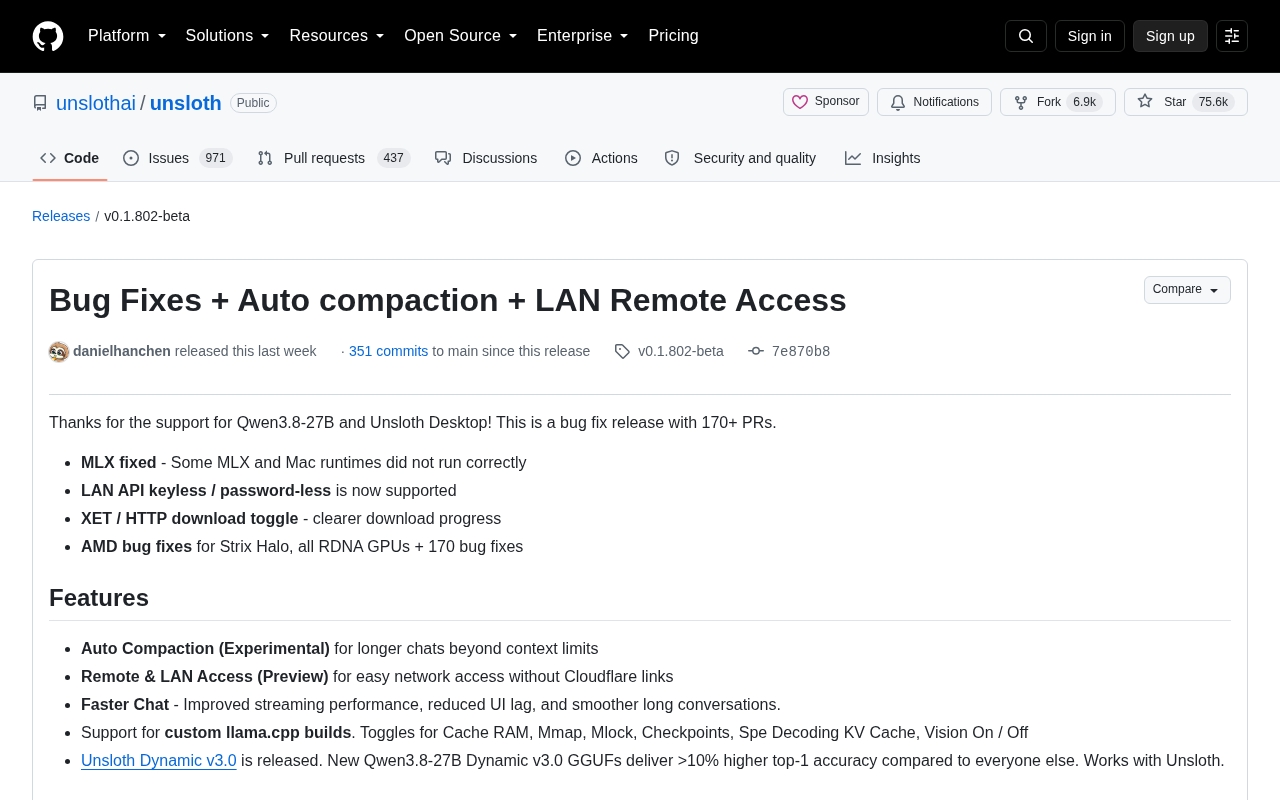
Unsloth v0.1.802 brings auto compaction, LAN access, and Dynamic v3.0 quantization with 10%+ accuracy gain.
Unsloth v0.1.802-beta delivers auto context compaction for long conversations using retrieval over truncation, LAN remote access without external tunnels, and Dynamic v3.0 quantization achieving 10%+ accuracy improvements. The update includes 170+ PRs with multi-platform hardware support across NVIDIA, AMD, Apple Silicon, and Intel.
Open-source large model toolchain project Unsloth recently released the v0.1.802-beta update, titled "Bug Fixes + Auto compaction + LAN Remote Access." Despite being positioned as a bug fix release, this update includes over 170 PRs and introduces a suite of practical experimental features like automatic context compaction and LAN remote access. For users deploying models locally, this is a substantial iteration.
As a star project with 75.6k stars on GitHub, Unsloth is renowned for efficient fine-tuning and inference. This update not only fixes numerous compatibility issues but also delivers systematic enhancements in long conversation handling, cross-device access, and hardware adaptation.
Auto Compaction: A Long Conversation Solution Beyond Context Limits
The most anticipated feature in this update is Auto Compaction, currently in experimental stage. It addresses a core pain point in local model usage—limited context windows that easily "overflow" during long conversations.
How Auto Compaction Works
Traditional approaches typically truncate message history simply, but Unsloth employs a more sophisticated mechanism. When context space runs low, the system only removes entire rounds of the earliest conversations, never truncating mid-message or modifying saved conversation records themselves.
More critically, conversations removed from active context don't "disappear." They're indexed into each thread's independent searchable archive through Unsloth's existing RAG pipeline (storage, chunking, embedding, retrieval). Users can later recall this content through the search_conversation tool.
Interestingly, the Unsloth team deliberately chose to prioritize lexical search over semantic retrieval. The reason is practical: chat history recall often involves exact matches—like a person's name, number, or ID—where lexical search proves more reliable.
Why Not Use Summary Compression
An interesting technical decision: Unsloth explicitly abandoned the common "summary compression" approach. The official rationale—summaries provide minimal benefit while adding approximately 190 seconds of overhead to each compression. This "retrieval over summarization" philosophy reflects the team's balance between practicality and performance.
Additionally, archives persist across "context epochs," meaning future compressions can restore previously removed content, forming a cumulative conversation memory bank. The system also displays context window information before conversations begin, giving users clear visibility into available space.
LAN Remote Access: Cross-Device Solution Without Cloudflare Tunnels
The second heavyweight feature is Remote & LAN Access, currently in preview. Previously, accessing a local Unsloth instance from other devices often required external tunnel solutions like Cloudflare links, with cumbersome configuration.
The new version adds a dedicated remote access section in settings, supporting:
- Enable or disable LAN access without restart
- Connection via address, QR code scanning, and optional auto-start
- LAN access disabled by default, requiring mandatory admin password change to enable
From a security design perspective, Unsloth adopts a "default-off + forced password change" strategy, preventing users from inadvertently exposing local services. The version also supports passwordless/keyless LAN API access, providing convenience for calls in trusted internal network environments. This feature holds high practical value for users wanting to access home or office local models from mobile devices like phones and tablets.
Comprehensive Performance and Chat Experience Optimization
Beyond two core new features, this update extensively refined chat experience and inference performance.
Smoother Chat Interaction
Officials report that optimizing streaming output and thread handling made long conversations faster with noticeably reduced UI lag. Several efficiency-boosting features were added:
- Projects management: Organize chats, files, and workspaces together
- Chats remember composer settings, system prompts, and model sampling options
- New prompt queueing and customizable shortcuts
- New
edit_filetool supporting partial file modifications - Improved tool calling and MCP behavior
Full Platform Hardware Adaptation
Hardware improvements were particularly dense, demonstrating Unsloth's commitment to multi-platform support:
- Support for custom llama.cpp builds
- New advanced switches: Cache RAM, Mmap, Mlock, Checkpoints, speculative decoding KV Cache, Vision toggle, etc.
- Fixed AMD bugs for Strix Halo and all RDNA GPUs
- Fixed some MLX and Mac runtime issues
- Added Intel XPU support
- Improved ROCm, xFormers, and flash-attention compatibility
- XET / HTTP download switching with clearer download progress
This coverage across NVIDIA, AMD, Apple Silicon, and Intel platforms further expands Unsloth's applicability in heterogeneous hardware ecosystems.
Dynamic v3.0 Quantization: Over 10% Model Accuracy Improvement
Alongside this tooling update, Unsloth released the Dynamic v3.0 quantization scheme. According to official data, the new Qwen3.8-27B Dynamic v3.0 GGUF model achieves top-1 accuracy over 10% higher than comparable alternatives.
This data reflects Unsloth's continued investment in dynamic quantization technology. For users pursuing local deployment with accuracy sensitivity, higher accuracy means achieving performance closer to full-precision models with limited hardware resources—a core competitive advantage of the Unsloth ecosystem.
Additionally, API and service layers saw enhancements: Responses API supports structured output formatting, improved llama-server crash recovery, and added OpenCode V2 support to unsloth start. Hub, desktop packaging, training scheduling, and preprocessing workflows all received optimizations.
Summary
Despite the "bug fix" label, this Unsloth update carries far more weight than expected. Auto compaction cleverly addresses long conversation context limits through retrieval, LAN remote access lowers cross-device usage barriers, while full platform hardware adaptation and Dynamic v3.0 quantization accuracy improvements further solidify its position in the open-source local model toolchain.
For local deployment enthusiasts and developers needing flexible model access across devices, this version is worth upgrading to. Of course, auto compaction and remote access remain in experimental/preview status, so real-world stability awaits validation through actual user scenarios.
Related articles

JobRunner MCP Server: AI Agents Can Now Fix Failed Java Jobs
JobRunner launches an open-source MCP server enabling AI agents to view cluster status, diagnose failures, and recover Java jobs—incident response from any cloud coding environment or existing agent.

MLAI Digital Launches 9 Security Agents: MCP Server Safeguards the Full Lifecycle of Agentic AI
MLAI Digital launches Security MCP Server with nine built-in specialized security agents covering vulnerability discovery, attack simulation, prompt injection detection, API and infrastructure assessment, and accelerated remediation—embedding security validation across the full Agentic AI lifecycle from development to production.

Running Isaac Lab on H100 GPUs: Exploring Better Approaches
Exploring optimization methods for running Isaac Lab on NVIDIA H100 GPUs, including MIG configuration, mixed precision, TensorRT acceleration, and community experience to improve robotics simulation and reinforcement learning efficiency.