Unsloth v0.1.803 Update: Auto Context Compaction and LAN Remote Access Explained
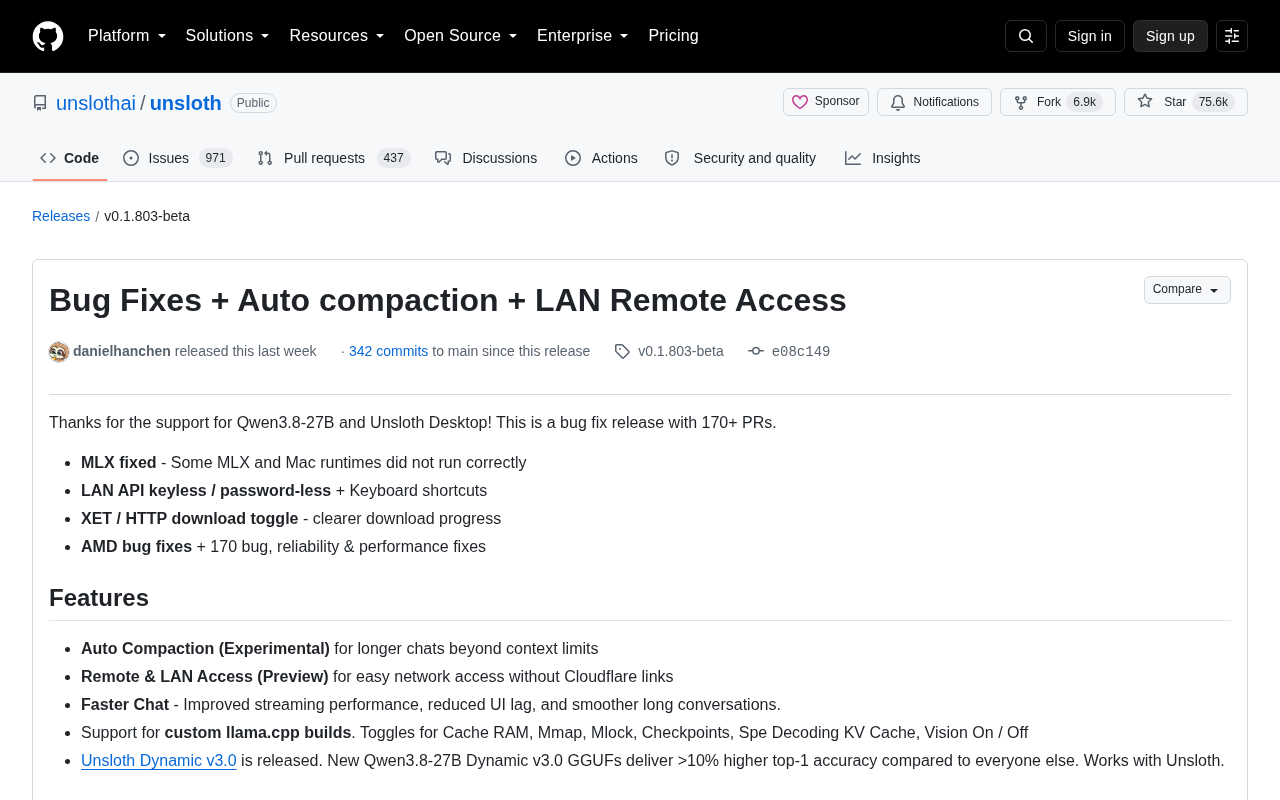
Unsloth v0.1.803 adds auto context compaction, LAN access, and Dynamic v3.0 quantization.
Unsloth v0.1.803-beta merges 170+ PRs focused on stability, while introducing two experimental features: Auto Context Compaction that archives displaced conversation turns for searchable recall via lexical search, and native LAN Remote Access eliminating the need for Cloudflare tunnels. The release also includes Dynamic v3.0 quantization with 10%+ accuracy gains, AMD/Intel hardware fixes, and extensive chat performance optimizations.
Unsloth v0.1.803-beta: A Major Stability Release with 170+ Improvements
Unsloth, the open-source project renowned for fine-tuning acceleration (with 75K GitHub stars), recently released v0.1.803-beta. Rather than a feature explosion, this update is best described as a milestone iteration centered on stability, accompanied by two experimental new features. According to the official release notes, this version merges over 170 Pull Requests covering bug fixes, reliability, and performance optimizations, while delivering three major highlights: Auto Compaction, LAN Remote Access, and a comprehensively improved chat experience.
For developers who regularly work with local LLMs, this update addresses two very real pain points: context window limitations and cross-device access to local inference services. Let's break down these two core capabilities and their technical design.
Auto Context Compaction: A Practical Solution to Breaking Conversation Length Limits
From Simple Truncation to Archival Search
Every local LLM is constrained by a fixed context window. The context window is one of the core architectural constraints of large language models, referring to the maximum number of tokens a model can process in a single inference pass. For example, Llama 3 has a context window of 8K tokens, while GPT-4 Turbo extends to 128K tokens. This limitation stems from the quadratic computational complexity of the self-attention mechanism in the Transformer architecture — as input sequence length increases, computation and VRAM usage grow quadratically. The traditional approach when conversations get too long is to simply discard early content using sliding windows or FIFO queues to truncate the oldest tokens, causing the model to "lose memory" and drop critical context information in multi-turn conversations.
Unsloth's answer this time is far more elegant — Auto Compaction (Experimental) allows you to conduct conversations that exceed the model's context limit, while historical turns moved out of context "remain searchable."
The core mechanism is worth examining: when context space runs low, the system only moves the earliest complete conversation turns out of the active context as whole units, and never truncates mid-message. Original conversation records remain intact, and the displaced content is indexed through Unsloth's existing RAG pipeline (storage, chunking, embedding, retrieval) to create a searchable archive independent to each thread.
RAG (Retrieval-Augmented Generation) is a technical paradigm that combines external knowledge bases with large language models, first proposed by Meta AI in 2020. Its core workflow consists of four stages: storage (persisting documents to a database), chunking (splitting long text into retrieval-friendly segments), embedding (converting text into high-dimensional vector representations via embedding models), and retrieval (finding the most relevant segments in vector space based on a query). In Unsloth's scenario, RAG is cleverly repurposed to manage conversation history displaced from the context — each conversation thread maintains an independent retrieval index, so compressed historical content isn't discarded but transferred to an on-demand recall archive system.
Why Lexical Search Instead of Summary Compression
An interesting engineering decision: Unsloth abandoned the conversation summary approach. The team explicitly stated that summaries "provide minimal benefit while adding roughly 190 seconds of overhead per compaction." Instead, the system forces a "recall" when displacing conversation turns rather than relying on the model to search on its own, with subsequent retrieval handled through search_conversation.
More crucially, retrieval prioritizes lexical search over semantic search. Lexical search and semantic search represent two fundamentally different paradigms in information retrieval. Lexical search is based on exact vocabulary matching, with typical algorithms including BM25 and TF-IDF, ranking results by calculating term frequency and inverse document frequency of query words in documents. Its advantages are speed, no GPU inference requirement, and extremely reliable matching for precise terms. Semantic search relies on vector embedding models (like sentence-transformers) to map text into continuous vector spaces, finding semantically similar but differently worded content through metrics like cosine similarity.
Unsloth's rationale for prioritizing lexical search is pragmatic: chat memory recall typically involves exact matches — names, numbers, or IDs. For these types of queries, lexical search has far higher accuracy than semantic search, without introducing the additional computational overhead of embedding models. This deep understanding of actual usage scenarios reflects the Unsloth team's engineering restraint and focus. Additionally, archives persist across "context epochs," meaning future compaction operations can recover previously displaced content.
LAN Remote Access: A Native Alternative to Cloudflare Tunnels
Native Cross-Device Access Support
Previously, accessing a locally running Unsloth service from a phone or another computer typically required external tools like Cloudflare Tunnel links. Cloudflare Tunnel (formerly Argo Tunnel) is a zero-trust network service provided by Cloudflare. It works by running a daemon called cloudflared locally, which actively establishes outbound connections to Cloudflare's edge network, with external requests reverse-proxied through Cloudflare's global CDN to the local service. While this approach is secure and convenient, it introduces external dependencies — requiring a Cloudflare account, relying on third-party network infrastructure, and routing all traffic through Cloudflare's servers. For scenarios where you only need cross-device access within a home or office LAN, this is overkill.
This update's Remote & LAN Access (Preview) feature makes everything native and simple — you can manage it directly from settings, allowing other devices on the same network to access Unsloth, eliminating the middleman and solving the problem at the local network level.
The new version adds a dedicated remote access settings area supporting connection addresses, QR code scanning, and optional auto-start. Notably, users can enable or disable LAN access without restarting.
Security by Default
Beyond convenience, Unsloth has implemented sensible default security constraints: LAN access is disabled by default, and can only be enabled after changing the system-generated admin password. At the API level, keyless/passwordless LAN access options are available alongside keyboard shortcuts. This "secure by default, open on demand" design is a necessary safeguard when exposing local services to a network environment.
Performance and Hardware Compatibility: Comprehensive Low-Level Optimizations
Smoother Chat Experience
Beyond the two major new features, this update includes extensive chat experience optimizations. The team reports improved streaming performance, reduced UI stuttering, and smoother long conversations. The PR list reveals numerous fine-grained improvements for long threads, such as "immediately render the latest messages in long threads rather than rebuilding all messages first" and "lazily render syntax highlighting for off-screen code blocks" — critical engineering details for improving response speed in large-scale conversations.
Additional additions include a prompt queue, customizable hotkeys, an edit_file tool for local file modifications, and improved tool calling and MCP behavior.
Broader Multi-Platform Hardware Compatibility
On the hardware front, this update covers an impressively wide range:
- Support for custom llama.cpp builds. llama.cpp is an open-source project initiated by Georgi Gerganov in March 2023 that implements LLM inference in pure C/C++, capable of running on ordinary CPUs without a GPU. The project spawned the entire local LLM inference ecosystem, and its GGUF (GPT-Generated Unified Format) has become the de facto standard for local quantized models. Custom build support means users can compile optimized versions for specific hardware (such as particular CUDA architectures or Apple Silicon chips) or enable experimental features like speculative decoding.
- New advanced settings toggles for Cache RAM, Mmap, Mlock, Checkpoints, speculative decoding KV cache, and vision toggles. Speculative decoding is a technique that accelerates autoregressive generation using a "small model drafts, large model verifies" strategy — a much smaller draft model rapidly generates multiple candidate tokens, which the target large model then verifies in parallel in a single pass. When the draft model's prediction accuracy is high, this can deliver 2-3x end-to-end speedup. KV cache requires special handling in this process because cache entries corresponding to rejected tokens need to be correctly rolled back.
- AMD-related bug fixes improving ROCm, xFormers, and Flash-Attention compatibility. ROCm (Radeon Open Compute) is AMD's open-source GPU computing platform, positioned against NVIDIA's CUDA ecosystem. xFormers is Meta's efficient Transformer component library providing memory-efficient attention implementations that can reduce VRAM usage from O(n²) to O(n). Flash-Attention is an IO-aware exact attention algorithm proposed by Tri Dao et al. that achieves 2-4x speed improvements and 5-20x VRAM savings through tiled computation and kernel fusion. Interoperability among these three on AMD platforms has been an ongoing compatibility challenge, making this fix significant for the AMD GPU user community.
- New Intel XPU support
- Fixes for MLX and Mac runtime issues
- Improved MTP performance and VRAM handling
For multi-GPU users, edge cases were fixed such as re-querying projector placement after tensor parallelism downgrade. Tensor parallelism is a technique that splits a single model's weight matrices across multiple GPUs for parallel computation, suitable for scenarios where a single model is too large to fit in one GPU's VRAM. The fix here addresses the need to redetermine the allocation strategy across GPUs for the vision model's projector layer (the component that maps image features into the language model's space) when tensor parallelism configurations change.
Unsloth Dynamic v3.0: A Precision-Leading Dynamic Quantization Scheme
Also released alongside this version is the Unsloth Dynamic v3.0 quantization scheme. The team claims that the new Qwen3.8-27B Dynamic v3.0 GGUF model achieves over 10% higher top-1 accuracy compared to other industry solutions, with full Unsloth compatibility.
Dynamic quantization has long been Unsloth's technical hallmark. Model quantization is the technique of converting neural network weights from high-precision floating point (such as FP16/BF16) to lower-precision representations (such as INT4/INT8), aiming to dramatically reduce model size, inference VRAM, and computation at an acceptable accuracy cost. Traditional uniform quantization applies the same bit-width to all layers, but research shows that different layers in a model have significantly varying sensitivity to quantization — early attention layers and final output layers are typically more precision-sensitive, while intermediate feed-forward network layers can better tolerate lower precision. Unsloth's Dynamic Quantization scheme is built on this insight, analyzing each layer's weight distribution and its impact on final output to automatically assign optimal quantization bit-widths to different layers. For example, sensitive layers might retain 6-bit quantization while robust layers are compressed to 2-bit, concentrating precision loss where its impact is minimal while keeping overall model size unchanged. The v3.0 improvement further solidifies Unsloth's competitiveness in the local quantized model space.
Summary: A Pragmatic Iteration Focused on Real-World Use Cases
Overall, Unsloth v0.1.803-beta isn't a version chasing flashy feature stacking, but rather a pragmatic iteration aimed at being "functional, user-friendly, and stable." The 170+ PR fix count shows the team is polishing the product's reliability foundation, while Auto Context Compaction and LAN Remote Access precisely address real pain points in local LLM usage.
For developers and enthusiasts deploying LLMs locally, the archival search-based context management and native LAN access in this update are practical capabilities worth trying immediately. And the precision breakthrough of the Dynamic v3.0 quantization scheme once again demonstrates Unsloth's technical prowess in the open-source model optimization space.
Related articles
Vercel AI SDK TUI: A New Option for Terminal-Based AI Interaction
Vercel AI SDK introduces @ai-sdk/tui for terminal AI interactions, bringing streaming output, tool calling, and AI conversations to the command line.
Microsoft Copilot Copyright Lawsuit: 8.2 Million Conversations Reveal the Truth About AI Content Copying
Microsoft discloses 8.2M Copilot conversations in NYT copyright lawsuit, claiming AI rarely copies news content. Explore the key data, legal disputes, and implications for the AI industry.
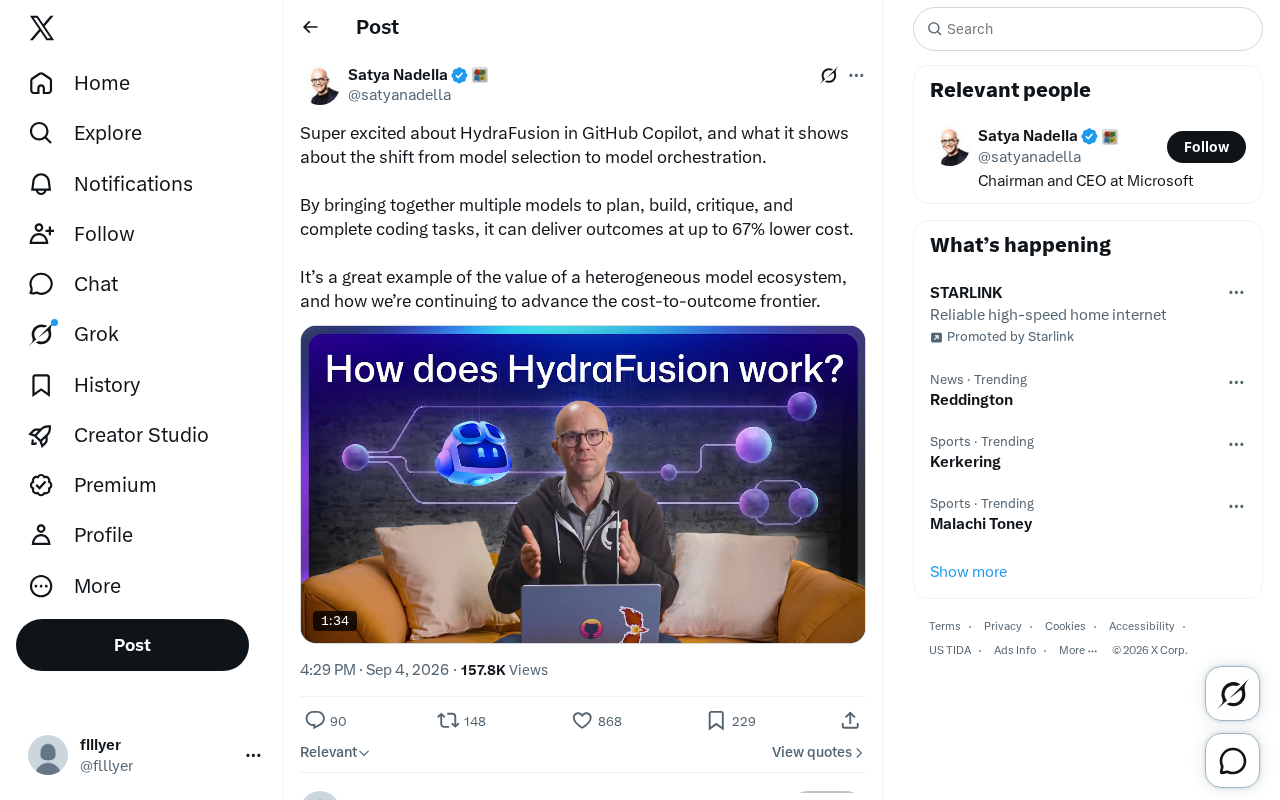
HydraFusion Explained: How GitHub Copilot's Multi-Model Orchestration Cuts Costs by 67%
Deep dive into GitHub Copilot's HydraFusion multi-model orchestration: its Plan-Build-Critique-Complete workflow, how it cuts costs by 67%, and the paradigm shift from model selection to orchestration.