Unsloth v0.1.811 Released: Docker Multi-User Support and AMD ROCm Integration Explained

Unsloth v0.1.811 adds AMD ROCm support, multi-user isolation, and a rebuilt Docker architecture for production-ready LLM fine-tuning.
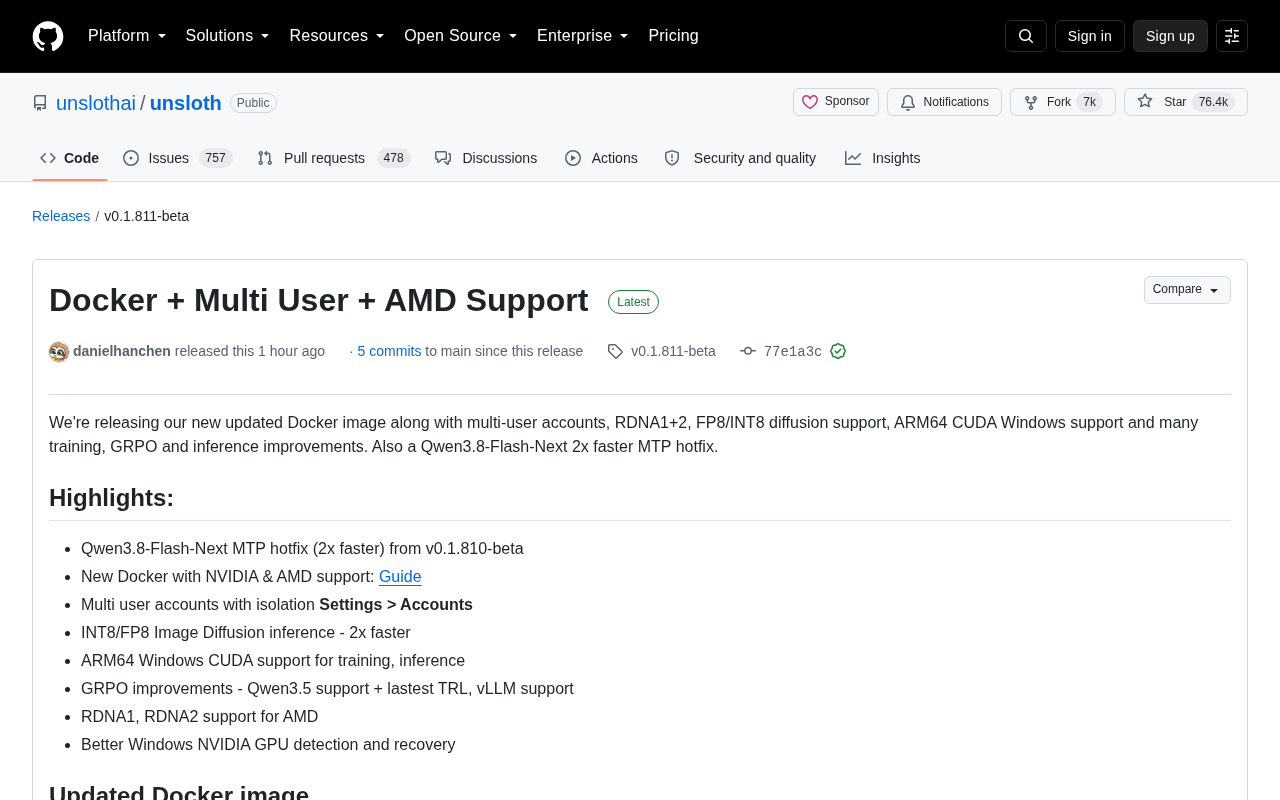
Unsloth v0.1.811-beta is a significant release spanning deployment, collaboration, and hardware. It debuts an AMD ROCm Docker image with official support for RDNA1/RDNA2 GPUs, breaking NVIDIA's monopoly on local LLM fine-tuning. The Docker architecture has been systematically rebuilt with decoupled data persistence and restored TRL training patches. Multi-user account isolation via one-time setup codes enables independent workspaces while allowing cross-account model sharing for VRAM efficiency. Additional improvements include GRPO training updates, INT8/FP8 inference speedups, and an OS-level tool sandbox preview, marking Unsloth's evolution from personal tool to production-grade platform.
The open-source LLM fine-tuning tool Unsloth has landed its v0.1.811-beta update, bringing three major features: a redesigned Docker image, multi-user account isolation, and AMD GPU support. For users running local AI deployments who have long been tied to the NVIDIA ecosystem, this update fills important gaps in both hardware compatibility and team collaboration scenarios.
Core Updates at a Glance
The three highlights of this release target deployment, collaboration, and hardware respectively:
- New Docker Images: Support for both NVIDIA and AMD platforms, with a rebuilt CUDA base image and Studio configuration
- Multi-User Account Isolation: Create independent accounts under
Settings > Accountsfor workspace separation - AMD RDNA1/RDNA2 Support: A new ROCm image finally gives AMD GPU users an official path to run fine-tuning
Also included is an MTP hotfix for Qwen3.8-Flash-Next with roughly 2× inference speed improvement per official notes, plus CUDA training and inference support for ARM64 Windows platforms.
A Deep Rebuild of the Docker Image
The new Docker release isn't just a feature add-on — it's a systematic overhaul of the underlying architecture. The team updated the main CUDA image and Studio installation flow, removed cached packages bundled at build time to reduce image size, and restored Unsloth's training patches on GPU hosts. This last point is particularly important: earlier versions had an issue where TRL patches were disabled in Docker environments, preventing full training performance from being realized.
Data persistence has also improved: Studio data is now stored on a separate volume, decoupled from the application code. This means user data won't be lost when updating the container, and auto-generated passwords, configurable ports, and dependency retention mechanisms have all been refined. For production environments that require frequent image updates, this decoupled design significantly reduces operational overhead.
Perhaps the most noteworthy addition is the AMD ROCm image, introduced for the first time alongside the CUDA image for supported Linux hosts. This breaks the long-standing NVIDIA CUDA monopoly on local LLM fine-tuning, giving users with RDNA1 and RDNA2 architecture AMD GPUs an officially supported path.
ROCm (Radeon Open Compute) is AMD's open-source software platform for general-purpose GPU computing — essentially AMD's answer to CUDA. It provides a complete runtime, compiler, and math library stack that enables deep learning frameworks like PyTorch to dispatch tensor operations to AMD GPUs. RDNA1 and RDNA2 are AMD's consumer-grade GPU architectures launched starting in 2019, covering the RX 5000 and RX 6000 series. Official ROCm support for consumer-grade cards has historically lagged and been unstable, often requiring users to manually patch around device detection — a configuration burden that deterred most non-expert users. By providing a pre-configured ROCm Docker image, Unsloth encapsulates the complex driver version matching and environment setup inside the image itself. Users simply pull the image and get a verified, working environment, substantially lowering the barrier to entry for AMD GPU users in local LLM fine-tuning.
Multi-User Accounts: From Personal Tool to Team Platform
The multi-user feature represents a meaningful expansion of the tool's use cases. Previously, Unsloth Studio was essentially a single-user tool. The new version allows creating multiple accounts via one-time setup codes, each with its own independent password.
The design strikes a clever balance: each account's work remains isolated, but when configurations match, multiple accounts can share already-loaded models. This is highly practical in scenarios where multiple people share a single GPU server — it protects data privacy while avoiding the VRAM waste of redundant model loading. The team also emphasizes that existing single-account behavior is unchanged, so existing users can upgrade without altering their workflow.
Comprehensive Improvements to Training, Inference, and Research
Beyond the three headline features, this release includes polish across a range of technical details:
GRPO training adds support for Qwen3.5 and tracks the latest TRL and vLLM. Image diffusion inference now supports INT8/FP8, delivering roughly 2× speedup. The MLX platform gains video input capability, optional MoE and decoding optimizations, and more reliable multimodal conversation behavior.
Hardware detection sees notable improvements: better NVIDIA GPU detection and recovery on Windows, GGUF VRAM estimation refinements, DGX Spark handling, NVLink checks, and user-defined GPU ordering. These seemingly minor fixes have a direct impact on stability and resource utilization in local deployments.
Deep Research now handles incomplete report retention and JSON output more robustly, and scanned PDF uploads gain a local OCR fallback. On the API side, video input support has been added to /v1/chat/completions, along with the ability to access installed Ollama models via the API.
GRPO (Group Relative Policy Optimization) is a reinforcement learning algorithm that has gained significant traction in the LLM post-training space, introduced and popularized by the DeepSeekAd team in their work on DeepSeek-R1. Unlike PPO — which requires a separate Critic model in traditional RLHF — GRPO estimates the baseline by sampling multiple outputs for the same prompt and computing relative rewards within the group, eliminating the Critic network entirely. This dramatically reduces VRAM usage and training complexity, making reinforcement learning fine-tuning feasible on consumer-grade single GPUs. INT8 and FP8 quantization are techniques that compress model weights or activations from standard FP16/BF16 precision to lower-bit representations: INT8 maps floating-point values to 8-bit integers, while FP8 retains a floating-point format but reduces the exponent and mantissa bit widths. Both can more than double inference throughput with negligible quality degradation while cutting VRAM usage by roughly half — particularly valuable for compute-intensive workloads like image diffusion models.
Security: Toward Sandboxed Tool Execution
As AI tool calling capabilities grow more powerful, security boundaries become an unavoidable topic. This update strengthens credential protection and tool call validation, triggering an approval request when a tool attempts to access files outside the sandbox.
Even more notable is the new OS-level tool sandbox preview, currently available on supported Linux and macOS hosts. The team also honestly acknowledges current limitations: network access remains unrestricted, and in automatic mode when OS isolation is unavailable, existing security measures are preserved. This incremental, transparent approach to communicating boundaries is more trustworthy than claiming "fully secure."
Tool Calling (also known as Function Calling) refers to the mechanism by which a large language model, upon recognizing a need for external capability during inference, generates structured function call instructions that the host program executes and returns results from, allowing the model to continue its reasoning. As AI Agent use cases proliferate, models may be granted permissions to perform file reads/writes, code execution, network requests, and more. If a model is manipulated via prompt injection or makes an erroneous decision, it could cause damage to the host system. OS-level sandboxing restricts a process's system call permissions and file access scope using Linux seccomp/namespaces or macOS Sandbox frameworks, preventing tool processes from reaching resources outside the sandbox boundary. Unsloth's current implementation retains network access, indicating that its sandboxing strategy prioritizes filesystem isolation — the most common attack surface — while leaving network-layer isolation for a future iteration due to the added complexity of proxy and allowlist management. This aligns with the evolution path of mainstream Agent security frameworks in the industry.
Closing Thoughts
Judging by the density of the changelog, v0.1.811 is a substantial release spanning Docker, multi-user support, AMD compatibility, training optimizations, and security sandboxing. For developers, AMD ROCm support lowers the hardware barrier to local fine-tuning, while multi-user isolation gives Unsloth the foundation to evolve into a team collaboration platform. Together, these two capabilities signal that this open-source fine-tuning tool is graduating from a "personal toy" to something genuinely production-ready.
Related articles

Chain of Thought Isn't Just for AI: How Humans Can Use CoT to Improve Thinking Quality
Chain of Thought isn't just a prompt trick for large models. Starting from a Hacker News discussion, this article analyzes why CoT works for human thinking too, breaks down actionable ways to transfer it, and highlights the key differences between human CoT and machine CoT.
Cloudflare Teams Up with OpenAI: Closi…
Cloudflare Teams Up with OpenAI: Closing the Loop from Vulnerability Discovery to Defense with AI
Cloudflare uses OpenAI Daybreak to investigate security vulnerabilities and generate reviewable remediation plans, while developers use Codex to boost coding efficiency and quality.

Orca Multi-Agent Orchestration in Practice: A Guide to Parallel Collaboration with Claude and Codex
Orca is Stable AI's free open-source agent workbench supporting 34 agents like Claude Code and Codex in parallel. Learn its Git worktree isolation, multi-model orchestration, and mobile management.