Unsloth v0.1.906 Released: Browser Use and Qwen-Image-2.1-Turbo Are Here

Unsloth's new release lets local models control a browser and adds 8-step image generation, text diffusion training, and multiple inference speedups.
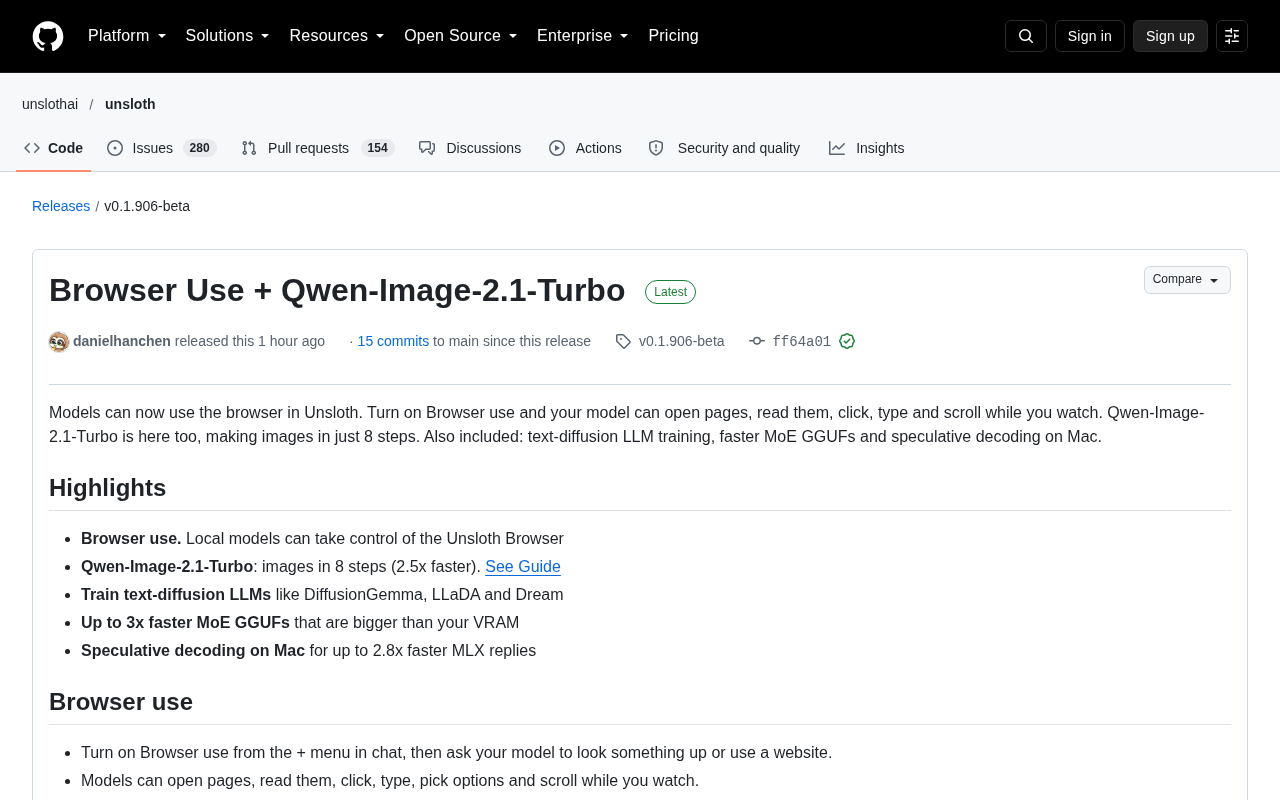
Unsloth released v0.1.906-beta, adding several capabilities at once. The most notable is Browser Use: local models can open pages, read content, click, type, and scroll in an isolated tab, asking for confirmation before logins, form submissions, or purchase/delete actions, with passwords, card numbers, and codes never auto-filled. Image-side integration includes the official 8-step Qwen-Image-2.1-Turbo (4.2GB Q4 GGUF, ~2.5x faster) and ComfyUI text encoder reuse. A new DiffusionTrainer supports text diffusion LLM training for DiffusionGemma, LLaDA, Dream, and more, plus LoRA+ and GPTQ fine-tuning. Performance gains include up to 3x for MoE GGUF beyond VRAM and up to 2.8x from Mac MLX speculative decoding.
Local Models Can Finally Browse the Web on Their Own
Unsloth has released v0.1.906-beta, packing an update with several completely different capabilities: local models controlling a browser, 8-step image generation, text-diffusion language model training, and a batch of inference acceleration optimizations.
In the release notes, danielhanchen put Browser Use front and center. This isn't a simple "web search" plugin — it lets local models directly operate a real browser tab: opening pages, reading content, clicking buttons, typing text, scrolling pages, with you able to watch the whole process happen alongside it. The model runs in a separate tab and cannot access your other tabs.
According to the release notes, Browser Use is compatible with local models and API providers, and even small text-only models can use it. There are several hard safety constraints: the model asks for confirmation before logging in, submitting forms, or triggering purchase/send/delete-type buttons; passwords, card numbers, and one-time verification codes are never filled in by the model. Users can restrict which sites the model can open, as well as its access to browsing history and downloads, in Settings > Browser.
Qwen-Image-2.1-Turbo: 8-Step Image Generation
On the image generation side, Unsloth has integrated Qwen-Image-2.1-Turbo, the official 8-step version of Qwen-Image-2.1. It can be run directly on the Images page, with a model size of 4.2 GB in Q4 GGUF. Compared to the regular version, 8-step sampling speeds up image generation by about 2.5x.
For ComfyUI users there's a practical change: it now directly reuses the existing text encoder in your ComfyUI folder instead of downloading another copy. Image LoRAs trained in Unsloth can be exported as reusable or shareable files, and image LoRAs can also be loaded from local folders.
Text Diffusion Model Training Support
Another notable direction in this version is training support for text-diffusion LLMs. The new DiffusionTrainer can train models including DiffusionGemma, LLaDA, LLaDA2, Dream, Nemotron, and SDAR.
This is a relatively cutting-edge area of exploration — traditional LLMs generate tokens sequentially, while diffusion models generate text through progressive denoising. Unsloth has built this training pipeline into a one-click UI, lowering the barrier to trying it out. Also added are LoRA+ training (configured via loraplus_lr_ratio) and LoRA fine-tuning support for GPTQ models.
According to the release notes, when fine-tuning tool-calling datasets, training now automatically includes the tool definitions for each data row, and supports multi-turn agent trajectories.
Text diffusion models are a technical path entirely different from mainstream autoregressive LLMs. Traditional GPT-style models generate tokens one by one from left to right, with each position's output depending on everything generated before it; diffusion models borrow the denoising approach from image generation, starting from a fully noisy sequence and iteratively restoring clean text over multiple rounds. This means the model can "see" global information across the entire sequence at each step, naturally supporting parallel generation and iterative correction at any position. Representative works include LLaDA, Dream, and others, which show performance comparable to or even better than same-scale autoregressive models on certain reasoning tasks, and can theoretically be accelerated by reducing denoising steps. Unsloth has turned this type of model's training pipeline into an out-of-the-box DiffusionTrainer; for developers wanting to try this cutting-edge direction, the biggest value is saving the work of assembling your own training loop and handling masking and noise scheduling.
Performance Optimizations: MoE, MLX, and Speculative Decoding
The performance-side changes are quite dense. MoE GGUF models can achieve up to 3x speedup on NVIDIA and AMD GPUs even when their size exceeds VRAM; when flash-attn and xformers are not installed, sample packing training speeds up by up to 8x (NVIDIA, PyTorch 2.12+).
Mac users get even more noticeable gains this time. After adding speculative decoding to the MLX inference backend, reply speed improves by up to 2.8x while output remains consistent. MLX speculative decoding automatically sets draft depth and supports multiple draft models including MTP, DFlash, DSpark, and EAGLE-3.
There's also progress on decision model training on macOS: Laya and Clef decision models can now be trained on Apple Silicon, and Clef also supports image training.
MoE (Mixture of Experts) models consist of multiple "expert" sub-networks, activating only a few experts per forward pass, so the total parameter count can be very large while actual compute is equivalent to a small model. But this sparse activation introduces irregular memory access: all weights still need to reside in memory or be swapped in on demand, and some experts may need to be streamed from system memory or even disk, making bandwidth a bottleneck. Unsloth's optimization this time allows MoE GGUF models to gain up to 3x speedup on NVIDIA and AMD GPUs via layered offloading and prefetching strategies, even when total weights exceed VRAM. For users running large MoE models on consumer-grade GPUs, these optimizations often pay off more noticeably than simply compressing quantization bit-widths.
Speculative decoding is an acceleration technique that "uses a cheap model to guess and a large model to verify." It first uses a small draft model to quickly generate several candidate tokens, then has the target large model verify these candidates in parallel at once, accepting the parts consistent with its own predictions. Since verifying a batch of tokens with the large model takes nearly the same time as generating a single token, overall throughput often improves severalfold, while output quality is theoretically identical to pure large-model decoding. MLX is Apple's machine learning framework built for Apple Silicon, fully leveraging unified memory and Metal acceleration. With this release, Unsloth adds speculative decoding to the MLX backend, improving reply speed on Mac by up to 2.8x, while automatically adjusting draft depth and supporting multiple draft models such as MTP, DFlash, DSpark, and EAGLE-3, clearly improving the cost-effectiveness of local inference on Mac.
Chat and Desktop Experience
React code blocks (JSX and TSX) in the Chat interface can now run directly in the browser as live previews. The Deep Research feature supports using MCP tools as citation sources, and on retry after failure it continues from completed steps rather than starting over.
Unsloth now reads AGENTS.md files in the Unsloth home and project folders, injecting their contents into chat instructions. Desktop projects can run tools directly in folders already on your computer. On the voice side, after enabling "Read replies automatically" in Settings > Voice, each reply will be read aloud once it's complete.
Model Support and Engine Expansion
AMD GPU users (Linux and Windows WSL) can now use the optional vLLM engine. The version also adds support for DeepSeekAd-OCR and DeepSeek-OCR-2, and the Hub model list can be filtered by parameter count, context length, and organization.
In multi-user installation scenarios, administrators can restrict which models each managed account can use. A detailed Live monitor lets you view GPU load, temperature, and power consumption.
Judging from the commit history, this release contains a large number of changes, covering many engineering details such as installer fixes, ROCm compatibility, Windows path handling, and RAG PDF parsing performance. If you're interested in these underlying fixes, you can check the accompanying changelog.
One-line Summary
Unsloth's new version lets local models control a browser, and brings 8-step image generation, text diffusion training, and multiple inference accelerations.
Paragraph Summary
Unsloth has released v0.1.906-beta, adding capabilities across several directions at once. The most notable is Browser Use: local models can open web pages, read content, click, type, and scroll in a separate tab, and ask for user confirmation before logging in, submitting forms, or triggering purchase/delete-type operations, with passwords, card numbers, and verification codes never auto-filled. On the image side, it integrates the official 8-step Qwen-Image-2.1-Turbo, a 4.2GB Q4 GGUF that improves image generation speed by about 2.5x and can reuse ComfyUI text encoders. The new DiffusionTrainer supports text diffusion LLM training, covering models such as DiffusionGemma, LLaDA, and Dream, along with LoRA+ and GPTQ fine-tuning. Performance optimizations include up to 3x acceleration for MoE GGUF running beyond VRAM, and up to 2.8x improvement from Mac MLX speculative decoding.
Related articles

Local Creative Writing Model Showdown: Fine-tuned Qwen3.8 27B Wins, DeepSeek v4.1 Underwhelms
Bilibili creator tests seven local creative writing models: Hemingway and HumanLike Chat based on Qwen3.8 27B perform best, DeepSeek v4.1 is plain, Dongfang Shuo ranks last with confused characters. Includes three test prompts, scores, and usage advice.

Liang Wenfeng's Three Big Bets: Why Did DeepSeek Open-Source Its 82% Gross Margin?
Why did DeepSeek open-source DeepInfer, its 82% gross margin inference framework, and then launch a hundred-billion funding round? An analysis of Liang Wenfeng's three big bets and the open-source strategy.

Restoring 169 Episodes of a Classic TV Show with AI Super-Resolution: A 95-Hour Home PC Diary
A Bilibili creator used an RTX 3070 Ti home desktop and open-source AI super-resolution tools to restore 169 episodes of Growing Pains from DVD quality over 95 hours, costing only 20 yuan in electricity. The diary reveals real pitfalls in deinterlacing, model selection, and fully automated pipelines, plus lessons in AI collaboration.